Compute & AI Infrastructure
The AI Infrastructure Credit Stack: Where the Buildout Borrows, and Where It Cracks
The buildout no longer fits inside cash flow. Off-balance-sheet leases, project bonds, private credit, and GPU-backed loans are repricing at different speeds.
Atomic answer
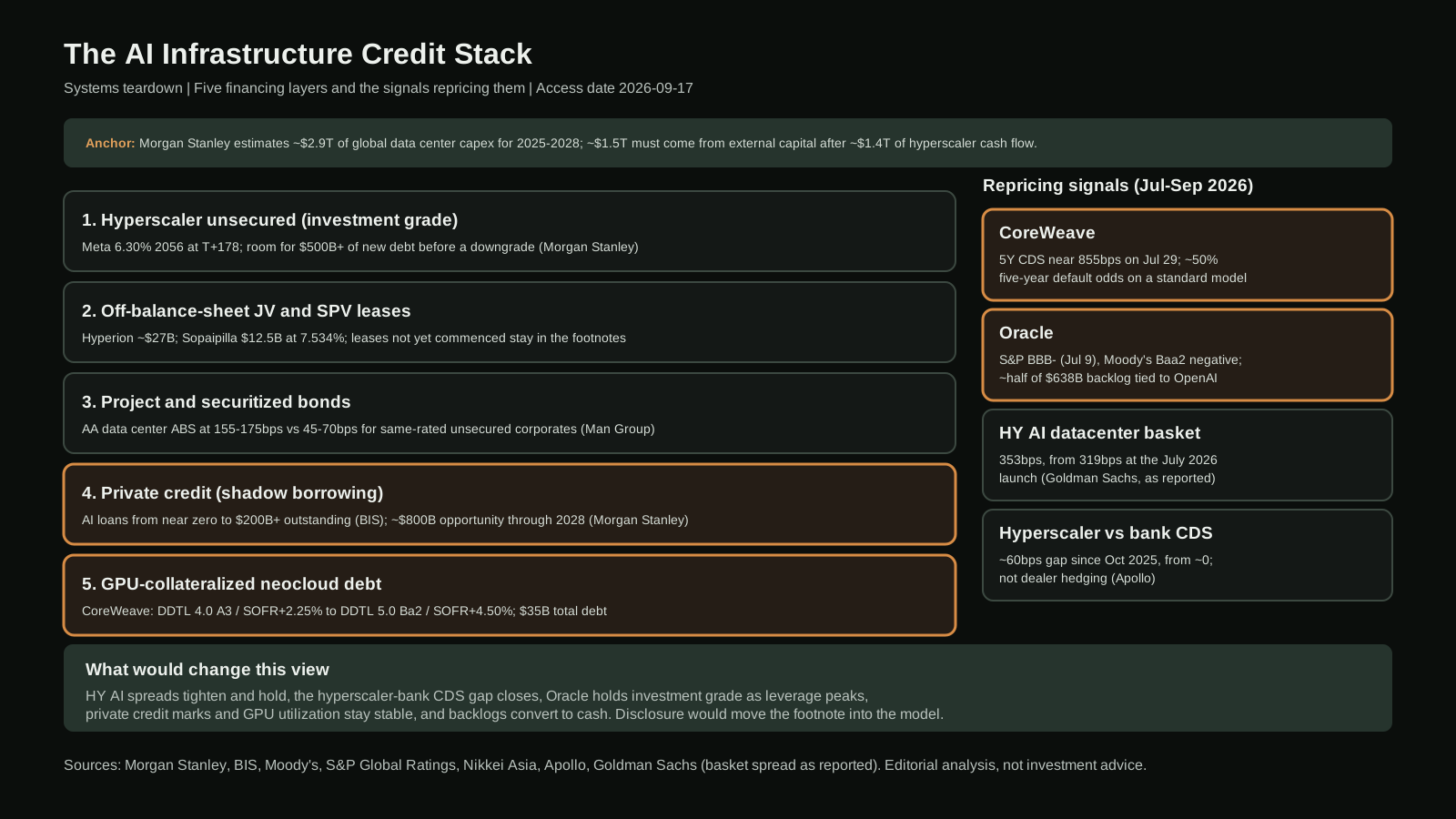
The 2025-2028 AI buildout no longer fits inside hyperscaler cash flow. Morgan Stanley puts global data center capex at roughly $2.9 trillion through 2028 and estimates a $1.5 trillion external financing gap. The capital arrives in five layers: investment-grade hyperscaler bonds, off-balance-sheet JV and SPV leases, project and securitized bonds, private credit, and GPU-collateralized neocloud debt. The layers are separating. CoreWeave CDS near 855 basis points, Oracle at BBB- from S&P, the Goldman high-yield AI datacenter basket at 353 basis points, and the hyperscaler-versus-bank CDS gap near 60 basis points are repricing marks inside the stack, not proof that it fails. The binding constraint is shifting from compute demand to the cost of the next layer of credit. In late July 2026, the credit market priced both ends of the buildout within three days. BlackRock placed $12.547 billion of notes for Project Sopaipilla, the 960-megawatt Meta campus in El Paso, at a 7.534% yield and A+/AA- ratings. CoreWeave's five-year credit default swap topped roughly 855 basis points, implying about a 50% chance of default within five years. Same sector, same week, opposite signals. They are different layers of one credit stack, and the spread between them is the most useful diagnostic in the AI buildout today.
Who is this for?
This article is for three readers. The founder or operator selling into the buildout, whose contracted revenue depends on a counterparty financed by the same credit stack. The allocator who has to distinguish a hyperscaler contract from a special purpose vehicle lease that looks like one. The government buyer underwriting compute capacity, because public capital that plugs into a private credit structure inherits its refinancing risk.
The decision is the same for all three: separate the credit of the end customer from the credit of the vehicle, and know which one fails first when financing tightens. The Capital Stack tool tracks the public programs.
The buildout outgrew the balance sheet
Morgan Stanley's July 2025 research is the anchor. It put cumulative global data center capex at roughly $2.9 trillion for 2025 through 2028 and estimated that hyperscaler cash flow covers about $1.4 trillion of it. The remaining $1.5 trillion, slightly more than half the total, must come from external capital. (Morgan Stanley Research, July 2025.)
The Bank for International Settlements documented the mechanism. BIS Bulletin No. 120, published 2026-01-07, counted private credit lending to AI-related firms from near zero to more than $200 billion outstanding and projected $300 billion to $600 billion by 2030. The March 2026 BIS Quarterly Review named the structure "shadow borrowing": a joint venture or special purpose entity owns the data center, raises the debt privately, and leases it back to a hyperscaler that holds a minority stake and provides guarantees. The debt is economic; the balance sheet sees a footnote. (BIS Bulletin 120; BIS Quarterly Review.)
The footnote is now the size of the balance sheet. Nikkei Asia estimated off-balance-sheet AI obligations at five large US technology firms at roughly $1.65 trillion, against about $1.35 trillion of reported debt; Meta alone accounted for about $420 billion, nearly three times its visible debt. (Nikkei Asia, 2026-07-21.) Moody's put combined lease commitments across the six companies it tracks at $1.2 trillion, more than $820 billion for data centers still under construction, against roughly $460 billion of direct debt and capex headed for $785 billion in 2026 and about $1 trillion in 2027. (Moody's via CNBC, 2026-07-24.)
Five layers, five risks
Layer one is investment-grade unsecured. Oracle aside, it is the strongest paper in the market and prices tight: Meta's 6.30% 2056 bonds traded at T+178 in late July 2026, and Morgan Stanley estimates the largest hyperscalers could add more than $500 billion of debt before a downgrade. (Morgan Stanley Research, July 2025; PitchBook, 2026-07-28.)
Layer two is the off-balance-sheet JV and SPV lease. Meta's Hyperion campus was financed through a roughly $27 billion vehicle with PIMCO taking a large share, and Sopaipilla, an 80:20 joint venture with Meta, placed $12.547 billion at 7.534%. The bonds are investment grade because the tenant is: S&P notched them one level below Meta's AA- rating and leaned on the residual value guarantee. (Kirkland & Ellis, 2025-10-21; Fitch Ratings, 2026-08-13; Franklin Templeton, 2026-07-16; PitchBook, 2026-07-28.)
Layer three is project and securitized bonds. Here the market pays for structure: Man Group noted that since early 2025, AA-rated data center ABS carried spreads of 155 to 175 basis points while same-rated unsecured corporate paper traded at 45 to 70. (Man Group, 2026-09-09.)
Layer four is private credit, the least visible layer. BIS data show direct loans to AI-related firms above $200 billion outstanding; Morgan Stanley sizes the opportunity at about $800 billion through 2028. The BIS flags an uncomfortable detail: AI loans carry spreads similar to non-AI loans even as equity valuations price outsized returns. (BIS Bulletin 120; Morgan Stanley Research.)
Layer five is GPU-collateralized neocloud debt, where the collateral is the compute itself. The $8.5 billion DDTL 4.0 facility in March 2026 was rated A3 by Moody's and priced at SOFR plus 2.25%, secured by GPUs and a take-or-pay contract with Meta (CoreWeave, 2026-03-31). Two months later, DDTL 5.0, backed by contracts with two non-investment-grade customers, raised $3.1 billion at SOFR plus 4.50% and a Ba2 rating. A follow-on facility in August priced at SOFR plus 5.50%. (CoreWeave, 2026-05-18; MarketWise, 2026-08-27.) The collateral is the same silicon at every layer. What moves is the credit standing behind the payments: the rating travels with the offtake, and the hardware is only the recovery floor.
Where the cracks show
Oracle is the clearest single-name crack. S&P cut it to BBB- on 2026-07-09, one notch above speculative grade, citing capex guided to $90 billion to $95 billion for fiscal 2027, a range Oracle gave on its September 10, 2026 earnings call rather than a figure printed in its written results disclosure, and a free operating cash flow deficit forecast near $42 billion. Moody's holds Baa2 with a negative outlook, two notches above junk, and Fitch rates it BBB. Around half of Oracle's $638 billion in remaining performance obligations traces to OpenAI. (S&P Global Ratings, 2026-07-09; Oracle investor relations, Q1 FY2027 results release and 2026-09-10 earnings call, 2026-09-10, the call on which the $90-95B capex range was given; Reuters, 2026-08-04; Investing.com, 2026-07-21.)
CoreWeave is the clearest structural crack. Moody's rates the corporate family Ba3, and the CDS market moved to roughly 855 basis points at the end of July. Its second-quarter 2026 interest expense reached $640 million, more than double a year earlier, on about $35 billion of total debt, while 2026 capex guidance sits at $35 billion to $39 billion. Equity analysts still carried an average price target near $146. Credit and equity are pricing incompatible realities. (24/7 Wall St., citing Bloomberg data, 2026-07-29; Tech Times, 2026-07-30; Motley Fool, 2026-09-01.)
At index level, Goldman Sachs launched a high-yield AI datacenter basket in July 2026 with 18 equal-weighted issuers at an average spread of 319 basis points. By mid-September it traded at 353, as reported, wider than its June 2022 level, while forward AI issuance carried a 381 basis point option-adjusted spread. Goldman's own strategists noted separately that their AI leadership basket had gone from 74 basis points to nearly double. (CryptoBriefing, citing Goldman research, 2026-09-13; Goldman Sachs, 2026-08-05.) Both the CoreWeave CDS level and the Goldman basket spreads rest on secondary reporting of non-public market data, a single-origin chain rather than audited marks.
Apollo supplies the systemic read. Chief economist Torsten Slok wrote on 2026-09-16 that the gap between hyperscaler CDS and bank CDS has widened to about 60 basis points from roughly zero since October 2025, and that the move is not dealer hedging. What the market is repricing, in his words, is hyperscaler credit fundamentals: a debt-financed capex cycle with rising leverage, negative free cash flow, and uncertain payback on depreciating assets. (Apollo Daily Spark, 2026-09-16; Apollo via CNBC, 2026-09-16.) Moody's named Oracle and CoreWeave as the weakest credit links in the group in July, while the four strongest hyperscalers keep the best balance sheets in the world. (Moody's via CNBC, 2026-07-24.)
The circular layer beneath the stack
Circular vendor financing is the layer credit spreads cannot see clearly. Nvidia committed up to $100 billion to OpenAI in September 2025 against at least 10 gigawatts of its own systems, and Oracle signed a $300 billion compute contract with OpenAI the same month. In July 2026, reporting described Nvidia in talks to backstop as much as $250 billion of OpenAI's lease obligations at a SoftBank-developed Ohio campus and to finance up to $350 billion of chip purchases, part of a deal wave worth more than $750 billion. (NVIDIA, 2025-09-22; Fortune, 2025-09-28; Reuters, 2025-09-10; Los Angeles Times / Bloomberg, 2026-07-29.)
Vendor financing is legal and often sensible. The question at this scale is narrower: what share of the contracted backlog reflects independent demand rather than the supplier's own balance sheet? When a chipmaker guarantees a customer's lease so the customer can buy the chipmaker's product, the revenue is real and the demand signal is not. The stack above the labs is only as strong as their ability to keep raising capital.
What would change this view
The falsifiers are specific. This view weakens if the cost of the next layer falls and stays down: the high-yield AI datacenter basket back below 300 basis points for a quarter, CoreWeave CDS durably under 500, and GPU-backed facilities pricing tighter rather than wider. It weakens if the hyperscaler-versus-bank CDS gap closes toward zero, because Apollo's reading is fundamentals rather than hedging. It weakens if Oracle holds investment grade with leverage peaking inside S&P's base case of 4.5 times debt to EBITDA and then declines, and if the stronger hyperscalers keep their ratings without agency adjustments to adjusted debt. (Reuters, 2026-08-04.)
It weakens if private credit marks hold: no redemption gates, stable business development company values, and new paper clearing at or better than initial price talk. It weakens if backlogs convert to cash and GPU rental rates and utilization stabilize with a deeper secondary market for used accelerators. It weakens if the 2026-2028 refinancing wall clears at acceptable spreads. (Capacity, 2026-08-12.)
Disclosure is the final falsifier. Moody's may adjust adjusted debt as lease commencement dates and residual value guarantees become clearer. Better visibility would not shrink the obligations, but it would move them from the footnote into the model. The Bottleneck Map classifies this as a Layer 3 constraint with a Layer 6 capital channel; the next two quarters of spread data will confirm or break that classification.
FAQ
Q: Is this a bubble call? A: No. It is a stack map. The top layers still clear at tight spreads; the change is the price of the lower layers. A bubble call would require demand to fail; the evidence shows financing costs rising before demand does.
Q: Why does Oracle matter when most hyperscalers are AA-rated? A: Oracle is the marginal borrower, and marginal borrowers set the clearing price for the next layer. It is the second-largest non-financial issuer in the Bloomberg US Corporate Bond Index after Amazon, with about $117 billion outstanding, and it has the thinnest rating cushion in the group. (The Next Web, 2026-07-16.)
Q: What is GPU-collateralized debt, and why does the rating differ from the issuer? A: A bankruptcy-remote SPV borrows against GPUs plus the customer contracts that generate the cash flow. Moody's rated one CoreWeave facility A3 because Meta's take-or-pay obligation stood behind it, even though CoreWeave's corporate family rating is Ba3. The structure transfers risk to the offtake counterparty, which is why the offtake, not the hardware, is the thing to diligence. (CoreWeave, 2026-05-18.)
Sources
- Morgan Stanley Research, "Bridging a $1.5tr Data Center Financing Gap": morganstanley.com PDF (July 2025, accessed 2026-09-17). Primary.
- BIS Bulletin No. 120, "Financing the AI boom: from cash flows to debt": bis.org (2026-01-07, accessed 2026-09-17). Primary.
- BIS Quarterly Review, "Financing the AI infrastructure boom: on- and off-balance sheet borrowing": bis.org (2026-03-16, accessed 2026-09-17). Primary.
- Nikkei Asia, "Five US tech giants' hidden debts soar to $1.65tn on opaque AI funding": asia.nikkei.com (2026-07-21, accessed 2026-09-17). Primary reporting.
- CNBC, "Moody's says 'unprecedented' AI spending threatens credit quality of Amazon, Meta, Alphabet and others": cnbc.com (2026-07-24, accessed 2026-09-17). Primary reporting on a Moody's research note.
- S&P Global Ratings, "Oracle Corp. Downgraded To 'BBB-/A-3' From 'BBB/A-2'": spglobal.com (2026-07-09, accessed 2026-09-17). Primary rating action.
- Oracle investor relations, "Oracle Announces Q1 Results Driven by Triple Digit Growth in Cloud Infrastructure Revenues", the Q1 FY2027 results release and 2026-09-10 earnings call; the $90-95 billion fiscal 2027 capex range was given on the call and is not printed in the release: investor.oracle.com (2026-09-10, accessed 2026-09-17). Primary company disclosure.
- Reuters, "Oracle Corp goes for high-stakes ratings gamble in AI strategy": reuters.com (2026-08-04, accessed 2026-09-17). Primary reporting.
- Investing.com, "Oracle Is a Step From Junk. Can It Afford the AI Boom?": investing.com (2026-07-21, accessed 2026-09-17). Secondary analysis citing S&P.
- Reuters, "OpenAI, Oracle sign $300 billion computing deal": reuters.com (2025-09-10, accessed 2026-09-17). Primary reporting.
- Fortune, "Nvidia's $100 billion investment in OpenAI has analysts asking about circular financing": fortune.com (2025-09-28, accessed 2026-09-17). Credible press.
- NVIDIA, "OpenAI and NVIDIA Announce Strategic Partnership to Deploy 10 Gigawatts of NVIDIA Systems": nvidianews.nvidia.com (2025-09-22, accessed 2026-09-17). Primary company disclosure.
- Los Angeles Times / Bloomberg, "Nvidia's $750-billion AI bet deepens fears of a circular tech bubble": latimes.com (2026-07-29, accessed 2026-09-17). Credible press.
- CNBC, "Hyperscaler debt signals warning sign, Apollo cautions": cnbc.com (2026-09-16, accessed 2026-09-17). Primary reporting on an Apollo note.
- Apollo, "The Daily Spark: Hyperscaler CDS Widening Is Not a Dealer Inventory Story": apollo.com (2026-09-16, accessed 2026-09-17). Primary commentary; CNBC remains the carrier for the 60 basis point quantification.
- Goldman Sachs, "How AI Debt Is Reshaping Credit Markets": goldmansachs.com (2026-08-05, accessed 2026-09-17). Primary research commentary.
- CryptoBriefing, "Goldman Sachs reports HY AI datacenter basket trades at 353bps spread": cryptobriefing.com (2026-09-13, accessed 2026-09-17). Secondary; flagged in the source notes.
- CoreWeave investor relations, "CoreWeave Closes Landmark $8.5 Billion Financing Facility, Achieving First Investment-Grade Rated GPU-backed Financing": investors.coreweave.com (2026-03-31, accessed 2026-09-17). Primary company disclosure.
- CoreWeave investor relations, "CoreWeave Closes $3.1 Billion Loan Facility, Expanding Access to Public Markets for GPU-Backed Financing": investors.coreweave.com (2026-05-18, accessed 2026-09-17). Primary company disclosure.
- MarketWise, "CoreWeave Stock: The $2.6 Billion Debt Signal the AI Bubble Is Ignoring": marketwise.com (2026-08-27, accessed 2026-09-17). Secondary.
- PitchBook, "Investors dig in to $12.5B data center bond deal for BlackRock-sponsored Sopaipilla": pitchbook.com (2026-07-28, accessed 2026-09-17). Credible trade press.
- Fitch Ratings, "Fitch Rates Sopaipilla Investor, LLC's Senior Secured Notes 'AA-'": fitchratings.com (2026-08-13, accessed 2026-09-17). Primary rating action; confirms the AA- rating and the 7.534% coupon.
- Kirkland & Ellis, "Kirkland Represents Blue Owl on Joint Venture with Meta to Develop Hyperion Data Center": kirkland.com (2025-10-21, accessed 2026-09-17). Primary transaction counsel; confirms the approximately $27 billion Hyperion development and PIMCO participation.
- Franklin Templeton, "Beyond the Chips: Hyperscalers and the Financing of AI": franklintempleton.com (2026-07-16, accessed 2026-09-17). Credible asset-manager research.
- Man Group, "The Mispriced Debt Powering the AI Boom": man.com (2026-09-09, accessed 2026-09-17). Credible asset-manager research.
- Motley Fool, "CoreWeave's Interest Expense Hit $640 Million Last Quarter": fool.com (2026-09-01, accessed 2026-09-17). Secondary, summarizing company filings.
- Capacity, "CoreWeave's debt hits $35bn: What it means for the neocloud refinancing wall": capacityglobal.com (2026-08-12, accessed 2026-09-17). Credible trade press.
- 24/7 Wall St., "Nebius Drops 10%, CoreWeave Sinks 9% as Rising Credit-Swap Costs Hit the AI Cloud Trade": 247wallst.com (2026-07-29, accessed 2026-09-17). Secondary, citing Bloomberg data.
- Tech Times, "CoreWeave CDS Hits 50% Default Odds": techtimes.com (2026-07-30, accessed 2026-09-17). Secondary, citing CDS pricing models and analyst consensus.
- The Next Web, "Oracle is one notch above junk after S&P downgrade": thenextweb.com (2026-07-16, accessed 2026-09-17). Secondary.
- MIT Technology Review, "What's at stake in AI's trillion-dollar gamble": technologyreview.com (2026-09-15, accessed 2026-09-17). Credible press.
- Companion visual, "The AI Infrastructure Credit Stack": ai-infrastructure-credit-stack.svg (accessed 2026-09-17). Site asset.
- Bottleneck Map pillar: Bottleneck Map (accessed 2026-09-17). Site pillar.
- Capital Stack tool: Capital Stack (accessed 2026-09-17). Site tool.

Methodology
This article follows the Bottleneck Map method. The constraint is assigned to Layer 3, Compute & AI Infrastructure, because the binding risk sits in the financing layer of the compute stack rather than in compute supply, with Layer 6 (Non-Dilutive Capital and Procurement) connected as the public-capital channel and Layer 2 (Energy and Power) connected through the power-linked buildout. The companion visual at ai-infrastructure-credit-stack.svg maps the five financing layers and the four repricing signals cited in the text.
Every number carries a named source in the sources list, and source-confidence labels follow the editorial standards: Primary where a named institutional source, rating action, or company disclosure is cited inline; Mixed where the figure aggregates reported disclosures rather than an audited total, as with the Nikkei off-balance-sheet estimate; Analytical where the claim reflects Stack & State judgment across multiple sources. The Goldman high-yield AI datacenter basket spread is labeled as reported because the underlying research note is not public; the CoreWeave CDS level is Bloomberg data cited through secondary coverage, and both are flagged in the companion source notes. No number is asserted without a named source, and no URL is invented.
Research cutoff and access date for all sources: 2026-09-17. Corrections: /connect/.
Stack & State is an editorial and ecosystem-intelligence publication. Nothing here is legal, investment, procurement, or compliance advice. Program details change; verify requirements with primary sources and qualified advisors.