Industrial Components
The Certification Bottleneck Behind Strategic Technology
Standards and test infrastructure determine market access across energy, defense, and medical hardware. The certification path is not a compliance formality. It is the gate that decides who sells.
Atomic answer
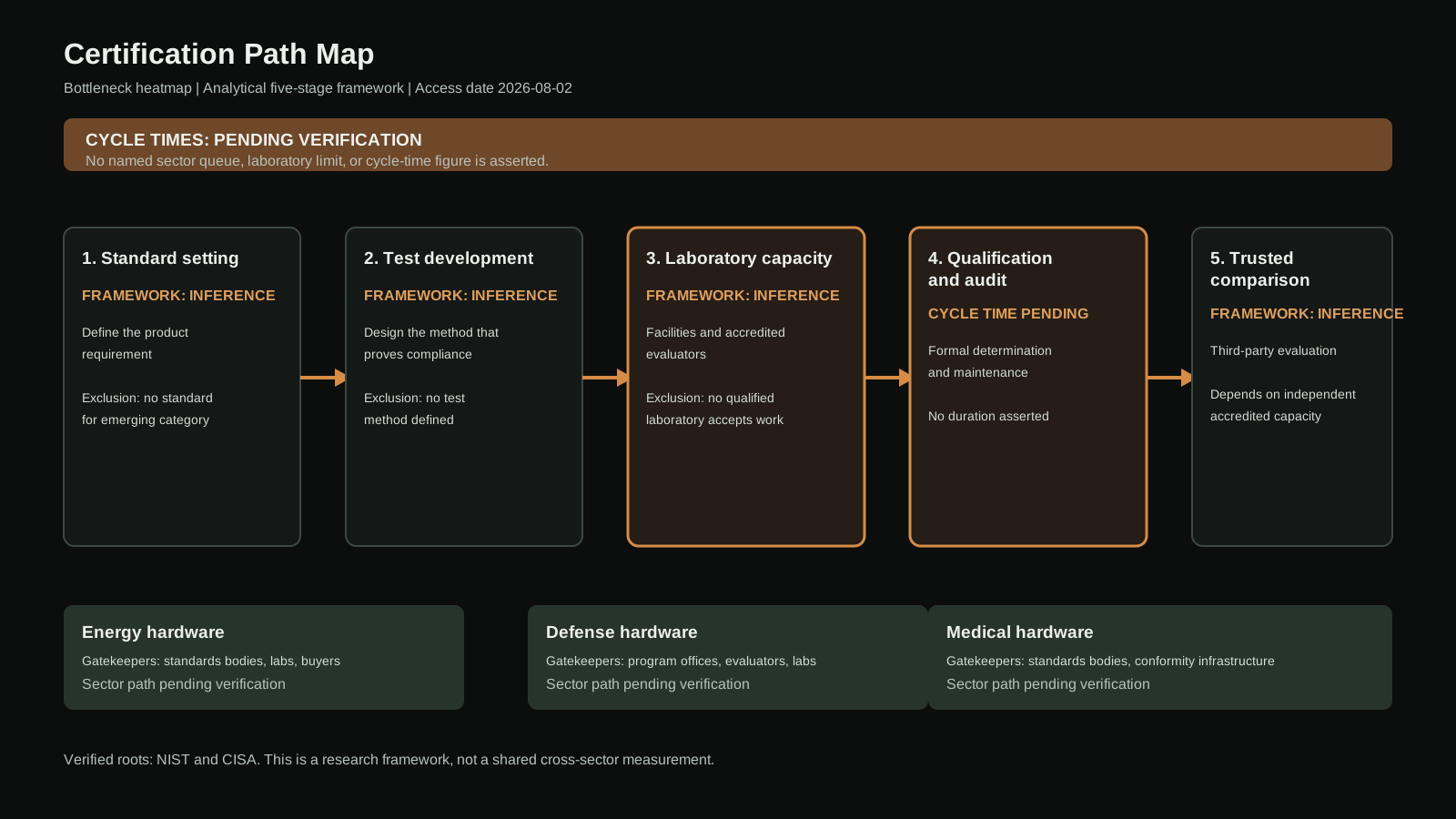
Some regulated or mission-critical hardware products must meet specified testing, qualification, or certification requirements before a buyer can procure them. The applicable gate varies by product, buyer, and jurisdiction. This article is a conceptual map of five possible stages: standard setting, test development, laboratory capacity, qualification and audit, and trusted comparison. It does not establish a shared cross-sector queue or a named certification-cycle time for energy, defense, and medical hardware. This article assigns the bottleneck to Layer 5, Export Controls, interpreted as the market-access gate; the alternative reading is a distinct gate that may warrant its own treatment.
Who is this for?
This article is for the hardware founder and the allocator deciding whether a product can actually reach the market, and how long the gate takes.
The decision in front of you: can you map the certification path for your product, identify the test infrastructure it depends on, and estimate how long the gate actually takes? A product that cannot be certified cannot be sold, and the queue is now a scheduling input, not an afterthought.
Where does it actually bottleneck?
The bottleneck is in Layer 5, Export Controls, interpreted as the market-access gate layer: certification is the standards-side gate that decides which products and which companies can sell into strategic markets, running parallel to the trade-side gate. The alternative reading is that certification is a distinct gate that belongs in no existing layer and may warrant its own treatment.
Certification can let a buyer rely on a defined test, qualification, or conformity process rather than repeat all testing itself. Whether it is a binding constraint depends on the applicable standard, test method, laboratory scope, buyer requirement, and jurisdiction. This article has not yet verified named queue times or laboratory-capacity limits in the sectors named, so the five-stage table is a framework for research rather than a cross-sector measurement. Source confidence: Analytical framework; sector evidence pending verification. Signal strength: Watch.
The site's processing-lens language applies: the certificate is the downstream stage, and the test infrastructure is the upstream capacity that gates it. Software can shorten the documentation side. It cannot create a laboratory.
| Stage | What it is | Where it gates | Evidence level | | --- | --- | --- | --- | | Standard setting | Defining the requirement the product must meet | Standards bodies move slowly; emerging categories lack standards | Inference | | Test development | Designing the test methods that prove compliance | Novel categories need new test methods | Inference | | Laboratory capacity | The physical test facilities and accredited evaluators | Scarce capacity; long queues in hot categories | Inference | | Qualification and audit | The formal determination and its ongoing maintenance | Qualification cycles measured in months to years | Inference; cycle times pending | | Trusted comparison | Third-party evaluation across vendors | Depends on accredited independent capacity | Inference |
No named certification-cycle time is asserted in this piece: no dated standards-body, agency, or industry disclosure was available at the 2026-08-02 cutoff for any cycle-time figure. The stage rows are framework, not measurement. Source confidence: Analytical framework; cycle times pending verification.
Who controls it?
The gatekeepers are the standards bodies, the accreditors, and the program offices that demand the certificates. NIST is central to the measurement and standards infrastructure, and CISA runs cybersecurity and critical-infrastructure standards work; both roots are verified. (NIST, CISA, accessed 2026-08-02.) Source confidence: Primary (roots, verified HTTP 200). GAO documents program and certification gaps, but GAO's text was not machine-readable at the 2026-08-02 cutoff; no specific GAO finding is cited here. Source confidence: Primary (root browser-only); no finding asserted.
The exclusion mechanics matter more than the list of names. A startup in an emerging category can be excluded not because its product fails, but because no standard exists for its category, no test method is defined, or no qualified laboratory will accept the work. Those are not technical failures. They are market-access failures, and they are the reason certification is a bottleneck story rather than a compliance story. Source confidence: Analytical.
This framework should be tested separately against grid-hardware qualification, defense test-and-evaluation, and medical-device conformity records. It does not establish that those sectors share one queue, one laboratory constraint, or one certification cycle. Source confidence: Pending verification.
Why should founders care?
Three mechanisms, not recommendations.
First, certification has a capital requirement, and it is under-provisioned relative to the products it gates. Building and accrediting test infrastructure is expensive, and the capacity tends to lag the demand it serves. Federal programs can fund the standards and measurement base; NIST is the standing example. What is missing in the hot categories is the accredited capacity to run the qualification work at the volume the buildout needs. For an allocator, that is the investable signal: test infrastructure and certification capacity in a gated category is a capital-under-provisioned stage, and the stage is the gate. Source confidence: Analytical.
Second, the exclusion mechanics are where startups lose. A product in an emerging category can be excluded by the absence of a standard, a test method, or a laboratory, none of which is a product failure. A founder who maps the certification path before the prototype is done can see the exclusion coming; one who treats certification as a late-stage legal task cannot.
Third, the diligence question is the certificate, not the demo. The gap between a working product and a certifiable one is where schedule risk lives: which standard governs the category, whether the test infrastructure exists, and who is accredited to run it. A founder who builds the testing or the trusted-comparison layer for an emerging category is building the market-access infrastructure. Source confidence: Analytical for the mechanisms; the investable-stage claim is a hypothesis pending verified cycle-time and capacity data.
FAQ
Q: Is certification really a bottleneck, or just paperwork? A: It is a physical-capacity problem, not a paperwork problem. Qualified laboratories, accredited test facilities, and trained evaluators are scarce, and hot categories queue behind the same test infrastructure. The product can be ready while the certificate is not. Source confidence: Analytical.
Q: How long does certification actually take? A: No named cycle time is asserted in this piece. No dated standards-body, agency, or industry disclosure was available at the 2026-08-02 cutoff for any cycle-time figure. The cycle-time column is labeled pending. Source confidence: Pending verification.
Q: Who controls the certification gate? A: The standards bodies, the accreditors, and the program offices that demand the certificates. NIST is central to the measurement and standards infrastructure; CISA runs the cybersecurity and critical-infrastructure layer; GAO documents where the gates fail, though its text was not machine-readable at the 2026-08-02 cutoff. Source confidence: Primary for the roots; Analytical for the gate read.
Q: Why does a good product fail to get certified? A: Often not because it fails a test, but because no standard exists for its category, no test method is defined, or no qualified laboratory will accept the work. Those are market-access failures, not technical failures. Source confidence: Analytical.
Q: What should an allocator diligence? A: The certificate, not just the demo: which standard governs the category, whether the test infrastructure exists, and who is accredited to run it. Test infrastructure in a gated category is a capital-under-provisioned stage. Source confidence: Analytical.
Q: Why is this assigned to the Export Controls layer? A: Because certification is a market-access gate that runs parallel to the trade-side gate: both decide which products and companies can sell into strategic markets. Certification is a market-access gate that may warrant its own treatment. Source confidence: Editorial judgment.
Sources
- NIST laboratory accreditation programs, scopes, and methods: NVLAP and Accreditation vs. Certification (accessed 2026-08-02). Primary.
- CISA PNT acquisition and resilience guidance: Federal PNT Services Acquisitions Guidance (accessed 2026-08-02). Primary.
- GAO documentation of program and certification gaps: GAO (not machine-readable at the 2026-08-02 cutoff; no specific finding cited).
- Market-access gate parallel: Export Controls for AI Models (accessed 2026-08-02). Site article.
- Non-dilutive capital for test infrastructure: Non-Dilutive Capital guide (accessed 2026-08-02). Site article.
- Bottleneck Map pillar: Bottleneck Map (accessed 2026-08-02). Site pillar.
- Named certification-cycle times by sector: pending verification at the 2026-08-02 cutoff; no figure is asserted.
Publication cutoff: 2026-08-02.
Methodology
This article follows the Bottleneck Map method. The bottleneck is assigned to Layer 5, Export Controls, interpreted as the market-access gate layer, because certification is the standards-side gate that decides who can sell into strategic markets. The alternative reading is that certification is a distinct market-access gate that may warrant its own layer. Layer 6 (Non-Dilutive Capital) and Layer 7 (Buyers) are connected as the funding and demand sides of the same gate.
Every claim carries a source-confidence classification per the editorial standards: Primary where a named, publicly verifiable source is cited inline; Analytical where the claim reflects Stack & State ecosystem observation. No certification-path claim could be verified against dated standards-body, agency, or industry disclosures at the 2026-08-02 cutoff, so the five-stage framework is published with the sector gates labeled as pending verification and no certification-cycle time is asserted. GAO's text was not machine-readable at the cutoff and no specific GAO finding is cited. Analytical classifications are hypotheses for navigation, not verified findings.
Research cutoff and access date for all sources: 2026-08-02. Corrections: /connect/.
Stack & State is an editorial and ecosystem-intelligence publication. Nothing here is legal, investment, procurement, or compliance advice. Program details change; verify requirements with primary sources and qualified advisors.