Energy, Power & Critical-Minerals Supply Chain
China Rare-Earth Controls: Processing Is the Real Bottleneck
The export measures are on a conditional pause while enforcement tightens, and the binding constraint was never ore ownership. It is refining, magnets, qualification, and offtake
Atomic answer
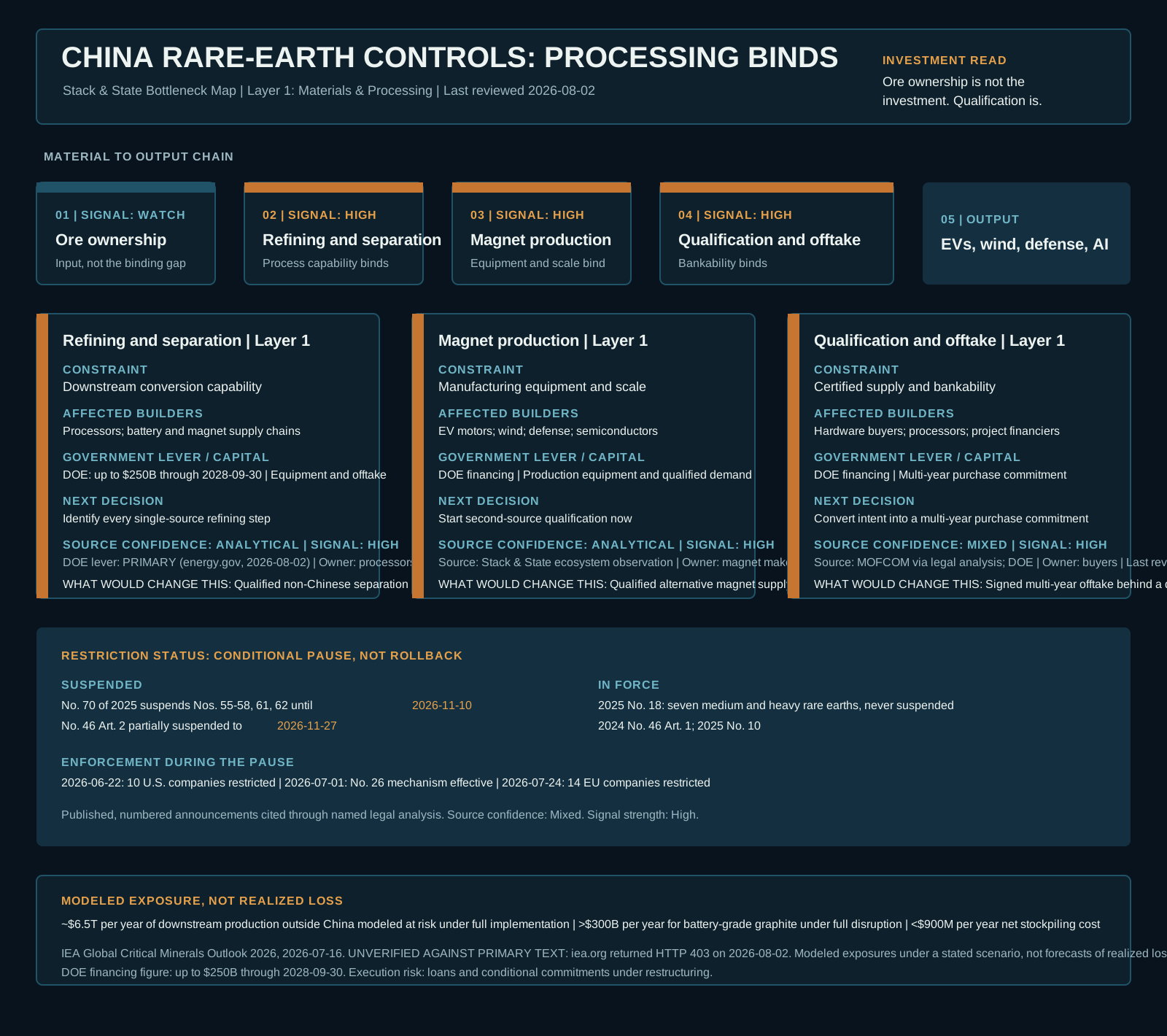
Ore ownership is not the investment. The binding constraint in the critical-mineral stack sits downstream of the mine, at refining and separation, magnet production, qualification, and offtake. China's rare-earth export measures are in a conditional pause rather than a rollback, while enforcement has tightened during the suspension window.
Who is this for?
This article is for the founder or operating executive whose product contains a sintered magnet, a specialty alloy, a high-purity semiconductor input, or battery-grade graphite: electric drivetrains, wind, defense electronics, robotics, semiconductor fabrication, aerospace, and increasingly AI hardware.
The decision you face is a sourcing and qualification decision with a date on it. Two expiry dates in November 2026 sit inside most hardware companies' current planning horizon, and requalifying a magnet or an alloy against a new processor is typically a multi-quarter engineering program, not a purchase order. If you wait for the swing to resolve before starting qualification, you start after the window closes.
It is also for the allocator underwriting a processing, separation, or magnet company. The diligence question this article is built around is not who owns the ore. It is who has qualified output and a multi-year purchase commitment behind it.
Where does the critical-mineral stack actually bottleneck?
Not at the mine. At the four stages between the mine and a finished component.
Upstream extraction is comparatively diversified and comparatively fast to announce. The stages that bind are refining and separation, where process capability rather than capital alone determines whether you can hit a specification; magnet production, where equipment and scale bind; qualification, where a buyer's engineering organization has to accept a new source into a certified design; and offtake, where the absence of a multi-year purchase commitment keeps an otherwise viable line from being financeable. A ton of ore with no qualified path through those four stages does not become a motor. Source confidence: Analytical (Stack & State ecosystem observation and pattern recognition). Signal strength: High. This is a hypothesis for navigation, not a verified quantitative finding.
The scale of what sits downstream of those stages is what makes the framing consequential. The International Energy Agency's Global Critical Minerals Outlook 2026, published 2026-07-16, models roughly USD 6.5 trillion per year of downstream production outside China at risk under full implementation of China's rare-earth export controls, across the automotive, high-technology, defense, and energy sectors, and models more than USD 300 billion per year of downstream output outside China at risk if battery-grade graphite trade were fully disrupted. (IEA Global Critical Minerals Outlook 2026; figures corroborated in secondary reporting by IndexBox, 2026-07-18.)
Two labels have to travel with those numbers. First, they are modeled exposures under a full-implementation scenario, not forecasts of realized loss, and they should never be quoted as damages. Second, iea.org returned HTTP 403 to automated access on 2026-08-02, so both figures are unverified against the primary text and rest here on secondary reporting about the report. Source confidence: Mixed (secondary corroboration of a primary institutional report that could not be opened). Signal strength: Medium, pending re-verification.
The same report is reported to estimate the net annual cost of stockpiling the eleven high-risk materials, for countries outside the dominant supplier, at less than USD 900 million. That figure carries no secondary corroboration captured on 2026-08-02 and is the least verified number in this article. Source confidence: Mixed, unverified against primary text and uncorroborated. If it holds, the asymmetry it implies is the sharpest allocation signal in the sector: a hedge priced in hundreds of millions against an exposure modeled in trillions means inventory is cheap and processing capability is the expensive part. That is precisely why the bottleneck stays downstream rather than in the warehouse.
Who controls the constraint, and what is its current status?
China's Ministry of Commerce and the General Administration of Customs control the policy variable, and its status is a matter of published record with announcement numbers and expiry dates.
- Announcement No. 70 of 2025, issued 2025-11-07, suspended the six export-control announcements of 2025-10-09 (Nos. 55, 56, 57, 58, 61, and 62), covering rare-earth production equipment, medium and heavy rare earths, rare-earth technologies, overseas rare-earth items with a Chinese nexus, lithium-battery items, and synthetic diamonds. The suspension runs until 2026-11-10.
- A parallel partial suspension of Announcement No. 46, Article 2, covering gallium, germanium, antimony, superhard materials, and stricter graphite review for the United States, runs from 2025-11-09 to 2026-11-27.
- 2025 Announcement No. 18, controlling seven medium and heavy rare earths including samarium, gadolinium, and terbium, remains in force and was not suspended. So do Article 1 of the 2024 Announcement No. 46, covering dual-use exports to United States military end users, and 2025 Announcement No. 10, covering tungsten, tellurium, bismuth, molybdenum, and indium.
(Pillsbury Winthrop Shaw Pittman analysis of the announcements, accessed 2026-08-02.) Source confidence: Mixed (the underlying announcements are published, numbered, and dated primary instruments; they are cited here through named legal analysis rather than from the original Chinese-language text). Signal strength: High.
Anyone reading that as a relaxation is reading half the record. Enforcement intensified during the suspension window:
- 2026-06-22: the Ministry of Commerce restricted 10 United States companies, barring suppliers anywhere from providing them with China-origin dual-use items.
- 2026-07-01: Announcement No. 26's reporting and reward mechanism took effect, an enforcement tool that relies partly on outside tips rather than on government inspection alone.
- 2026-07-24: shipments of dual-use materials were prohibited to 14 companies in the European Union.
(Corroborated in named legal-practice reporting on recent China export-control actions, accessed 2026-08-02.) Source confidence: Mixed. Signal strength: High.
The accurate read is a conditional pause with intensified targeted enforcement, not a suspended-or-reimposed binary. For an operator, the difference is practical: a broad measure on a published expiry date is something you can plan against, while entity-level enforcement is something that can reach your specific supplier without any change to the headline policy.
On the financing side, the relevant United States actor is the Department of Energy's Office of Energy Dominance Financing, formerly the Loan Programs Office. Its published mandate explicitly includes financing critical materials projects, and the authority carries a loan guarantee ceiling of up to $250 billion in total principal through 2028-09-30. (Department of Energy, accessed 2026-08-02.) Source confidence: Primary (energy.gov, accessed 2026-08-02).
Two qualifications. Execution risk is real: the reorganized office has been restructuring, revising, and eliminating existing loans and conditional commitments, so an announced facility is not a funded one. Source confidence: Mixed. And project finance does not create demand. Public capital can start a separation or magnet line; multi-year purchase commitments are what make it bankable and what decide whether it survives past its first cycle. Source confidence: Analytical.
Why should founders care before November 2026?
Because qualification is slower than policy.
The two suspension expiries, 2026-11-10 and 2026-11-27, are roughly a quarter away. Qualifying an alternative magnet or alloy supplier into a certified design is typically a multi-quarter engineering program covering sample production, metallurgical and performance testing, design review, and in regulated categories a formal source-change approval. A company that begins qualification when the measures change begins after the exposure has already landed.
Three concrete moves follow, in order of how quickly they can be started.
Map your position against the four downstream stages, not against country of origin. The useful question is not "is this material Chinese," it is "at which of refining, magnet production, qualification, or offtake do I have exactly one option?" Single points at qualification are the most expensive to fix and the least visible on a bill of materials.
Separate the paused measures from the live ones. A sourcing plan built on the assumption that all rare-earth controls are suspended is wrong today, because 2025 Announcement No. 18 covering seven medium and heavy rare earths was never suspended. Samarium, gadolinium, and terbium exposure is a current condition, not a scenario.
Treat offtake as a product. For a buyer, a multi-year purchase commitment is the instrument that converts a pilot-scale domestic processor into a financeable line, and it is also the thing that gets you allocated first when supply tightens. For a processor raising against federal financing, offtake is the missing half of the capital stack, not a commercial nicety. Source confidence: Analytical for the sequencing judgment.
What would change this assessment
- Restriction status. Expiry, extension, or early reinstatement of the suspensions on 2026-11-10 or 2026-11-27 would move the signal strength immediately. So would suspension or expansion of 2025 Announcement No. 18, the measure that is currently live.
- Enforcement trend. A further tranche of entity-level restrictions, or a visible pause in them, would confirm or break the conditional-pause reading.
- Verification of the modeled figures. Direct access to the IEA Global Critical Minerals Outlook 2026 primary text would move the $6.5 trillion, $300 billion, and under-$900-million figures from Mixed and unverified to Primary, or correct them. Until then they stay labeled.
- Downstream capacity. A financed, constructed, and qualified non-Chinese separation or magnet line operating at commercial volume with a multi-year offtake behind it would lower the bottleneck's signal strength. Announcements of mines or of capacity without offtake would not.
Last editorially reviewed: 2026-08-02.
FAQ
Q: Are China's rare-earth export controls currently in effect or not? A: Both, depending on the measure. The six announcements of 2025-10-09 (Nos. 55 through 58, 61, and 62) are suspended by Announcement No. 70 of 2025 until 2026-11-10, and Announcement No. 46 Article 2 is partially suspended until 2026-11-27. But 2025 Announcement No. 18, covering seven medium and heavy rare earths, remains in force, as do Article 1 of the 2024 Announcement No. 46 and 2025 Announcement No. 10 (published announcement status, accessed 2026-08-02). Treating the whole regime as paused is the most common planning error we see. Source confidence: Mixed. This is not legal advice; verify against the announcements and qualified counsel before acting.
Q: Should we take the $6.5 trillion figure at face value? A: No, and not because it is wrong. It is a modeled exposure under a full-implementation scenario, not a forecast of realized losses, and iea.org returned HTTP 403 to automated access on 2026-08-02, so it is unverified against the primary text and rests here on secondary reporting (IndexBox, 2026-07-18). Use it as a scale indicator for where downstream value is concentrated, never as a damages estimate. Source confidence: Mixed, unverified against primary text.
Q: If mining is diversified, why does supply still fail? A: Because a mine produces concentrate, not a component. Between the two sit separation and refining, magnet or cathode production, qualification into a certified design, and an offtake commitment that makes the intermediate capacity financeable. Each of those is more concentrated and slower to stand up than extraction, and a shortfall at any one of them is indistinguishable, from the buyer's side, from a shortage of ore. Source confidence: Analytical.
Q: Does federal financing solve the processing gap? A: It funds one side of it. The Office of Energy Dominance Financing explicitly names critical materials financing and carries a loan guarantee ceiling of up to $250 billion in total principal through 2028-09-30 (Department of Energy, accessed 2026-08-02). It does not create demand, and it carries execution risk: the reorganized office has been restructuring, revising, and eliminating existing loans and conditional commitments. The line that gets built and stays built is the one with a multi-year purchase commitment behind it. Source confidence: Primary for the program and ceiling; Mixed for execution risk; Analytical for the offtake read.
Q: What is the cheapest hedge available to a mid-size buyer? A: Inventory, if the reported stockpiling economics hold. The IEA is reported to estimate the net annual cost of stockpiling the eleven high-risk materials for countries outside the dominant supplier at under USD 900 million, which is small against the modeled exposure, though that figure carries no secondary corroboration captured on 2026-08-02 and is the least verified number in this article. At company scale the equivalent move is a buffer of the specific qualified grade you use, held while a second source completes qualification. Inventory buys time; it does not buy capacity. Source confidence: Mixed, unverified.
Sources
- Status of Chinese rare-earth and critical-mineral export measures: Announcement No. 70 of 2025 (issued 2025-11-07) suspending Nos. 55 through 58, 61, and 62 until 2026-11-10; partial suspension of Announcement No. 46 Article 2 from 2025-11-09 to 2026-11-27; 2025 Announcement No. 18 remaining in force: Pillsbury Winthrop Shaw Pittman (accessed 2026-08-02). Mixed: published primary instruments cited through named legal analysis.
- Enforcement actions during the suspension window: 10 United States companies restricted 2026-06-22; Announcement No. 26 reporting and reward mechanism effective 2026-07-01; 14 European Union companies restricted 2026-07-24: Morgan Lewis (accessed 2026-08-02). Mixed.
- Modeled exposure figures of roughly USD 6.5 trillion per year of downstream production outside China across automotive, high-technology, defense, and energy under full implementation, and more than USD 300 billion per year for battery-grade graphite; and the reported net annual stockpiling cost of under USD 900 million for the eleven high-risk materials: IEA Global Critical Minerals Outlook 2026 (2026-07-16), corroborated for the first two figures by IndexBox (2026-07-18). Unverified against primary text: iea.org returned HTTP 403 to automated access on 2026-08-02. All three are modeled exposures, not realized-loss forecasts. The stockpiling figure has no secondary corroboration captured this run.
- DOE Office of Energy Dominance Financing mandate, explicit critical materials financing, and $250 billion loan guarantee ceiling through 2028-09-30: Department of Energy (accessed 2026-08-02). Primary.
Methodology
This article follows the Bottleneck Map method. The bottleneck is assigned to Layer 1, Materials & Processing, because the primary constraint is downstream processing capability: refining and separation, magnet production, qualification, and offtake. It is deliberately not assigned to Layer 5, Export Controls & Compliance, even though export measures are the most visible variable, because the export regime changes the timing and severity of the constraint rather than causing it. Removing every restriction tomorrow would leave the separation, magnet, qualification, and offtake gaps exactly where they are.
Source confidence is stated per claim, following the editorial standards: Primary where a named, publicly verifiable institutional source is cited inline; Mixed where public data or a published instrument is combined with secondary sourcing or editorial interpretation; Analytical where the claim reflects Stack & State ecosystem observation. Analytical classifications are hypotheses for navigation, not verified factual findings, and nothing here is legal, investment, procurement, or compliance advice.
Modeled figures are labeled as modeled exposures under a stated scenario and are never presented as realized losses. Sources that blocked automated access are reported as blocked rather than guessed; the IEA figures above are carried with an explicit unverified-against-primary-text label and should be re-verified before any further use.
Research cutoff and access date: 2026-08-02. Corrections: /connect/.
Stack & State is an editorial and ecosystem-intelligence publication. Nothing here is legal, investment, procurement, or compliance advice. Program details change; verify requirements with primary sources and qualified advisors.
Verified sources
Last verified