Industrial Components
The Component Stack Beneath the Humanoid Robot
The form factor gets the headlines. The bottleneck is motors, actuators, reducers, encoders, bearings, batteries, and precision production, and the components decide who can scale.
Atomic answer
Humanoid robotics is covered as a form-factor story: a robot walks, a demo works, a valuation rises. The form factor is not the strategic bottleneck. The bill of materials is. A humanoid needs motors and actuators in every joint, reducers to torque them, encoders to know where the joint is, bearings to carry the load, batteries to run it, sensors to perceive, and precision production to make all of it consistent at scale. Capital is pouring into the form-factor layer while the component layer gets less scrutiny, and the July 2026 U.S. restrictions on foreign robotics put the component dependence into policy. The practical distinction: the product is the integration, but the constraint is the stack beneath it. A company that can assemble a humanoid but cannot source actuators at production volume does not have a manufacturing problem. It has a procurement problem, and that is the real market. The specific claim that components are the binding bottleneck is a hypothesis until teardown and scale data support it.
Who is this for?
This article is for the robotics founder, the component supplier, and the allocator deciding where the humanoid category actually binds.
The decision in front of you: can you map a representative humanoid's bill of materials, identify which components are single-point dependencies, and say where the manufacturing base sits? The form factor is an integration problem that capital can solve. The manufacturing base is a capital-and-qualification problem that takes years.
Where does it actually bottleneck?
The bottleneck is in Layer 1, Materials & Processing, because the constraint is the component manufacturing base: precision production at scale. This assignment is itself a hypothesis, labeled as such until teardown and import data verify which component class binds.
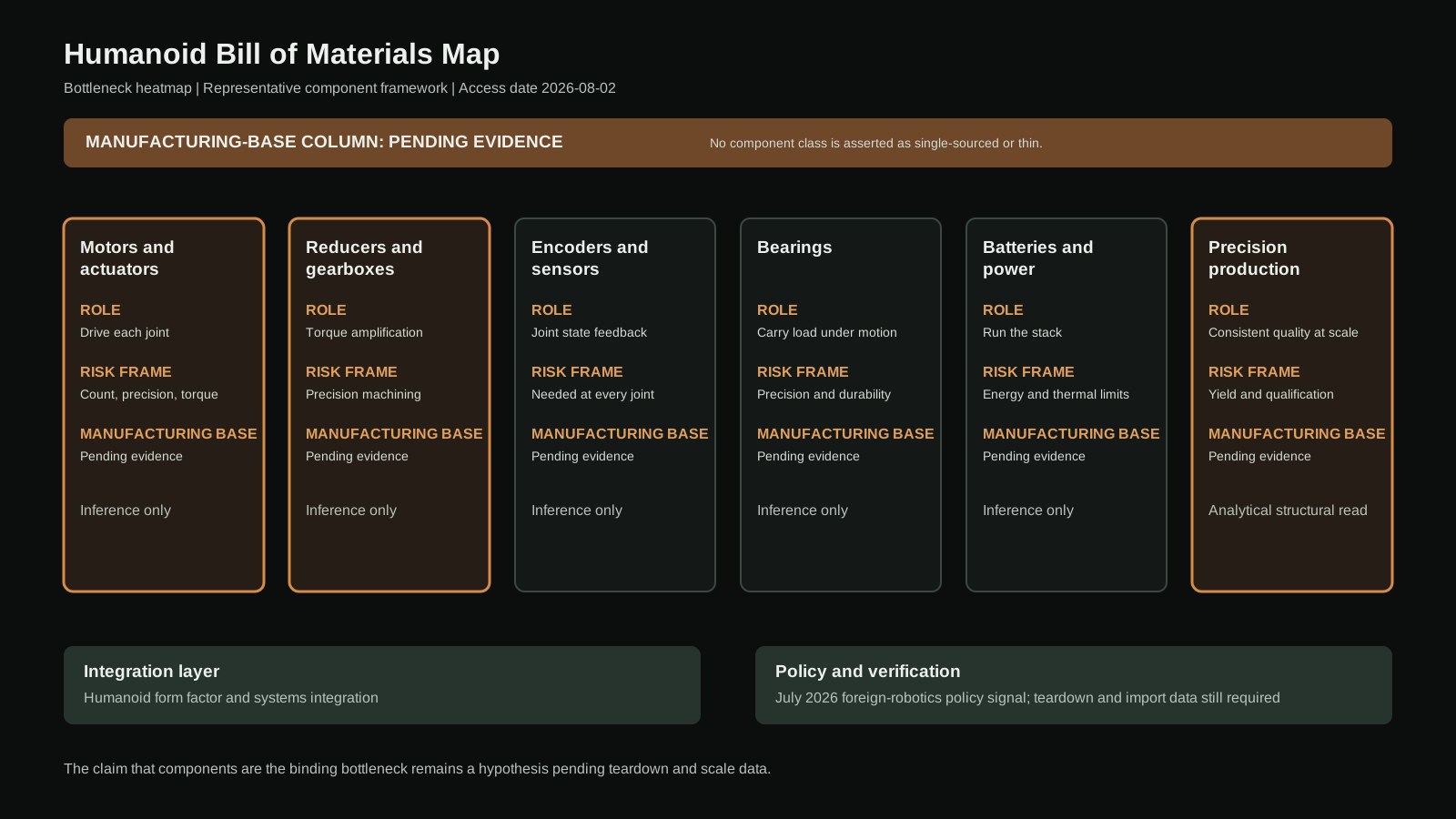
Every demo cycle produces a better walk or a faster hand. The coverage follows the form factor, and so does the capital. The component layer is where the physical constraint lives. A humanoid is a concentrated demand for precision motion: dozens of actuators and motors, a transmission between each motor and each joint, encoders to close each control loop, bearings and reducers that carry the load through years of operation, and a power system that has to run the whole stack without catching up in weight. None of this is exotic technology. It is precision production at scale, and precision production at scale is the hard problem in industrial hardware. Source confidence: Analytical (ecosystem observation); the manufacturing-base column per component class is pending verification and is not asserted. Signal strength: Watch.
| Component class | What it does | Why it is a risk | Evidence level | | --- | --- | --- | --- | | Motors and actuators | Drive each joint | High count per unit; precision and torque matter at every joint | Inference; manufacturing base pending | | Reducers and gearboxes | Torque amplification between motor and joint | A classic precision-machining and materials stage | Inference; manufacturing base pending | | Encoders and sensors | Joint position and state feedback | Needed per joint; small but non-negotiable | Inference; manufacturing base pending | | Bearings | Carry the load under motion | Precision bearings are a concentrated global supply | Inference; manufacturing base pending | | Batteries and power | Run the stack within a weight budget | Energy density and thermal limits bind the design | Inference; manufacturing base pending | | Precision production | Manufacture the above at consistent quality | Scale, yield, and qualification are the real gate | Inference; manufacturing base pending |
Every row is a potential single point of failure. The manufacturing-base column is explicitly pending evidence: it must be sourced from teardowns and import data before publication, and no component class is asserted as single-sourced or thin in this piece. Source confidence: Analytical framework; specific concentration claims pending.
Who controls it?
The policy dimension arrived in July 2026. The United States moved on foreign robotics, and Ars Technica's analysis of the restrictions lays out who wins and who loses. (Ars Technica, July 29, 2026, accessed 2026-08-02.) Source confidence: Secondary for the Ars Technica analysis; the policy event is corroborated by the FCC notice. Signal strength: High. The through-line is the supply chain: a robotics industry that depends on imported actuators, reducers, and precision parts faces a different constraint landscape than one that sources domestically. Component sovereignty is being enforced through procurement and trade policy, and the companies that control the component stage control market access.
The engineering and investment beats are live. IEEE Spectrum tracks humanoid robotics as an engineering and components beat, and a16z's American Dynamism program covers component and manufacturing economics as an investment theme. (IEEE Spectrum, a16z American Dynamism, accessed 2026-08-02.) Source confidence: Primary (roots, verified HTTP 200). The synthesis claim that capital is concentrating on form factors while components get less scrutiny is an inference from that coverage, not a verified funding statistic. Source confidence: Analytical.
Why should founders care?
Three mechanisms, not recommendations.
First, the bill of materials is now a compliance and procurement document as much as an engineering one. A founder who reads only the form-factor coverage will miss the change in the constraint landscape. The same pattern the site maps in critical minerals and grid hardware is now visible in robotics: the companies that control the component stage control the pace of the whole category.
Second, the sharpest version of the map asks which component classes are single-sourced or thin, and that evidence must come from teardowns and import data. Until it does, the structural claim is safer than the specific one: precision production is the unifying bottleneck, because motors, reducers, encoders, and bearings all sit in the same stage, a manufacturing-base stage where yield and qualification determine who can scale. The specific claim that any one component class is the binding stage remains a hypothesis. Source confidence: Hypothesis for the specific claim; Analytical for the structural claim.
Third, the map separates the integration layer from the component layer for allocators. The integration layer is crowded and capital-hungry; the component layer is where the single points of failure and the manufacturing-base economics live. The investors who funded the form factors will discover the component constraint when the demos become orders. For a component supplier, each humanoid line is a concentrated buyer of motors, reducers, encoders, and bearings: the map is the demand forecast.
FAQ
Q: Is the component stack really the bottleneck in humanoids? A: That is a hypothesis, not a verified finding. The structural claim is safer: precision production at scale is the hard problem, and components sit in a manufacturing-base stage where yield and qualification decide who scales. Teardown and import data are required to verify which component class binds. Source confidence: Hypothesis.
Q: What did the July 2026 U.S. restrictions on foreign robots change? A: They made component sourcing a policy question. A robotics industry that depends on imported actuators, reducers, and precision parts faces a different constraint landscape than one that sources domestically, per Ars Technica's analysis. Source confidence: Primary for the policy event; Analytical for the read.
Q: Which components are single-sourced? A: Not asserted in this piece. The manufacturing-base column is labeled pending evidence until teardown and import data are sourced; no component class is claimed to be single-sourced or thin. Source confidence: Pending verification.
Q: Is humanoid robotics mostly an integration problem? A: The form factor is an integration problem that capital can solve. The manufacturing base is a capital-and-qualification problem that takes years. The two should never be confused in a diligence memo. Source confidence: Analytical.
Q: What should a robotics founder do with the bill of materials? A: Run it as a supply-chain document before the demo goes on stage. If a critical component is single-sourced or imported, that is a strategic risk investors will diligence regardless of whether you do. Source confidence: Analytical.
Q: Where does the money sit in this stack? A: In the component layer, if the hypothesis holds: the companies that can qualify actuators, reducers, and encoders at production volume capture the stage everyone else depends on. That is the demand forecast, pending the verification that components bind. Source confidence: Analytical.
Sources
- FCC action on foreign-produced advanced robotic devices: FCC DA 26-786 (July 2026, accessed 2026-08-02). Primary.
- U.S. restrictions on foreign robots and the component-supply-chain through-line: Ars Technica (July 29, 2026, accessed 2026-08-02). Secondary (trade press).
- Humanoid robotics as a live engineering and components beat: IEEE Spectrum (accessed 2026-08-02). Primary (root).
- Component and manufacturing economics as an investment theme: a16z American Dynamism (accessed 2026-08-02). Primary (root).
- Manufacturing-base data per component class (teardowns, import data): pending verification at the 2026-08-02 cutoff; no figure is asserted.
- Materials and processing bottleneck lens: Materials Bottleneck article (accessed 2026-08-02). Site article.
- Trade-policy market-access surface: Export Controls for AI Models (accessed 2026-08-02). Site article.
- Bottleneck Map pillar: Bottleneck Map (accessed 2026-08-02). Site pillar.
Publication cutoff: 2026-08-02.
Methodology
This article follows the Bottleneck Map method. The bottleneck is assigned to Layer 1, Materials & Processing, because the constraint is the component manufacturing base beneath the robot; Layer 4 (Autonomy) is connected as the systems layer that consumes the components, and Layer 5 (Export Controls) as the policy layer that now shapes component sourcing.
Every claim carries a source-confidence classification per the editorial standards: Primary where a named, publicly verifiable source is cited inline; Analytical where the claim reflects Stack & State ecosystem observation; Hypothesis for the specific claim that components are the binding bottleneck. No representative humanoid teardown or import data was available at the 2026-08-02 cutoff, so the manufacturing-base column is explicitly marked as pending verification and no component class is asserted as the binding stage. Analytical and Hypothesis classifications are hypotheses for navigation, not verified findings.
Research cutoff and access date for all sources: 2026-08-02. Corrections: /connect/.
Stack & State is an editorial and ecosystem-intelligence publication. Nothing here is legal, investment, procurement, or compliance advice. Program details change; verify requirements with primary sources and qualified advisors.