Water & Industrial Siting
Distributed Water Reuse Could Be the Next Industrial Utility
Onsite treatment changes siting and resilience economics. A factory or campus that treats and reuses its own water is a different asset than one that buys from the municipal grid, and the unit economics decide which is viable.
Atomic answer
Onsite water reuse converts a fixed monthly purchase into a capital investment with unit economics. A facility that treats and reuses its own water stops paying for draw it does not need, stops paying discharge fees for water it returns, and buys resilience: it keeps running when the municipal supply or the basin is stressed. The federal stack is now explicit. DOE's National Alliance for Water Innovation issued a $12 million request for proposals for onsite industrial water-reuse systems in July 2026, and the EPA's Water Reuse Action Plan 2.0 names microchip fabrication and data center cooling as target sectors. The practical distinction: reuse is not one technology, it is a treatment train matched to the water you have and the water you need. The unit economics decide everything, and they are project-specific. The question is not whether onsite reuse works. It is whether the economics close without a subsidy, at this site, at this scale. The bottleneck sits in Layer 6, Non-Dilutive Capital: the category runs on federal pilots, and unsubsidized economics are unproven.
Who is this for?
This article is for the industrial operator, the developer, and the allocator deciding whether onsite reuse is a capital decision or a pilot story.
The decision in front of you: can you run the unit economics of onsite reuse for your own site, and do you know which federal pilots and deadlines to watch? The federal program is real and dated, and the deadline structure tells an operator when to have a project concept ready. Concept papers are due September 15, 2026, and full proposals November 24, 2026.
Where does it actually bottleneck?
The bottleneck is in Layer 6, Non-Dilutive Capital, because this article examines the transition from federally supported pilots to commercially financed deployments; it makes no sector-wide finding on unsubsidized economics.
DOE's NAWI RFP names three source types: cooling water, process and rinse water, and wastewater treatment effluent, and three reuse patterns: within a single unit process, from one process's wastewater to other processes, and moving nuisance water to a high-value use at an adjoining facility. The framing emphasizes upgrading water quality, not transferring lower-quality water to a process with fewer constraints: reuse is a quality ladder, not a recycling loop. (DOE NAWI, accessed 2026-08-02.) Source confidence: Primary (energy.gov, verified HTTP 200). Signal strength: High.
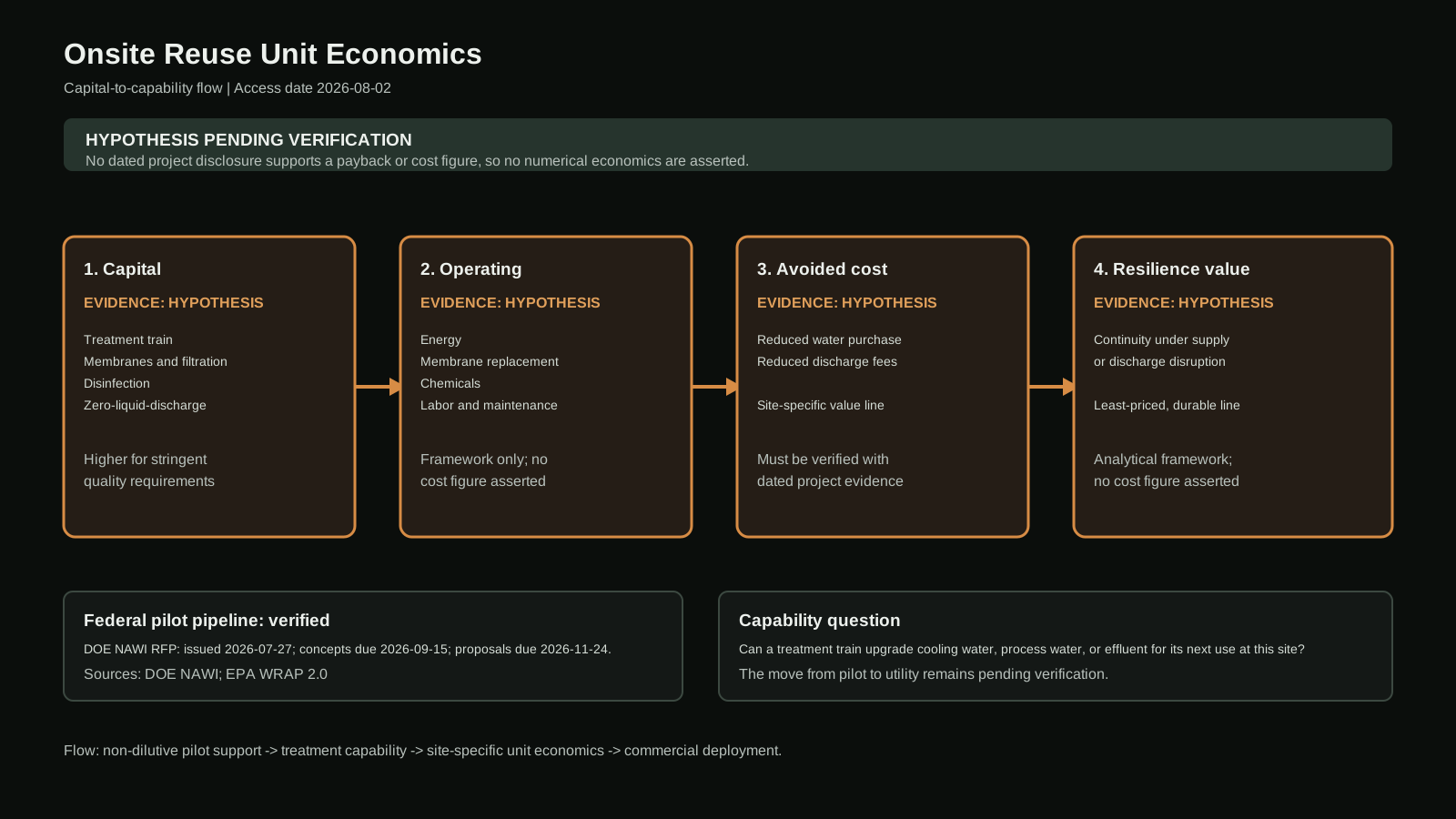
The table ships as hypothesis pending verification: no dated project disclosure could be tied to it, and no payback or cost figure is stated.
| Cost or value | What it is | Where it bites | | --- | --- | --- | | Capital | The treatment train: membranes, filtration, disinfection, and in the hardest cases zero-liquid-discharge | Hardest for sites with stringent quality requirements | | Operating | Energy, membrane replacement, chemicals, labor, maintenance | Energy and membranes dominate at scale | | Avoided cost | Reduced water purchase and reduced discharge fees | The two lines that make the payback move | | Resilience value | Continuity of operations when supply or discharge is disrupted | The least-priced line and the most durable |
Every real project trades cost against value; projects close when avoided cost plus resilience value clears the operating line and pays down the capital. Source confidence: Analytical (framework); the per-line economics are Hypothesis pending verification.
Who controls it?
The federal government controls the current pipeline, and the dates are the control surface. NAWI, a public-private partnership led by DOE's Lawrence Berkeley National Laboratory, issued the $12 million RFP on July 27, 2026. Concept papers are due September 15, 2026, and full proposals are due November 24, 2026. The RFP targets the three non-traditional sources already named, across sectors that include chemicals, food and beverage, paper and pulp, semiconductors, iron and steel, and automotive. Source confidence: Primary (energy.gov, verified HTTP 200). Signal strength: High.
EPA's WRAP 2.0, launched in April 2026, names microchip and memory fabrication and data center cooling as priority sectors for reuse and frames reuse as a competitiveness and resilience tool rather than a mandate. (EPA news release, April 16, 2026, accessed 2026-08-02.) Source confidence: Primary (epa.gov, verified HTTP 200). Signal strength: High. The Bureau of Reclamation is a third federal lane for water funding; its root is verified, while specific funding pages block automated fetching and must be confirmed in a browser before any figure is cited.
The second-order control is the site itself. Reuse decouples location from the water grid: a facility that reuses its own water depends less on the municipal supply, can locate in basins that would otherwise be marginal, and can expand without renegotiating its municipal draw. The NAWI RFP is explicit that industrial sites are often chosen based on proximity to reliable water supplies, and that onsite systems let manufacturers locate where power, land, and labor work and carry their own water solution. Source confidence: Primary for the RFP framing; Analytical for the structural read.
Why should founders care?
Three mechanisms, not recommendations.
First, resilience is the unpriced line. A municipal supply can be interrupted by drought, by a main break, or by allocation policy during a shortage. A discharge permit can be contested by the same local politics that are now killing data centers. A facility with onsite treatment and storage can keep running through supply stress and can hold water when discharge is constrained. For a fab, where a production stop costs more than the treatment train, the option is the point of the investment. Operators underprice this line because it is an option, not a running cost. Source confidence: Analytical.
Second, the subsidy question is the category question. The federal RFP funds pilots and demonstrations, which is exactly the stage where the unit economics are still being proven. If the economics only close when a grant covers the capital, the category stays a pilot story rather than becoming an industrial utility. The named reader decision is to test the project against unsubsidized economics before banking on the pilot: run the four-line economics with the subsidy stripped out, then add it back. If the project only works subsidized, it is a pilot; if it works unsubsidized at this site, it is a utility.
Third, the market is the quality ladder, not the recycling loop. Founders building treatment, monitoring, or reuse software should target tools that upgrade water quality for a next process and instrumentation that makes reuse trains auditable. Allocators should diligence the quality gap and the discharge politics, not the pilot press release: what water quality does the reuse train actually deliver, what does it cost unsubsidized, and what happens to the project when the local discharge debate turns?
FAQ
Q: Does onsite reuse actually work? A: This article does not make a general technical-performance finding. The open question is whether economics close without a subsidy at a given site and scale. The unit-economics table is labeled Hypothesis pending verification because no dated project disclosure could be tied to it in this run. Source confidence: Analytical.
Q: What are the NAWI deadlines? A: The $12 million RFP was issued July 27, 2026; concept papers are due September 15, 2026, and full proposals November 24, 2026. Source confidence: Primary (DOE).
Q: What are the three reuse source types? A: Cooling water, process and rinse water, and wastewater treatment effluent, with the emphasis on upgrading water quality rather than transferring lower quality. Source confidence: Primary (DOE).
Q: Who pays for the treatment train? A: That is the open question. Federal pilots cover demonstrations; the capital decision belongs to the site, and it only closes when avoided cost plus resilience value clears operating cost and pays down capital. Source confidence: Analytical.
Q: Why is this a non-dilutive capital bottleneck? A: Because the category currently sits in the non-dilutive layer: federal grants and RFP programs are its support structure, and unsubsidized unit economics are unproven. The constraint is the climb from non-dilutive pilots to commercial capital. Source confidence: Analytical.
Q: What would upgrade this from a pilot story to a utility story? A: Demonstrated unsubsidized economics at full scale across multiple sites, backed by dated project or permit disclosures. That is what would change this assessment. Source confidence: Analytical.
Sources
- DOE NAWI $12M RFP, issue date July 27, 2026, source types, reuse patterns, quality-ladder emphasis, sectors, and deadline dates (concept papers September 15, 2026; full proposals November 24, 2026): DOE / NAWI (accessed 2026-08-02). Primary.
- EPA Water Reuse Action Plan 2.0, priority sectors of microchip/memory fabrication and data center cooling, partnership-based and not a mandate: EPA news release (April 16, 2026, accessed 2026-08-02). Primary.
- Bureau of Reclamation water-funding programs: Bureau of Reclamation (accessed 2026-08-02). Primary (root); specific funding pages browser-only, no figure cited.
- Non-dilutive capital context for industrial capacity: Non-Dilutive Capital guide (accessed 2026-08-02). Site article.
- Reuse as a siting and resilience mechanism: Bottleneck Map (accessed 2026-08-02). Site pillar.
Publication cutoff: 2026-08-02.
Methodology
This article follows the Bottleneck Map method. The bottleneck is assigned to Layer 6, Non-Dilutive Capital, because onsite reuse currently runs on federal non-dilutive pilots and the binding question is whether unsubsidized unit economics close; Layer 1 (Materials & Processing) and Layer 7 (Buyers) are connected as the physical-input and demand sides of the same constraint.
Every claim carries a source-confidence classification per the editorial standards: Primary where a named, publicly verifiable institutional source is cited inline; Analytical where the claim reflects Stack & State ecosystem observation. The unit-economics table could not be tied to three dated project or permit disclosures at the 2026-08-02 cutoff, so it is explicitly marked as Hypothesis pending verification, and no payback or cost figure is stated. Sources that blocked automated access are labeled browser-only rather than guessed. Analytical classifications are hypotheses for navigation, not verified findings.
Research cutoff and access date for all sources: 2026-08-02. Corrections: /connect/.
Stack & State is an editorial and ecosystem-intelligence publication. Nothing here is legal, investment, procurement, or compliance advice. Program details change; verify requirements with primary sources and qualified advisors.