Energy, Power & Critical-Minerals Supply Chain
DPA Title III for Materials Companies: The Authority Clock and the Offtake Test
What the Defense Production Act Title III program funds, who qualifies, how to apply, and what winning applications look like for materials and manufacturing startups
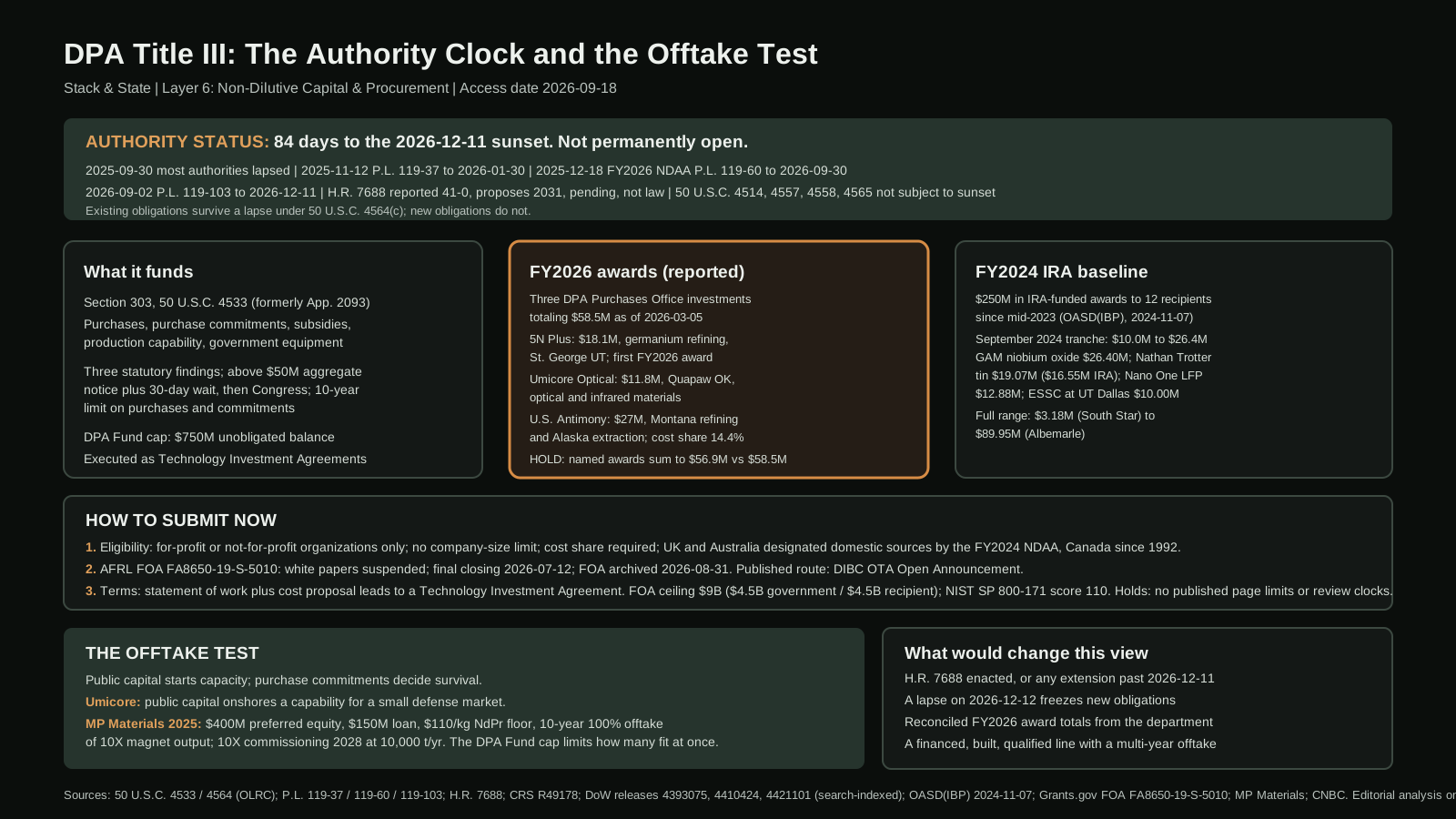
Atomic answer
DPA Title III is the federal government's purchase and finance authority for domestic industrial capacity, codified at 50 U.S.C. 4533. It is not permanently open. Most DPA authorities lapsed on 2025-09-30; the FY2026 NDAA (P.L. 119-60) extended the sunset to 2026-09-30; and P.L. 119-103 (signed 2026-09-02) moved it to 2026-12-11. H.R. 7688 would extend the expiring provisions to 2031 and raise the DPA Fund cap from $750 million to $2 billion, but it remains pending, not law. The Department of War's DPA Purchases Office reported three FY2026 investments totaling $58.5 million as of 2026-03-05, including $18.1 million for germanium refining and $11.8 million to Umicore for optical materials, against $250 million in Inflation Reduction Act-funded awards to twelve recipients since mid-2023. The frame that matters is offtake: public capital can start a separation, refining, or magnet line, and a purchase commitment decides whether it survives. Source confidence: Primary for the statute, sunset dates, and individual awards; Mixed for the FY2026 running totals; Analytical for the offtake read. On 2026-09-18, a materials company working from the older literature would believe DPA Title III is permanently open. It is not. The authority has run on stopgaps for a year, and the current one expires on 2026-12-11.
Who is this for?
This article is for the founder or executive at a materials, mining, refining, chemical, or advanced manufacturing company deciding whether federal money belongs in the capital stack, and for the allocator underwriting that company. The decision is the same for both: is the authority open, does the award buy output, and who is the buyer after the government's money runs out.
What DPA Title III is, and what it actually funds
Title III of the Defense Production Act of 1950 is the industrial-base authority. The purchase and purchase-commitment power materials companies care about is Section 303, codified at 50 U.S.C. 4533, "Other presidential action authorized." Older material sometimes cites 50 U.S.C. App. 4533; that citation is wrong. Before the DPA was editorially reclassified and renumbered at 50 U.S.C. 4501 et seq., Section 303 sat at 50 U.S.C. App. 2093. (Office of the Law Revision Counsel, 50 U.S.C. 4533, laws in effect 2026-09-17, accessed 2026-09-18.) Source confidence: Primary.
The statute authorizes the President to "create, maintain, protect, expand, or restore domestic industrial base capabilities essential for the national defense" through purchases, commitments to purchase, subsidies, development of production capabilities, and installation of government-owned equipment in private facilities. Loans and loan guarantees sit separately at Sections 301 and 302, codified at 50 U.S.C. 4531 and 4532. Source confidence: Primary.
Three findings gate every action: the item must be essential to national defense; industry cannot provide the capability in a timely manner without presidential action; and the action must be the most cost-effective, expedient, and practical alternative. Above $50 million in aggregate for one shortfall, the statute requires congressional notice and a 30-day wait, and any amount above that threshold requires an Act of Congress. Purchases and purchase commitments cannot run more than ten years from the initial action. The DPA Fund has a $750 million cap on its unobligated fiscal-year balance. (50 U.S.C. 4533; CRS R49178, accessed 2026-09-18.) Source confidence: Primary.
Recent awards execute as Technology Investment Agreements, a cooperative agreement rather than a procurement contract. The program office sits inside the Manufacturing Capability Expansion and Investment Prioritization directorate; the Air Force Research Laboratory is the FOA's executive agent. Source confidence: Primary for the instruments (Simpler.Grants.gov FOA, accessed 2026-09-18); Mixed for the office structure, which comes from the department's program pages.
The authority clock: what expires, and when
This is the correction that matters most for planning. The DPA is not permanently authorized, and it lapsed in this cycle. The dated sequence:
- 2025-09-30: the prior authorization expired. The lapse ran through the October-November 2025 government shutdown, which the department later said delayed award announcements.
- 2025-11-12: P.L. 119-37, the continuing resolution that ended the shutdown, applied the date in its Section 106(3), January 30, 2026, to 50 U.S.C. 4564(a) in Section 130. (P.L. 119-37, accessed 2026-09-18.)
- 2025-12-18: the FY2026 NDAA, P.L. 119-60, Division H, Title LXXXI, Section 8101, substituted September 30, 2026 for September 30, 2025 in the termination clause.
- 2026-09-02: P.L. 119-103, the Continuing Appropriations and Extensions Act, 2027, Section 2004, substituted December 11, 2026 for September 30, 2026. (50 U.S.C. 4564, laws in effect 2026-09-17; H.R. 6500 enrolled text, accessed 2026-09-18.)
- 2026-12-11: the current sunset. From 2026-09-18, that is 84 days.
Certain provisions are not subject to the sunset. Section 4564(a) excepts 50 U.S.C. 4514, 4557, 4558, and 4565 from termination, so those authorities remain in effect regardless of the clock. Source confidence: Primary.
H.R. 7688, the DPA Modernization Act of 2026, is the pending fix. Introduced on 2026-02-25, it was ordered reported 41-0 on 2026-03-04 and reported with an amendment on 2026-04-15 (H. Rept. 119-611, Union Calendar No. 529). It would extend the expiring provisions through September 30, 2031, raise the DPA Fund cap to $2 billion, and create a Critical Minerals Resilience Initiative. It is still a bill, not law. (H.R. 7688; CRS R49178, accessed 2026-09-18.) Source confidence: Primary.
A lapse is not the same as a default. Section 4564(c) provides that termination does not affect the disbursement of funds or the carrying out of any contract, guarantee, commitment, or other obligation entered into before the termination date. Existing awards survive; the authority to make new ones does not. Source confidence: Primary.
What the government actually bought
The FY2026 numbers are small, named, and specific. The Department of War reported three DPA Purchases Office investments totaling $58.5 million since the start of fiscal 2026:
- 5N Plus Inc.: $18.1 million, investment dated 2025-12-15, to expand germanium metal refining at St. George, Utah, sevenfold to more than 20 metric tons annually for optical and solar crystal supply chains. It was the first FY2026 investment. The release also states FY2025 recipient cost shares totaled $88 million. (DoW release 4393075, accessed 2026-09-18.)
- Umicore Optical Materials USA Inc.: $11.8 million, investment dated 2026-01-30 and announced 2026-02-20, to establish processing capability in Quapaw, Oklahoma, for materials used in advanced optics, night vision, surveillance, and infrared systems. The same release describes it as one of two FY2026 investments totaling $30.8 million. (DoW release 4410424; InsideDefense, 2026-02-20, accessed 2026-09-18.)
- U.S. Antimony Corporation: $27 million, investment dated 2026-02-24, to modernize antimony refining in Montana and establish extraction in Alaska. The company disclosed a recipient cost share of $3.9 million, about 14.4 percent. (DoW release 4421101; USAC release, 2026-03-05, accessed 2026-09-18.)
All three use Ukraine supplemental funds and support Executive Order 14241 on American mineral production. The department's press releases returned HTTP 403 to automated access during this review; their text was captured through search indexing and verbatim republications. Source confidence: Mixed.
A hold belongs here. The named awards do not reconcile with the reported totals: $18.1 million plus $11.8 million equals $29.9 million against the stated two-investment total of $30.8 million, and adding the $27 million antimony award gives $56.9 million against the stated $58.5 million for three. Use the individual awards as the hard numbers; treat the totals as reported, not audited. Source confidence: Mixed.
FY2024 was bigger and better documented. The Office of the Assistant Secretary of Defense for Industrial Base Policy reported $250 million in Inflation Reduction Act-appropriated DPA Title III awards to twelve recipients since mid-2023. The September 2024 tranche is the clean range: $26.40 million to Global Advanced Metals USA for high-purity niobium oxide in Boyertown, Pennsylvania; $19.07 million to Nathan Trotter & Co. ($16.55 million IRA) for tin smelting and refining in Coatesville, Pennsylvania; $12.88 million to Nano One Materials for lithium iron phosphate cathode material; and $10.00 million for the Energy Storage Systems Campus at the University of Texas at Dallas. Across all twelve, amounts ran from $3.18 million (South Star Battery Metals) to $89.95 million (Albemarle). (OASD(IBP) award summary, 2024-11-07, accessed 2026-09-18.) Source confidence: Primary for the award list; the summary page could not be opened directly during this review and was captured through search indexing.
The largest transaction of the cycle is the MP Materials partnership, announced in July 2025. The government agreed to purchase $400 million of convertible preferred stock, provide a $150 million loan for heavy rare earth separation at Mountain Pass, guarantee a $110 per kilogram NdPr price floor for ten years, and purchase 100 percent of the magnets produced at the planned 10X facility for ten years. JPMorgan and Goldman Sachs committed $1 billion of construction financing, and the 10X facility is expected to commission in 2028 at 10,000 metric tons annually. (MP Materials announcement, 2025-07-10; CNBC, 2025-07-10, accessed 2026-09-18.) Source confidence: Primary company disclosure and credible press.
How to access the checkbook now
The published funding opportunity is FA8650-19-S-5010, "Defense Production Act Title III Expansion of Domestic Production Capability and Capacity." White paper acceptance is suspended until further notice. The FOA's final closing date was 2026-07-12, and the opportunity was archived on 2026-08-31. Eligibility is unrestricted to for-profit and not-for-profit organizations; government organizations and individuals are not solicited. Cost sharing is required. The cost ceiling is $9 billion, split $4.5 billion government and $4.5 billion recipient. (Simpler.Grants.gov, last updated 2026-05-13, accessed 2026-09-18.) Source confidence: Primary.
With the FOA window closed, the published route for unsolicited white papers is the Defense Industrial Base Consortium Other Transaction Agreement Open Announcement, the department's vehicle for unsolicited ideas in critical supply chain resiliency focus areas. Membership is free. The FY2024 NDAA designated the United Kingdom and Australia as domestic sources for DPA funds; Canada has held that status since 1992. (DoW release 4410424; businessdefense.gov, accessed 2026-09-18.) Source confidence: Primary for the DIBC OTA route; Mixed for the program-page content, which returned HTTP 404 to direct access and was captured through search indexing.
The process is documented but its timing is not. A white paper must address the three statutory findings; favorably reviewed submissions are invited to a statement of work and a detailed cost proposal, and the award is executed as a Technology Investment Agreement. Two explicit holds: the department publishes neither white-paper page limits nor average review and award timelines. The one dated sequence this cycle is Umicore, with the investment dated 2026-01-30 and announced 2026-02-20 after the shutdown delay. Do not build a capital plan around an assumed review clock. Source confidence: Primary for the process documents; holds on the timing figures.
The offtake test
The strategic question is not how much money the program has. It is what kind of money the award is. A cost-share award funds construction of a line; a purchase commitment creates the demand that makes the line financeable and keeps it running after the award ends. DPA Title III is unusual because its core Section 303 authority is the purchase commitment, which puts it with project finance and offtake rather than research grants.
Umicore is the smaller version of the test: public capital onshores a processing capability for optical and infrared materials where the defense market alone may not support a commercial facility. MP Materials is the larger version: the government became the customer, with a price floor and a ten-year purchase commitment behind a multibillion-dollar capacity build. If the government is only a grantmaker, the commercial demand case still has to close. If the government is a buyer, the project has cleared the constraint that kills most first-of-a-kind processing lines. Source confidence: Analytical.
This is the same bottleneck logic that runs through our China rare-earth controls and offtake map work: public capital starts capacity, and only purchase commitments make it permanent.
What would change this view
The warning weakens if H.R. 7688 or another extension moves the sunset past 2026-12-11 before the clock runs out. Enactment of the 2031 date would largely retire the authority-clock risk; a stopgap would lower urgency, not uncertainty. A reconciled FY2026 award total from the department would move the award figures from Mixed to Primary. Raising the DPA Fund cap, as H.R. 7688 proposes, changes how many price-floor structures the government can carry at once.
The warning breaks if no extension passes and the authority lapses on 2026-12-12. New purchase commitments and new awards would stop until Congress acts, as they did in October-November 2025, even though existing obligations survive under Section 4564(c).
The bottleneck read itself weakens with evidence of operations, not announcements: a financed, built, and qualified line with a multi-year offtake, or Title III capacity awards converting into named commercial buyers. Another year of capacity awards without offtake would raise it.
FAQ
Q: Is DPA Title III open for applications right now? A: The authority runs through December 11, 2026. The AFRL white paper window is suspended and the FOA was archived on 2026-08-31, so the published route is the DIBC OTA Open Announcement. Source confidence: Primary for the sunset and FOA status; Mixed for the DIBC route.
Q: What is the correct citation for DPA Title III? A: The purchase and purchase-commitment authority is Section 303, codified at 50 U.S.C. 4533. Older material may cite 50 U.S.C. App. 2093; the incorrect App. 4533 citation circulates as well. The Act now appears at 50 U.S.C. 4501 et seq. after editorial reclassification. Source confidence: Primary.
Q: Can an early-stage company qualify? A: The FOA imposes no company-size limit, but it requires a for-profit or not-for-profit organization, cost share, the three statutory findings, and a NIST SP 800-171 score of 110. The department does not publish award-rate data by company stage, so claims about startup odds are a hold, not a fact. Source confidence: Primary for eligibility; Analytical for the read.
Q: Is a DPA Title III award automatically an offtake? A: No. The authority can support purchases and purchase commitments, but many awards are cost-share agreements for capability, not purchase commitments for output. The MP Materials transaction used a price floor and a ten-year offtake. Read the award instrument, not the press release. Source confidence: Analytical.
Q: What happens to an executed award if the authority lapses? A: Under 50 U.S.C. 4564(c), termination does not affect disbursement of funds or the carrying out of contracts, guarantees, commitments, or other obligations entered into before the termination date. Existing awards survive. What stops is new authority to obligate funds. Source confidence: Primary.
Sources
- Defense Production Act Section 303, 50 U.S.C. 4533, "Other presidential action authorized": Office of the Law Revision Counsel (laws in effect 2026-09-17, accessed 2026-09-18). Primary. Purchase and purchase-commitment authority; three findings; $50 million threshold and 30-day wait; ten-year limit; former appendix cite 50 U.S.C. App. 2093.
- Defense Production Act termination, 50 U.S.C. 4564: Office of the Law Revision Counsel (laws in effect 2026-09-17, accessed 2026-09-18). Primary. Current sunset December 11, 2026; amendment history P.L. 119-60 (2025) and P.L. 119-103 (2026); non-sunset provisions; Section 4564(c) survival of existing obligations.
- Continuing Appropriations and Extensions Act, 2027, P.L. 119-103, Section 2004 (H.R. 6500): enrolled text; congress.gov bill page (signed 2026-09-02, accessed 2026-09-18). Primary.
- Continuing Appropriations, Agriculture, Legislative Branch, Military Construction and Veterans Affairs, and Extensions Act, 2026, P.L. 119-37, Section 130: public law text (2025-11-12, accessed 2026-09-18). Primary. DPA extension to January 30, 2026.
- DPA Modernization Act of 2026, H.R. 7688: congress.gov all-info; H. Rept. 119-611 (reported 2026-04-15, accessed 2026-09-18). Primary. Ordered reported 41-0 on 2026-03-04; Union Calendar No. 529; pending.
- Congressional Research Service, "The DPA Modernization Act of 2026: An Overview" (R49178): congress.gov PDF (accessed 2026-09-18). Primary. DPA Fund cap of $750 million; proposed increase to $2 billion; extension through 2031; Critical Minerals Resilience Initiative.
- Department of War, "Department of War Invests $18.1M to Increase U.S. Refining Capacity for Germanium Metal": war.gov (investment dated 2025-12-15, accessed 2026-09-18). Mixed. Direct fetch returned HTTP 403; text captured through search indexing. 5N Plus, St. George, Utah; sevenfold expansion to more than 20 metric tons annually; first FY2026 investment; FY2025 recipient cost shares of $88 million.
- Department of War, "Department of War Invests $11.8M for the Domestic Processing of Critical Materials": war.gov (2026-02-20, accessed 2026-09-18). Mixed. Direct fetch returned HTTP 403; text captured through search indexing and verbatim republications. Umicore Optical Materials USA, Quapaw, Oklahoma; one of two FY2026 investments totaling $30.8 million; Ukraine supplemental; Executive Order 14241; DIBC OTA route for unsolicited ideas.
- InsideDefense, "DOD awards $11.8M in DPA funds to boost mineral supply chain": insidedefense.com (2026-02-20, accessed 2026-09-18). Trade press. Advanced optics, night vision, surveillance, and infrared uses; two-investment total.
- Department of War, "Department of War Invests $27M for the Domestic Excavation, Extraction, Processing, and Refinement of Antimony": war.gov (investment dated 2026-02-24, accessed 2026-09-18). Mixed. Direct fetch returned HTTP 403; text captured through search indexing. U.S. Antimony Corporation; one of three FY2026 investments totaling $58.5 million.
- United States Antimony Corporation, award announcement: AccessNewswire (2026-03-05, accessed 2026-09-18). Primary company disclosure. Recipient cost share of $3.9 million, about 14.4 percent.
- Office of the Assistant Secretary of Defense for Industrial Base Policy, "Summary of DPAP Awards Funded via Inflation Reduction Act for Critical Mineral Production": acq.osd.mil (2024-11-07, accessed 2026-09-18). Primary. $250 million to twelve recipients since mid-2023; September 2024 tranche of four awards; range of $3.18 million to $89.95 million. Page captured through search indexing during this review.
- Grants.gov / Simpler.Grants.gov, "Defense Production Act Title III Expansion of Domestic Production Capability and Capacity," FOA FA8650-19-S-5010: simpler.grants.gov (last updated 2026-05-13, accessed 2026-09-18). Primary. White papers suspended; closing date 2026-07-12; archive date 2026-08-31; $9 billion cost ceiling on a $4.5 billion / $4.5 billion split; cost sharing required; NIST SP 800-171 score of 110; sample Technology Investment Agreement.
- MP Materials, "MP Materials Announces Transformational Public-Private Partnership with the Department of Defense": mpmaterials.com (2025-07-10, accessed 2026-09-18). Primary company disclosure. $400 million convertible preferred stock; $150 million loan; ten-year $110 per kilogram NdPr price floor; ten-year offtake of 10X magnet output.
- CNBC, "Pentagon to become largest shareholder in rare earth magnet maker MP Materials": cnbc.com (2025-07-10, accessed 2026-09-18). Credible press. 10X capacity of 10,000 metric tons annually; JPMorgan and Goldman Sachs $1 billion financing; 2028 commissioning target.
- Department of War / businessdefense.gov, DPA Title III announcements page: businessdefense.gov (accessed 2026-09-18). Mixed. Direct fetch returned HTTP 404; content captured through search indexing. DIBC OTA Open Announcement; UK and Australia designated as domestic sources by the FY2024 NDAA; Canada since 1992.
- Companion visual, "DPA Title III: The Authority Clock and the Offtake Test": dpa-title-iii-materials-companies.svg (accessed 2026-09-18). Site asset.
- Bottleneck Map pillar: Bottleneck Map (accessed 2026-09-18). Site pillar.
- Methodology: methodology (accessed 2026-09-18). Site method.
- Editorial standards: editorial standards (accessed 2026-09-18). Site standard.

Methodology
This article follows the Bottleneck Map method. The primary constraint is assigned to Layer 6, Non-Dilutive Capital and Procurement, because the binding variable for a materials company accessing this channel is the authorization clock and the contract structure, not the technical merit of the project. Layer 1 (Materials & Processing) and Layer 2 (Energy and Power) are connected where the capacity would be built. The companion visual at dpa-title-iii-materials-companies.svg maps the authority clock, the FY2026 and FY2024 award records, the current submission route, and the offtake test.
Source confidence is stated per claim, following the editorial standards: Primary where a statute, public law, congressional document, Federal Register-style notice, or company disclosure is cited; Mixed where a primary page could not be opened directly and was captured through search indexing and verbatim republications, or where reported totals do not reconcile with named awards; Analytical where the claim reflects Stack & State judgment across multiple sources. Explicit holds travel with this article: the FY2026 running totals do not reconcile with the named awards; the department does not publish white-paper page limits or average review and award timelines; no department-wide award range is published; and the treatment of a specific transaction in a lapse is a matter for transaction counsel. No number is asserted without a named source, and no URL is invented.
Research cutoff and access date for all sources: 2026-09-18. Corrections: /connect/.
Stack & State is an editorial and ecosystem-intelligence publication. Nothing here is legal, investment, procurement, or compliance advice. Program details change; verify requirements with primary sources and qualified advisors.
Verified sources
- 50 U.S.C. 4533, DPA Section 303 (OLRC)
- 50 U.S.C. 4564, DPA termination, sunset December 11, 2026 (OLRC)
- P.L. 119-103, Continuing Appropriations and Extensions Act, 2027, Sec. 2004 (signed 2026-09-02)
- P.L. 119-37, Sec. 130, DPA extension to January 30, 2026
- H.R. 7688, DPA Modernization Act of 2026, status and H. Rept. 119-611
- CRS R49178, The DPA Modernization Act of 2026: An Overview
- DoW release, 5N Plus germanium $18.1M (2025-12-15)
- DoW release, Umicore $11.8M (2026-02-20)
- DoW release, U.S. Antimony $27M (2026-02-24)
- OASD(IBP), Summary of DPAP Awards Funded via Inflation Reduction Act (2024-11-07)
- Grants.gov, DPA Title III FOA FA8650-19-S-5010
- MP Materials, DoD public-private partnership (2025-07-10)
Last verified