Energy, Power & Critical-Minerals Supply Chain
The Energy-Materials-Compute Nexus: One Constraint Chain, Three Chokepoints
How AI data center demand, grid infrastructure constraints, and critical minerals supply are converging into a single bottleneck that founders must understand
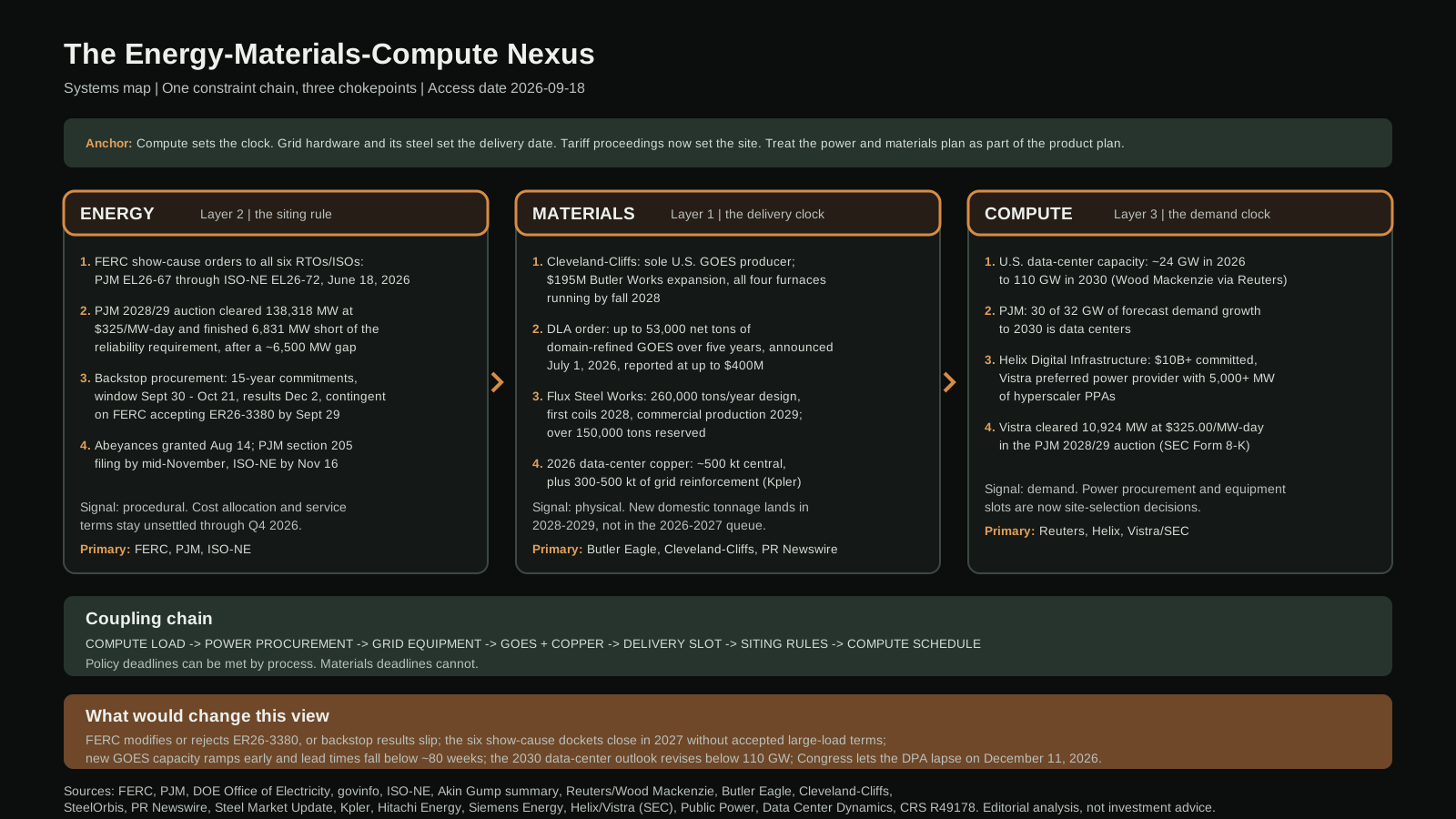
Atomic answer
The energy-materials-compute nexus is one constraint chain with three price signals. Compute sets the clock: U.S. data-center capacity is projected to grow from roughly 24 GW in 2026 to 110 GW in 2030, and PJM attributes 30 of its 32 GW of forecast demand growth through 2030 to data centers. Grid hardware sets the delivery date: generator step-up transformer lead times passed 160 weeks in Q1 2026, and domestic GOES for transformer cores has one producer. Tariff proceedings set the site: FERC's June 18, 2026 show-cause orders require all six RTOs and ISOs to justify or reform large-load rules, and PJM's 2028/2029 capacity auction cleared 6,831 MW short of its reliability requirement.
Who is this for?
Three operators, one decision: the AI infrastructure founder or developer whose schedule depends on a power date you do not control; the grid-hardware or materials operator deciding whether new capacity is financeable; and the allocator underwriting either one. The diligence question has shifted from "is there demand" to "can this site be powered, on what date, and who pays for the upgrades." If your model treats power procurement as a facilities line item rather than a schedule risk, the 2026 record is the correction. (Analytical)
How do energy, materials, and compute couple?
Compute demand into energy. Data centers are now the marginal new load in the largest U.S. power market. PJM's August 13, 2026 large-load filing states that of 32 gigawatts of forecast demand growth between 2024 and 2030, 30 gigawatts is data centers. (Public Power, 2026-08-14; Mixed, trade press summarizing the filing.) That figure is now the planning basis for capacity procurement, not a scenario on the side.
Energy into materials. Serving that load requires transformers, circuit breakers, switchgear, conductors, and substations, all competing for the same upstream inputs, chiefly grain-oriented electrical steel (GOES) and copper. When equipment lead times stretch past three years, the binding constraint has moved from the factory floor to the steel mill. (Analytical; the steel-to-transformer link is analyzed in the published Upstream Bottlenecks piece.)
Materials into compute. A campus cannot earn revenue until equipment arrives and interconnection is energized, so materials dates and tariff outcomes propagate into capacity schedules. The 2026 evidence is that both are being priced at the front end, through equipment ordered years ahead and power procurement signed before construction. (Analytical)
The asymmetry is the point: a regulatory deadline can be met by filing, and capacity can be bought at auction, but a new GOES line cannot be commissioned faster than its construction schedule allows.
Why is the tariff proceeding now a siting rule?
On June 18, 2026, FERC issued tailored show-cause orders under section 206 of the Federal Power Act to each of the six regional grid operators under its jurisdiction: PJM (EL26-67), SPP (EL26-68), NYISO (EL26-69), MISO (EL26-70), CAISO (EL26-71), and ISO-NE (EL26-72). Each RTO/ISO and its transmission owners have 60 days to justify existing tariffs or file reforms in five categories: application and study processes, cost-shifting prevention and transparency, co-location and behind-the-meter clarity, new services for flexible large loads, and a process for generation serving electrically proximate loads. (FERC, 2026-06-18; Primary.)
The orders treat a large load as a new commercial or industrial customer with peak load of 50 MW or greater connected above 69 kV. (Akin Gump, 2026-06-18; Mixed, law-firm summary.) If your campus crosses that line, the tariff proceeding is your siting process until FERC says otherwise.
FERC granted 90-day abeyances on August 14, 2026, moving responses to November 16, 2026; PJM intends to file under section 205 by early to mid November and ISO-NE by November 16. (ISO-NE, accessed 2026-09-18, Primary; PJM abeyance motion, 2026-07-28, Primary.) Until those filings are accepted, interconnection service terms and cost allocation remain unsettled, and speculative queue positions should not be underwritten as firm.
Two market signals ran alongside the docket. PJM's 2028/2029 Base Residual Auction cleared 138,318 MW of unforced capacity at the $325 per MW-day cap and still finished 6,831 MW short of the one-event-in-10-year reliability standard, after a roughly 6,500 MW shortfall in the prior auction. (PJM, 2026-07-14; Primary.) PJM then proposed a Reliability Backstop Procurement: initial target of 6,831 MW, 15-year commitments, a proposed offer window of September 30 to October 21, 2026, results by December 2, contingent on FERC accepting Docket ER26-3380 by September 29. (PJM fact sheet; Primary.) PJM also filed an Interim Resource Adequacy Service framework on August 13, 2026 for large loads that do not bring their own supply, consistent with the administration's Ratepayer Protection Pledge: build, bring, or buy. (Public Power, 2026-08-14; Mixed.) FERC separately approved a PJM fast-track interconnection track in June 2026 for up to ten large generation projects a year, at least 250 MW each and online within three years. (Data Center Dynamics, 2026-06-11; Mixed.)
Why does the materials leg set the delivery clock?
Transformer delivery is the clearest transmission channel from energy demand into materials, and lead times are the signal. DOE's Office of Electricity states that critical grid equipment faces lead times of two or more years and that some transformers have seen price increases of four to nine times over five years. (DOE, 2026-08-10; Primary.) Wood Mackenzie data reported by Reuters put generator step-up transformer lead times above 160 weeks in the first quarter of 2026, versus a 143-week average in 2024. (Reuters, 2026-07-09; Primary reporting of consultancy data.) Analysts cited by Energy-Storage.news describe large units stretching as long as four years. (Energy-Storage.news, 2026-05-12; Secondary, low confidence.) We hold the widely circulated 128-week figure; the sourced range is what this article uses.
The upstream input is GOES. Cleveland-Cliffs is the only U.S. producer, and in April 2026 its Butler Works expansion received final local approval: a $195 million project adding four induction reheat furnaces, with the first unit expected at the end of 2027 and all four running by fall 2028. (Butler Eagle, 2026-04-20; Primary reporting; Cleveland-Cliffs, accessed 2026-09-18; Primary company disclosure.)
The Defense Logistics Agency has also contracted the steel directly: a fixed-price, five-year order for up to 53,000 net tons of domain-refined GOES for national security storage, announced July 1, 2026 and reported by trade press at up to $400 million. (Cleveland-Cliffs Q2 2026 earnings presentation, accessed 2026-09-18, Primary; SteelOrbis, 2026-07-01, Secondary.)
New capacity is coming on a 2029 clock. On September 15, 2026, Flux Steel Works announced it will renovate the former ATI specialty steel plant in Louisville, Ohio, into a GOES mill designed for more than 260,000 tons per year, with first coils in 2028 and commercial production in 2029; the company reports reservations for more than 150,000 tons. (PR Newswire, 2026-09-15, Primary company release; Steel Market Update, 2026-09-17, Secondary.) Even on schedule, the first meaningful new domestic tonnage arrives at the end of the decade, not in the 2026-2027 window when the current queue of projects needs equipment.
Copper is the second material leg, and it is a marginal-tonne story rather than a shortage story. Kpler estimates that 2026 data-center construction embeds roughly 300,000 to 700,000 tonnes of copper, central near 500,000 tonnes, plus 300,000 to 500,000 tonnes of grid reinforcement; against global refined consumption near 28.7 million tonnes growing about 1.6 percent, construction alone absorbs roughly the entire year's growth in global consumption. (Kpler, 2026-07-17; Mixed.) Wood Mackenzie's reading is that the metals story is a grid story: facility-boundary power systems roughly double the metals intensity of the building, and annual capacity additions rise from about 15 to 20 gigawatts today toward 30 to 33 gigawatts in the early 2030s. (Wood Mackenzie, 2026-06-16; Mixed.)
Policy is responding on both fronts. DOE plans a program worth up to $375 million to rebuild the domestic grid-equipment supply chain, targeting refurbishment and reuse, equipment standardization, and next-generation power electronics such as solid-state transformers, with anticipated outcomes of up to a 10 percent reduction in imports and lead times and up to 25 percent lower utility spending. (DOE, 2026-08-10; Primary.) The April 20, 2026 presidential determination under section 303 of the Defense Production Act names grid infrastructure and electrical core steel as essential to national defense, the legal hook for that push. (Federal Register, 2026-04-23; Primary.) The caveat: most DPA authorities expire on December 11, 2026 (extended by P.L. 119-103, signed September 2, 2026), and the DPA Modernization Act of 2026 (H.R. 7688) would extend them five years to 2031. (CRS R49178, 2026-08-13; Primary.) The policy anchor is real but not permanent.
Equipment makers are adding capacity in parallel: Hitachi Energy broke ground in June 2026 on a $457 million expansion of its South Boston, Virginia transformer campus, and Siemens Energy broke ground on a $300 million switchgear factory in Pearl, Mississippi, part of a $1 billion U.S. program announced February 3, 2026. (Hitachi Energy, 2026-06-29; Primary; Siemens Energy, 2026-07-17; Primary.) These are 2027-2029 additions. They do not compete with the 2026-2027 order book.
Why is power procurement now a product decision?
The demand side has already repriced its strategy. U.S. data-center capacity is forecast to reach 110 gigawatts in 2030 from around 24 gigawatts in 2026, according to Wood Mackenzie's analysis reported by Reuters. (Reuters, 2026-07-09; Primary reporting of consultancy projections.)
Capital is structuring around that constraint. KKR, the Kuwait Investment Authority, NVIDIA, and Vistra launched Helix Digital Infrastructure in June 2026 with more than $10 billion in committed long-duration capital, naming Vistra as preferred power provider; Vistra states it has contracted more than 5,000 MW of power purchase agreements with hyperscalers. (Helix Digital Infrastructure, 2026-06-11; Primary.) Vistra separately disclosed that it cleared 10,924 MW in PJM's 2028/2029 auction at a weighted average clearing price of $325.00 per MW-day. (Vistra 8-K, 2026-07-14; Primary SEC filing.)
The power supply contracts that underwrite compute are lengthening. AWS and Talen Energy signed a 17-year PPA for 1.92 GW from the Susquehanna nuclear plant, and Constellation signed a 20-year agreement to supply Meta with 1.1 GW from its Clinton, Illinois plant. (Data Center Dynamics, accessed 2026-09-18; Mixed, trade press.) Long-dated offtake is how compute projects buy certainty against clocks they do not control. Eaton's second-quarter 2026 results put its Electrical sector backlog up 43 percent year over year, before most announced 2027-2029 capacity comes online. (Eaton Exhibit 99, 2026-07-31; Primary SEC filing.)
For an AI founder, site selection, procurement timing, and offtake structure are now product decisions. A campus with a power contract but no equipment slot is not de-risked; it is waiting in the same queue as everyone else. (Analytical)
Where does the chain bind first?
By horizon, the binding point moves. Through the end of 2026, the constraint is procedural: the show-cause dockets, the backstop schedule, and the section 205 filings determine what interconnection and cost-allocation terms a large load can sign. (Analytical) From 2027 through 2029, it is physical: transformer and switchgear factories and the GOES and copper feeding them set the delivery date, and new domestic GOES capacity arrives only in 2028-2029. (Analytical) After 2029, it is uncertain: if announced capacity lands and demand tracks the forecasts, the chain eases; if not, the bottleneck reappears further upstream. (Analytical)
One asymmetry is durable. Tariff rules can be rewritten in a filing cycle and capacity bought at auction, but a steel line cannot be willed into production on a policy timeline. The materials leg deserves the earliest attention even though the energy leg is loudest.
What would change this view
- FERC modifies or rejects ER26-3380, or the backstop schedule slips. The proposed window is September 30 to October 21, 2026 with results by December 2, contingent on an order by September 29. A rejection, a material modification, or slippage past the 2029/2030 Base Residual Auction would leave the 6,831 MW gap open and put more siting pressure on cost-allocation outcomes.
- The six show-cause dockets close in 2027 without accepted large-load tariff provisions. If FERC accepts filings in only some regions, or accepts terms that leave cost allocation unresolved, the nexus shifts back toward equipment scarcity and away from regulatory gating.
- New GOES capacity ramps earlier than announced. If Flux Steel Works pulls first coils materially ahead of 2028, or the Cleveland-Cliffs expansion completes ahead of fall 2028, and large-power-transformer lead times fall below roughly 80 weeks, the materials leg is loosening.
- The data-center demand forecast revises down. If the 2030 U.S. capacity outlook falls materially below 110 GW, or PJM stops assigning most demand growth to data centers, the forcing function weakens first and the materials queue shortens later.
- Congress extends the DPA before December 11, 2026 (extended by P.L. 119-103, signed September 2, 2026), or allows a lapse. An extension supports the grid supply-chain program; a lapse would remove the policy anchor behind the April 2026 determination.
FAQ
Q: Is this just the transformer shortage story with new labels? A: No. The transformer shortage is the delivery mechanism. The nexus argument is that three systems price the same project at once: tariff proceedings decide whether a large load can interconnect, materials capacity decides when equipment arrives, and compute demand decides how long the window stays open. The published Upstream Bottlenecks piece covers the steel-to-transformer link; this piece covers the coupling.
Q: Does new domestic GOES capacity fix the problem before 2030? A: Not before 2028-2029 at the earliest. Cleveland-Cliffs targets all four furnaces by fall 2028, and Flux Steel Works targets first coils in 2028 and commercial production in 2029. The 2026-2027 queue is served from existing capacity; new lines change the 2029-2030 picture.
Q: Is copper or electrical steel the binding material? A: For transformers and switchgear, electrical steel is the tighter single input: one U.S. GOES producer, with new capacity arriving at the end of the decade. Copper is tight on the margin rather than in absolute terms, but the marginal tonne sets the price, and data-center construction is absorbing roughly the equivalent of the entire 2026 growth in global refined copper consumption. Both matter; the steel gate is narrower. (Mixed)
Q: What should a founder or investor do with this view? A: Treat the power and materials delivery plan as a diligence item equal to the compute plan: confirm an equipment slot with a dated delivery, confirm the interconnection service structure against the current docket, and model the revenue start against the materials schedule rather than construction. (Analytical)
Sources
- FERC news release, show-cause orders to six RTOs/ISOs, docket numbers, 60-day timeline, five reform categories: ferc.gov (2026-06-18, accessed 2026-09-18). Primary.
- FERC June 2026 meeting summaries, docket list E-7 through E-12: ferc.gov (2026-06-18, accessed 2026-09-18). Primary.
- Akin Gump, show-cause order analysis including the 50 MW and 69 kV large-load definition: akingump.com (2026-06-18, accessed 2026-09-18). Mixed, law-firm summary.
- ISO-NE Large Loads Integration key project page, August 14, 2026 abeyance grant and November 16, 2026 section 205 filing date: iso-ne.com (accessed 2026-09-18). Primary.
- PJM motion to hold Docket EL26-67 in abeyance and planned section 205 filing (filed July 28, 2026): pjm.com PDF (2026-07-28, accessed 2026-09-18). Primary.
- PJM news release, 2028/2029 Base Residual Auction: 138,318 MW cleared, $16.4 billion, 6,831 MW short, $325/MW-day cap, prior auction shortfall about 6,500 MW: pjm.com (2026-07-14, accessed 2026-09-18). Primary.
- PJM Reliability Backstop Procurement fact sheet, 15-year commitments, proposed offer window September 30 to October 21, 2026, results December 2: pjm.com (updated July 2026, accessed 2026-09-18). Primary.
- PJM Board decision, CIFP Reliability Backstop Procurement, target 6,831 MW and cost allocation: pjm.com (2026-07-27, accessed 2026-09-18). Primary.
- Federal Register combined notice, ER26-3380 effective date September 29, 2026, filed July 31, 2026: federalregister.gov (2026-08-06, accessed 2026-09-18). Primary.
- Public Power, PJM Interim Resource Adequacy Service filing and the 30 of 32 GW data-center growth figure: publicpower.org (2026-08-14, accessed 2026-09-18). Mixed, trade press summarizing the filing.
- Data Center Dynamics, FERC-approved PJM fast-track interconnection: up to ten projects per year, at least 250 MW, online within three years, through end of 2027: datacenterdynamics.com (2026-06-11, accessed 2026-09-18). Mixed, trade press.
- DOE Office of Electricity, "Strengthening America's Grid Supply Chain": $375 million program, two-year-plus lead times, four-to-nine-times price increases, up to 10 percent lead-time and up to 25 percent utility-spending outcomes: energy.gov (2026-08-10, accessed 2026-09-18). Primary.
- Presidential Determination No. 2026-10 (DPA section 303), grid infrastructure, transformers, and electrical core steel: govinfo.gov (2026-04-23, accessed 2026-09-18). Primary.
- CRS R49178, DPA Modernization Act of 2026 overview; most DPA authorities sunset December 11, 2026 (extended by P.L. 119-103, signed September 2, 2026); H.R. 7688 would extend to 2031: congress.gov (2026-08-13, accessed 2026-09-18). Primary.
- Reuters, U.S. power companies scramble for equipment; Wood Mackenzie data on generator step-up transformer lead times above 160 weeks in Q1 2026 and circuit breakers at 125 weeks; U.S. data-center capacity to 110 GW in 2030 from about 24 GW: reuters.com (2026-07-09, accessed 2026-09-18). Primary reporting of consultancy data.
- Energy-Storage.news, transformer lead times as long as four years per PwC analysts: ess-news.com (2026-05-12, accessed 2026-09-18). Secondary, low confidence; used for range context only.
- Butler Eagle, Cleveland-Cliffs $195 million Butler Works expansion approval, four induction reheat furnaces, first unit end of 2027, all four by fall 2028: butlereagle.com (2026-04-20, accessed 2026-09-18). Primary reporting.
- Cleveland-Cliffs, Butler Works operations page, sole U.S. producer of grain-oriented electrical steel and high-permeability TRAN-COR: clevelandcliffs.com (accessed 2026-09-18). Primary company disclosure.
- Cleveland-Cliffs, second-quarter 2026 earnings presentation, DLA fixed-price contract, five-year ordering period, up to 53,000 net tons of domain-refined GOES for national security storage: clevelandcliffs.com PDF (accessed 2026-09-18). Primary company disclosure.
- SteelOrbis, Cleveland-Cliffs DLA award reported at up to $400 million, announced July 1, 2026: steelorbis.com (2026-07-01, accessed 2026-09-18). Secondary trade press; value described as up to.
- PR Newswire, Flux Steel Works secures former ATI plant in Louisville, Ohio: more than 260,000 tons per year design, first coils 2028, commercial production 2029, more than 150,000 tons reserved, more than 200 jobs: prnewswire.com (2026-09-15, accessed 2026-09-18). Primary company release.
- Steel Market Update, Flux Steel Works GOES plans and team: steelmarketupdate.com (2026-09-17, accessed 2026-09-18). Secondary trade press.
- Kpler, data-center copper intensity and 2026 estimates: roughly 300,000 to 700,000 tonnes central near 500,000 tonnes, plus 300,000 to 500,000 tonnes of grid reinforcement, against about 28.7 million tonnes of global refined consumption growing about 1.6 percent: kpler.com (2026-07-17, accessed 2026-09-18). Mixed, consultancy analysis.
- Wood Mackenzie, data-center metals demand as a grid story; facility-boundary power systems roughly double metals intensity; annual capacity additions 15 to 20 GW today toward 30 to 33 GW in the early 2030s: woodmac.com (2026-06-16, accessed 2026-09-18). Mixed, consultancy analysis.
- Hitachi Energy, $457 million South Boston, Virginia large-power-transformer expansion, about 825 jobs: hitachienergy.com (2026-06-29, accessed 2026-09-18). Primary.
- Siemens Energy, $300 million Pearl, Mississippi switchgear factory and $1 billion U.S. manufacturing program: siemens-energy.com (2026-07-17, accessed 2026-09-18). Primary.
- Siemens Energy, $1 billion U.S. manufacturing investment including North Carolina transformer capacity: siemens-energy.com (2026-02-03, accessed 2026-09-18). Primary.
- Helix Digital Infrastructure, KKR launch with Kuwait Investment Authority, NVIDIA, and Vistra; more than $10 billion in long-duration commitments; Vistra preferred power provider with more than 5,000 MW of hyperscaler PPAs: helixdi.com (2026-06-11, accessed 2026-09-18). Primary.
- Vistra Corp. Form 8-K, 10,924 MW cleared at $325.00 per MW-day in the PJM 2028/2029 auction: sec.gov (2026-07-14, accessed 2026-09-18). Primary SEC filing.
- Data Center Dynamics, AWS-Talen 17-year PPA for 1.92 GW from Susquehanna and Constellation-Meta 20-year agreement for 1.1 GW from Clinton: datacenterdynamics.com (accessed 2026-09-18). Mixed, trade press.
- Eaton Corporation Exhibit 99, second-quarter 2026 results, Electrical sector backlog up 43 percent year over year: sec.gov (2026-07-31, accessed 2026-09-18). Primary SEC filing.
- Stack & State, "Upstream Bottlenecks: Electrical Steel, Quantum, and Grid", published companion analysis of the steel-to-transformer link: stackandstate.com (updated 2026-08-02, accessed 2026-09-18). Site analysis.
- Companion visual, "The Energy-Materials-Compute Nexus": energy-materials-compute-nexus.svg (accessed 2026-09-18). Site asset.

Methodology
This article follows the Bottleneck Map method. The primary constraint is assigned to Layer 2, Energy & Power, because the gating mechanism in the 2026 record is the tariff proceeding and capacity process that decide whether and how a large load can be served; Layer 1 (Materials & Processing) appears as the delivery clock through grain-oriented electrical steel and copper, and Layer 3 (Compute & AI Infrastructure) as the demand clock. The nexus is the claim that these three clocks now price the same project simultaneously; the companion visual maps the coupling chain and the 2026 signals behind it.
Every claim carries a source-confidence label: Primary where a named institutional source, company disclosure, docket record, or SEC filing is cited inline; Mixed where trade press or consultancy analysis is combined with editorial interpretation; Analytical where the claim reflects Stack & State judgment across sources. The held claims are recorded rather than asserted: the 128-week large-power-transformer figure (the sourced range is DOE's two or more years, Wood Mackenzie's above 160 weeks, and PwC's four years); the claim that 80 percent of U.S. large power transformers rely on foreign imports of finished units (the sources describe component and material dependence, not a verified finished-unit share); the $45 billion private-credit figure once attributed to the Helix launch (the reviewed announcement documents more than $10 billion); and the claim that FERC requires proof of transformer delivery contracts before queue positions (the orders describe five reform categories, not a hardware procurement precondition). No bracketed placeholders remain in this draft.
Research cutoff and access date for all sources: 2026-09-18. Corrections: /connect/.
Stack & State is an editorial and ecosystem-intelligence publication. Nothing here is legal, investment, procurement, or compliance advice. Program details change; verify requirements with primary sources and qualified advisors.