Energy, Power & Critical-Minerals Supply Chain
The Gallium Freeze: Export Controls Meet the Waiver Economy
China's suspension of its gallium ban runs to November 27, 2026, yet Western prices are 9 to 10 times 2023 levels and U.S.-bound flows never resumed. The binding variable is administrative throughput: Chinese licenses, U.S. exemption clauses, and the 10 U.S.C. 4872 waivers that Washington is about to restrict.
Atomic answer
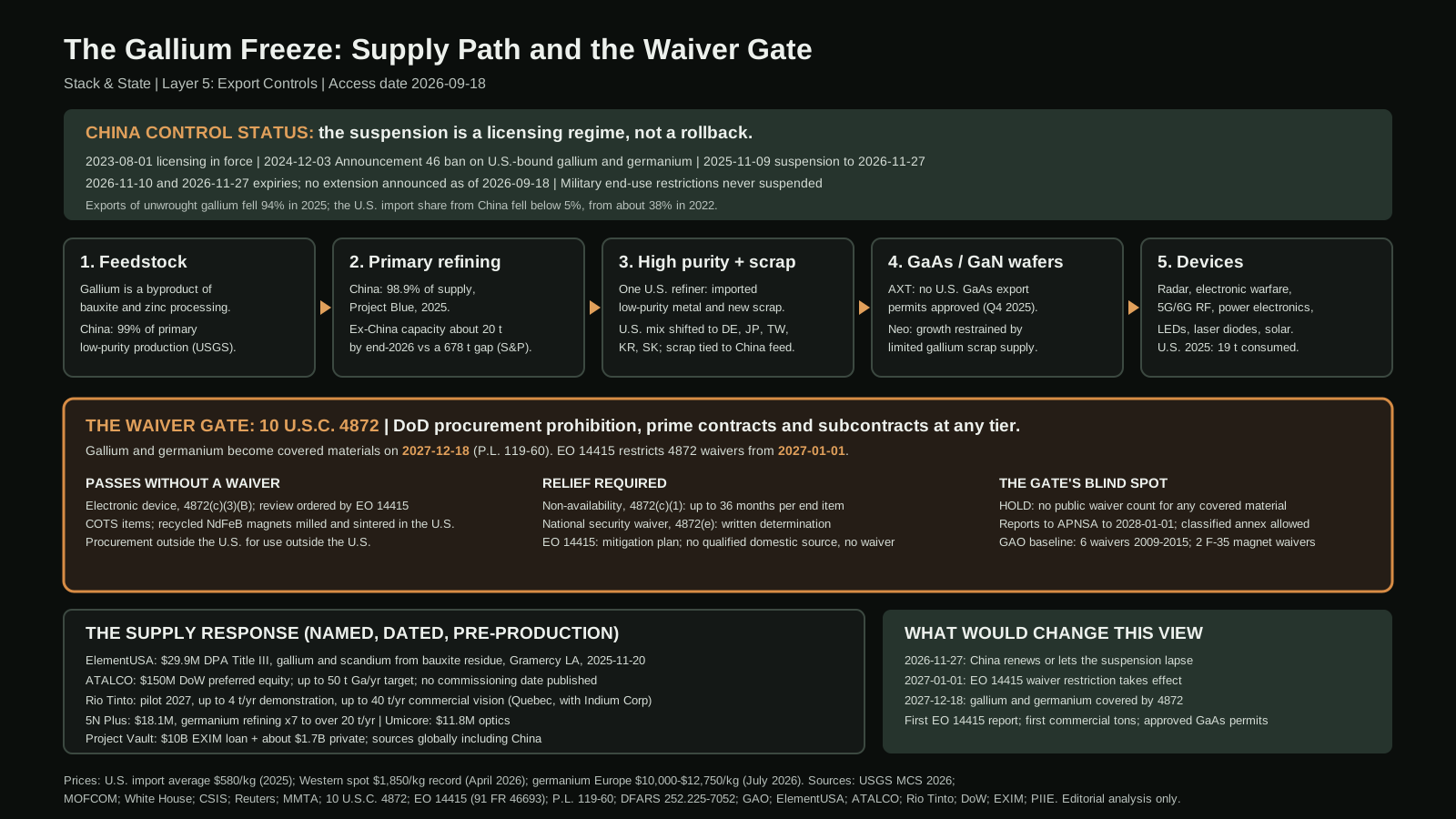
Gallium is not geologically scarce and the United States consumes about 19 metric tons per year. The freeze is administrative. China produces 99 percent of the world's primary low-purity gallium and has licensed exports since 2023-08-01; the November 2025 suspension that runs to 2026-11-27 removed a ban without restoring throughput, and Chinese exports of unwrought gallium fell 94 percent in 2025. On the American side, the gate that will decide how much Chinese-origin gallium can enter defense supply chains is 10 U.S.C. 4872, which the FY2026 NDAA extended to gallium and germanium effective 2027-12-18, and whose non-availability and national security waivers Executive Order 14415 restricted from 2027-01-01. The policy variable is not the ban but waiver and exemption throughput, and no public count of either exists. Source confidence: Primary for statutes, dates, and USGS data; Mixed for prices and trade flows carried through secondary sources; Analytical for the throughput thesis. A buyer reading headlines sees a thaw. A buyer reading the record sees a queue. The suspension is real, licensing is still the gate, and Western prices rose after the "de facto removal of controls" the White House announced in November 2025.
Who is this for?
This article is for the founder or supply chain lead whose product contains a GaAs or GaN device: defense radar and electronic warfare, 5G and 6G RF, power electronics, LEDs, laser diodes, infrared and solar products. It is also for the allocator underwriting gallium or germanium capacity and the programs officer whose supply plan depends on a waiver that may not survive 2027.
The decision is the same for all three: assume the material flows only if an administrative gate opens, and map the gate your product uses.
The controls are not the constraint. The licenses are.
China's gallium controls have moved through five published steps, each of which preserved the licensing apparatus underneath:
- 2023-07-03: MOFCOM announces export licensing for gallium and germanium, effective 2023-08-01. Every shipment needs a permit, and applicants disclose end users and end uses. (MOFCOM announcement, 2023, accessed 2026-09-18.)
- 2024-12-03: Announcement No. 46 imposes a presumption-of-denial ban on gallium, germanium, antimony, and superhard material exports to the United States, and tightens graphite review. (MOFCOM announcement, 2024, accessed 2026-09-18.)
- 2025-10-09: the October announcements (Nos. 55 through 62) add extraterritorial reach and technology controls.
- 2025-11-09: Announcement No. 72 suspends Article 2 of the 2024 announcement through 2026-11-27, restoring ordinary licensing review for U.S. civilian users but not the pre-2023 status quo. (MOFCOM announcement, 2025, accessed 2026-09-18; corroborated by Reuters, 2025-11-09.)
- 2026-11-10: the suspension of the October 2025 controls (Nos. 55 through 62) lapses; 2026-11-27: the suspension of Article 2 of the 2024 U.S.-targeted ban lapses. No extension of either was announced as of 2026-09-18. (CSIS, 2026-05-11, accessed 2026-09-18.)
The military end-use restrictions were never suspended. The White House described the deal as "the de facto removal of controls China imposed since 2023," while the Chinese instruments kept the base licensing regime, end-user documentation, and defense exclusions. (White House fact sheet, November 2025; CSIS, 2026-05-11, both accessed 2026-09-18.) Source confidence: Primary for the instruments and dates; Mixed for the fact-sheet characterization.
The observable consequence is that license throughput, not the headline ban, sets the flow. AXT, a major GaAs substrate producer, disclosed in its Q4 2025 earnings that while it generally receives permits for Asia and Europe, "no permits for the export of gallium arsenide to the U.S. have yet been approved" for its U.S. customers. Neo Performance Materials, the primary North American supplier, reported that growth "is restrained by limited gallium scrap supply" despite strong demand. (AXT Q4 2025 earnings; Neo Performance Materials Q4 2025 MD&A; both cited via CSIS, 2026-05-11.) Source confidence: Mixed (company documents quoted and linked through CSIS; this run did not open the filings directly).
What the price spread says about the gate
Prices separate the physical market from the administrative one. U.S. Customs data show the average unit value of imported gallium metal at an estimated $580 per kilogram in 2025, up about 30 percent from $439 in 2024 and roughly double the $277 average in 2021, the last full pre-control year. Western spot reached a record $1,850 per kilogram in April 2026, more than 200 percent above the start of 2025, while prices inside China held steady, producing a two-price market. (USGS Mineral Commodity Summaries 2026, gallium, published February 2026, accessed 2026-09-18; CSIS, 2026-05-11, citing Fastmarkets.) Source confidence: Primary for the USGS customs series; Mixed for the Fastmarkets spot print, which is paywalled and cited through CSIS.
Germanium shows the same pattern. The USGS 2025 annual average for germanium metal was $4,100 per kilogram, up 106 percent year over year. By July 2026, the Fastmarkets European monthly average was $10,000 to $12,750 per kilogram, approximately 8.5 times the June 2023 level. (USGS Mineral Commodity Summaries 2026, germanium, February 2026; MMTA, 2026-08-21, accessed 2026-09-18.) Source confidence: Primary for USGS; Mixed for the Fastmarkets monthly average carried through MMTA.
Flows confirm that relief did not clear the gate. China's exports of unwrought gallium fell 94 percent in 2025 and had not recovered in early 2026; U.S.-bound shipments effectively disappeared, with a single shipment of roughly 3 kilograms in July 2025. The U.S. import mix shifted to Germany, Japan, Taiwan, South Korea, and Slovakia, none of which mine primary gallium, a pattern consistent with recycled scrap ultimately derived from Chinese feedstock. (CSIS, 2026-05-11.) Reuters has separately reported mislabeling and third-country routing, which is what a large price wedge produces. (Reuters, 2025-07-09, accessed 2026-09-18.) Source confidence: Mixed (customs-data analysis and a single evasion report; both are consistent with, but do not prove, the recycling-nexus read).
The American gate: 10 U.S.C. 4872 and the waiver economy
The U.S. restriction that matters is not an import control. It is a procurement prohibition. Section 4872 bars the Secretary of War from procuring a covered material melted or produced in a covered nation, or an end item containing one, at any contract tier. Covered nations are China, Russia, Iran, and North Korea. (10 U.S.C. 4872, Office of the Law Revision Counsel, accessed 2026-09-18.) Source confidence: Primary.
Crucially, gallium and germanium were not covered materials until the FY2026 NDAA. Public Law 119-60, signed 2025-12-18, added molybdenum, gallium, and germanium to the definition, with the gallium and germanium restrictions effective 2027-12-18. (Pillsbury Winthrop Shaw Pittman, 2026-02-27; amendment note in 10 U.S.C. 4872.) The implementing DFARS clause, 252.225-7052, escalates on 2027-01-01 to a mined, refined, separated, melted, or produced test for the materials covered today. (48 CFR 252.225-7052, eCFR, up to date as of 2026-09-16, accessed 2026-09-18.) Source confidence: Primary.
That means the gallium restriction arrives just as the relief around it tightens. Executive Order 14415, signed 2026-07-20, orders the Department of War to stop issuing 4872(c)(1) non-availability waivers on 2027-01-01 unless a contractor submits an accepted mitigation plan identifying the non-compliant source, documenting exhaustive efforts to buy compliant material, and committing to a removal timeline. National security waivers under 4872(e) face the same condition or a National Security Council request. The order also requires a review of the electronic-device exemption and semiannual reports to the Assistant to the President for National Security Affairs through 2028-01-01, including "any continued use of waivers" and "the number of mitigation plans accepted," with a classified annex permitted. (Executive Order 14415, 91 FR 46693, published 2026-07-23, accessed 2026-09-18.) Source confidence: Primary.
The exemption structure matters more than the waivers. Section 4872(c)(3)(B) excepts an electronic device from the prohibition unless the Secretary makes a criticality determination. A GaN radar module or a GaAs RF front end can therefore reach a defense program as an electronic device even after gallium becomes a covered material. The same subsection excepts commercial off-the-shelf items and NdFeB magnets made from recycled material milled and sintered in the United States; non-availability relief runs up to 36 months per determination. (10 U.S.C. 4872(c), accessed 2026-09-18.) Source confidence: Primary for the statutory text; Analytical for the reading that electronic devices are the main channel through which gallium-bearing parts can lawfully continue to enter DoD supply chains.
Two facts keep this from being measurable. DFARS non-availability determinations are filed by contracting activity and by class, with class notices posted on SAM.gov, but there is no published running count. The historical baseline is also thin and old: GAO found six national security waivers for noncompliant specialty metals between 2009 and 2015, five for samarium-cobalt magnets, and its July 2025 industrial-base review documented two more tied to Chinese magnets found in the F-35 supply chain. (GAO-15-133, 2014-12; GAO-25-107283, 2025-07-24, both accessed 2026-09-18.) Source confidence: Primary for the GAO findings; Mixed as a proxy for 4872 activity, because that waiver authority sits at 10 U.S.C. 4863.
Hold: no public aggregate count of 4872(c)(1) or (e) waivers exists for any covered material, and none can exist yet for gallium because it is not a covered material until 2027-12-18. The EO 14415 reports go to the White House with a classified-annex option, so waiver throughput may never be fully public. The thesis therefore rests on the structure of the relief, not a count, and should be re-scored if the first semiannual report is published.
The stockpile buys through the same gate
The supply response is real but still pre-production. The Department of War awarded ElementUSA $29.9 million in DPA Title III funds on 2025-11-20 for a Gramercy, Louisiana demonstration facility that would extract gallium and scandium from bauxite residue. (ElementUSA; DoW announcement via Mirage News, 2025-11-20, accessed 2026-09-18.) Source confidence: Primary for the award; the department's broader award-count context mixes fiscal years and is held as reported, not audited.
In January 2026, Atlantic Alumina announced a $450 million partnership to keep the country's only operating alumina refinery running and build what it calls the first large-scale primary gallium circuit, in Gramercy, targeting up to 50 metric tons per year. The Department of War contributed $150 million of preferred equity and Pinnacle's fund invested more than $300 million. (Atlantic Alumina via Business Wire, 2026-01-12, accessed 2026-09-18.) Hold: 50 tons per year against U.S. consumption near 19 tons is a nameplate ambition, and no commissioning date was published.
Rio Tinto, with Indium Corporation, extracted first gallium from its Quebec alumina process in May 2025 and is building a pilot plant expected to operate in 2027, with a demonstration capacity of up to 4 tons per year and a commercial vision near 40 tons. On germanium, the DoW invested $18.1 million in 5N Plus to expand refining in Utah sevenfold to more than 20 tons annually and $11.8 million in Umicore for optical materials in Oklahoma. (Rio Tinto, 2026-03-02; DoW release 4393075; DoW release 4410424, all accessed 2026-09-18; release 4393075 returned HTTP 403 to automated access.)
Project Vault, the $10 billion Export-Import Bank loan plus roughly $1.7 billion in private preferred equity announced 2026-02-02, is the demand-side instrument. It will buy and hold minerals for civilian manufacturers through VaultCo, a private entity managed with Hartree, Traxys, and Mercuria, and officials have said it will source globally, including from China, because alternative supply does not yet exist at volume. PIIE names gallium and germanium as priorities and warns that China can throttle accumulation. (EXIM; PIIE policy brief 26-8, May 2026; Columbia Energy Policy, 2026-06-01, all accessed 2026-09-18.) Source confidence: Primary for the loan and structure; Mixed for sourcing intentions, which had not been detailed publicly as of the sources captured.
The physical gap is large. S&P Global estimates ex-China gallium supply capacity at about 20 tons by the end of 2026 against a supply gap near 678 tons, rising to roughly 386 tons by 2030 and still leaving 65 percent of ex-China demand dependent on China. Germanium refining capacity outside China is projected at 126 tons by 2030, about 48 percent of ex-China demand. (Reuters, syndicated by SRN News, 2026-09-18, accessed 2026-09-18.) Source confidence: Mixed (consultancy estimates carried through a news wire on the access date).
What would change this view
- Renewal or lapse at the expiries. An extension of the 2026-11-27 suspension keeps the licensing gate; a lapse makes the quota and end-use filters explicit. Watch license approvals, not announcements.
- Waiver transparency. Publication of the EO 14415 reports, a congressional release, or a SAM.gov class non-availability determination for gallium-bearing devices would convert the thesis from structure to count.
- The coverage date arrives unhedged. If 2027-12-18 passes with no funded non-Chinese output and no accepted mitigation plans, the exemption carries the entire load.
- First commercial tons and permits. Salable gallium from ATALCO, ElementUSA, or Rio Tinto with an offtake attached, or approved U.S. GaAs permits at a supplier, would show the gate opening.
Last editorially reviewed: 2026-09-18.
FAQ
Q: China suspended its gallium ban. Why are prices still seven to ten times 2023 levels? A: Because the suspension restored a licensing channel, not a market. The 2023 permit requirements, end-user documentation, and the military end-use exclusion remain in force, and approvals for U.S. dual-use customers have not returned. Exports of unwrought gallium fell 94 percent in 2025 and U.S.-bound flows effectively stopped, so the price still carries an administrative premium. On the ratio: S&P Global's 2026 market report puts ex-China prices near $2,100 per kilogram against about $300 in China, a spread of roughly seven times, while the September 2026 trade-press comparison runs at nine to ten times 2023 levels (CSIS, 2026-05-11; Reuters via SRN, 2026-09-18; S&P Global gallium market report, August 2026, captured via Metal Tech News). Source confidence: Mixed.
Q: Does 10 U.S.C. 4872 restrict gallium today? A: No. The FY2026 NDAA added gallium and germanium to the covered-material definition, but the restrictions take effect 2027-12-18, so the statute does not yet bar DoD procurement of Chinese-origin gallium. What applies now is EO 14415's supply-chain mapping and screening regime, plus the DFARS restrictions on magnets, tantalum, and tungsten. Source confidence: Primary.
Q: What is the electronic-device exemption and why is it the key waiver-economy provision? A: Section 4872(c)(3)(B) excepts an end item containing a covered material that is an electronic device, unless the Secretary of Defense makes a criticality determination on the recommendation of the Strategic and Critical Materials Board of Directors. Most gallium reaches a weapon system as GaAs or GaN electronics, so this exception, not a waiver, is the likely channel after 2027-12-18. EO 14415 section 2(f) orders a review of how it is being applied (EO 14415, 2026-07-20; 10 U.S.C. 4872). Source confidence: Primary for the statute and order; Analytical for the channel judgment.
Q: How is this different from the rare-earth bottleneck? A: Rare earths bottleneck at separation, magnets, qualification, and offtake; gallium bottlenecks at administrative throughput: a Chinese license queue, a small set of American exemption clauses, and waivers reportable only to the White House. Our China rare-earth controls article covers the first case. Source confidence: Analytical.
Sources
- U.S. Geological Survey, Mineral Commodity Summaries 2026, gallium (published February 2026; customs prices, consumption, import mix, stockpile, production shares): pubs.usgs.gov (accessed 2026-09-18). Primary.
- U.S. Geological Survey, Mineral Commodity Summaries 2026, germanium (prices, export volumes, import shifts): pubs.usgs.gov (accessed 2026-09-18). Primary.
- U.S. Geological Survey, Open-File Report 2024-1057, Quantifying potential effects of China's gallium and germanium export restrictions on the U.S. economy (modeled GDP exposure of $3.4 billion for a simultaneous complete restriction): pubs.usgs.gov (2024-10-15, accessed 2026-09-18). Primary, modeled scenario.
- MOFCOM gallium and germanium export licensing announcement (announced 2023-07-03, effective 2023-08-01): mofcom.gov.cn (accessed 2026-09-18; URL carried from CSIS). Primary instrument, cited via secondary link.
- MOFCOM Announcement No. 46 of 2024, U.S.-targeted controls including gallium and germanium (2024-12-03): mofcom.gov.cn (accessed 2026-09-18; URL carried from CSIS; the original link could not be independently corroborated). Primary instrument, cited through CSIS as intermediary.
- MOFCOM Announcement No. 72 of 2025, suspension of Article 2 of the 2024 announcement through 2026-11-27: mofcom.gov.cn (accessed 2026-09-18; URL carried from CSIS); corroborated by Reuters (2025-11-09). Primary.
- White House fact sheet, U.S.-China economic and trade deal including general licenses for gallium and germanium (November 2025): whitehouse.gov (accessed 2026-09-18). Primary policy document.
- CSIS, The U.S.-China Trade Truce Has Not Solved the Gallium Problem (customs flows, Fastmarkets record price, AXT and Neo disclosures, THAAD gallium intensity): csis.org (2026-05-11, accessed 2026-09-18). Credible analysis with linked primary documents.
- Reuters, China halts ban on gallium, germanium, antimony exports to U.S., but controls remain: reuters.com (2025-11-09, accessed 2026-09-18). Primary reporting.
- Reuters, Niche metals test West's resilience to Chinese export curbs (S&P Global and Project Blue capacity and demand estimates, the 9-10x 2023 price comparison, named projects): SRN News syndication (2026-09-18, accessed 2026-09-18). Credible press; underlying consultancy reports not directly verified.
- S&P Global, Critical Mineral Market Report: Gallium (2026 ex-China price near $2,100 per kilogram against about $300 in China, a spread of roughly seven times; structural cost of $620-$700 per kilogram; demand growth near 12 percent per year through 2030): spglobal.com PDF (published August 2026, accessed 2026-09-18; the PDF returned HTTP 403 to automated access and the figures were captured through Metal Tech News, 2026-08-12). Mixed: primary report captured through trade coverage.
- Reuters, How U.S. buyers bypass China's export ban (mislabeling and third-country routing): reuters.com (2025-07-09, accessed 2026-09-18). Single-source reporting.
- MMTA, AI and defence boost germanium demand and spark substitution risks (Fastmarkets July 2026 monthly average of $10,000-$12,750 per kilogram, 8.5x June 2023): mmta.co.uk (2026-08-21, accessed 2026-09-18). Trade association commentary citing Fastmarkets.
- 10 U.S.C. 4872, Acquisition of sensitive materials from non-allied foreign nations (prohibition, exceptions, waivers, definition, P.L. 119-60 amendment note): OLRC (laws in effect 2026-09-17, accessed 2026-09-18). Primary.
- Executive Order 14415, Securing America's Defense Supply Chains and Ensuring Domestic Acquisition of Critical Materials (91 FR 46693; waiver restriction from 2027-01-01, electronic-device exemption review, semiannual reports): Federal Register (signed 2026-07-20, published 2026-07-23, accessed 2026-09-18). Primary.
- Pillsbury Winthrop Shaw Pittman, NDAA Expands Sourcing Restrictions for Critical Minerals and Batteries (gallium and germanium covered-material effective date of 2027-12-18; waiver alignment): pillsburylaw.com (2026-02-27, accessed 2026-09-18). Mixed: named legal analysis of a primary instrument.
- DFARS 252.225-7052, Restriction on the Acquisition of Certain Magnets, Tantalum, and Tungsten (staged restriction dates and exceptions): eCFR (up to date as of 2026-09-16, accessed 2026-09-18). Primary.
- PGI 225.7018-4, Nonavailability determination process (individual and class determinations, routing and SAM.gov notice): Acquisition.gov (accessed 2026-09-18). Primary.
- GAO-15-133, Specialty Metals: DOD Dissemination of National Security Waiver Information Could Enhance Awareness and Compliance with Restrictions (six national security waivers from 2009 to 2015, five for samarium-cobalt magnets): gao.gov (2014-12, accessed 2026-09-18). Primary.
- GAO-25-107283, Defense Industrial Base: Actions Needed to Address Risks Posed by Dependence on Foreign Suppliers (two F-35 magnet national security waivers): gao.gov (2025-07-24, accessed 2026-09-18). Primary.
- ElementUSA, $29.9 million DPA Title III award for gallium and scandium recovery from bauxite residue in Gramercy, Louisiana: elementusaminerals.com (2025-11-20, accessed 2026-09-18); DoW text via Mirage News (2025-11-20). Primary company release and republication.
- Atlantic Alumina, $450 million partnership for alumina and a primary gallium circuit (up to 50 tons per year, $150 million DoW preferred equity): Business Wire (2026-01-12, accessed 2026-09-18). Primary company disclosure.
- Rio Tinto, gallium R&D project with the Government of Canada (pilot operational 2027, up to 4 tons per year demonstration, up to 40 tons commercial): riotinto.com (2026-03-02, accessed 2026-09-18). Primary company disclosure.
- Department of War DPA releases, 5N Plus germanium expansion ($18.1 million) and Umicore optical materials ($11.8 million): war.gov release 4393075 and war.gov release 4410424 (2025-12-15 and 2026-02-20, accessed 2026-09-18; release 4393075 returned HTTP 403 to automated access and was captured through search indexing). Mixed.
- EXIM, Project Vault loan approval ($10 billion direct loan, U.S. Strategic Critical Minerals Reserve): exim.gov (2026-02-02, accessed 2026-09-18). Primary.
- PIIE policy brief 26-8, Strengthening Project Vault (structure, $1.7 billion preferred equity, gallium and germanium recommendation, EXIM authorization expiry of 2026-12-31): piie.com (May 2026, accessed 2026-09-18). Primary policy research.
- Atlantic Council, Key questions on how Project Vault can secure minerals supplies: atlanticcouncil.org (2026-02-17, accessed 2026-09-18). Credible policy commentary.
- Columbia University Center on Global Energy Policy, Project Vault: Big Ambitions for Critical Minerals Stockpiling Face Tensions in Execution (sourcing from China, first tranche timing): energypolicy.columbia.edu (2026-06-01, accessed 2026-09-18). Credible policy analysis.
- RTX, microelectronics and GaN radar systems: rtx.com (accessed 2026-09-18). Primary company material.
- Companion visual, The Gallium Freeze: Supply Path and the Waiver Gate: gallium-freeze-export-controls-waivers.svg (accessed 2026-09-18). Site asset.

Methodology
This article follows the Bottleneck Map method. The constraint is assigned to Layer 5, Export Controls, because the binding variable is administrative relief throughput: Chinese export-license review, U.S. statutory exemptions, and 10 U.S.C. 4872 waivers. Layer 1, Materials & Processing, is connected because primary production and recycling sit there, and Layer 6, Non-Dilutive Capital and Procurement, is connected through DPA awards and Project Vault. This is deliberately different from our China rare-earth controls article, where the same visible control regime changes the timing but not the underlying separation and magnet bottleneck. For gallium, the byproduct mineral is available, the demand is small, and the gate is paper.
Source confidence is stated per claim following the editorial standards: Primary where a named institutional source, statute, regulation, or company disclosure is cited inline; Mixed where public data or a primary instrument is combined with secondary sourcing, or where a paywalled benchmark is carried through a named intermediary; Analytical where the claim is Stack & State ecosystem observation. Consultancy capacity estimates, Fastmarkets and Argus price prints, and Chinese customs-data analyses are labeled Mixed and should be re-verified before any transaction use.
Two holds travel with this article. First, no public aggregate count of 4872(c)(1) or (e) waivers exists, and the EO 14415 reports to the White House may be classified in part; the throughput thesis is therefore structural until a count is published. Second, the suspension expiries of 2026-11-10 (the October 2025 controls) and 2026-11-27 (the 2024 U.S.-targeted ban) are live as of the research cutoff, and no renewal notice had been published when this article was written. Nothing here is legal, investment, procurement, or compliance advice.
Research cutoff and access date: 2026-09-18. Corrections: /connect/.
Stack & State is an editorial and ecosystem-intelligence publication. Nothing here is legal, investment, procurement, or compliance advice. Program details change; verify requirements with primary sources and qualified advisors.
Verified sources
- USGS Mineral Commodity Summaries 2026, gallium (February 2026)
- USGS Mineral Commodity Summaries 2026, germanium (February 2026)
- USGS Open-File Report 2024-1057, gallium and germanium disruption model (2024-10-15)
- MOFCOM gallium and germanium licensing announcement (2023-07-03, effective 2023-08-01)
- MOFCOM Announcement No. 46 of 2024, U.S.-targeted controls (2024-12-03)
- MOFCOM Announcement No. 72 of 2025, suspension to 2026-11-27
- White House fact sheet, U.S.-China economic and trade deal (November 2025)
- CSIS, The U.S.-China Trade Truce Has Not Solved the Gallium Problem (2026-05-11)
- Reuters, Niche metals test West's resilience to Chinese export curbs (2026-09-18)
- MMTA, germanium demand and substitution risks (2026-08-21)
- 10 U.S.C. 4872 (OLRC, laws in effect 2026-09-17)
- Executive Order 14415 (91 FR 46693, published 2026-07-23)
- Pillsbury, FY2026 NDAA sourcing restrictions (2026-02-27)
- DFARS 252.225-7052 (eCFR, up to date 2026-09-16)
- GAO-15-133, specialty metals national security waivers (2014-12)
- GAO-25-107283, defense industrial base foreign dependence (2025-07-24)
- ElementUSA, $29.9M DPA Title III gallium and scandium award (2025-11-20)
- Atlantic Alumina, $450M alumina and gallium partnership (2026-01-12)
- Rio Tinto, Quebec gallium R&D project (2026-03-02)
- EXIM, Project Vault loan approval (2026-02-02)
- PIIE policy brief 26-8, Strengthening Project Vault (May 2026)
Last verified