Trust & Resilience
When GPS Jamming Becomes a Civilian Infrastructure Risk
GPS is timing, not just navigation. This is the failure-cascade map across aviation, telecom, finance, the grid, and logistics, and the fallback architecture that survives a degraded signal. Causality is left to official investigations.
Atomic answer
GPS is treated as a navigation service, but its most fragile value is timing and synchronization. Aviation uses it for navigation and approach. Telecom uses it to synchronize the network. Financial markets use it to timestamp transactions. The grid uses it to align phasor measurements across wide areas. Logistics uses it to route and track everything that moves. When the signal degrades, each sector fails differently, and some fail in ways that are not obvious because the dependence is buried in equipment bought years ago. The practical distinction: navigation is the visible layer, and timing is the dangerous layer. A pilot who loses GPS has instruments and procedures. A cellular network that loses precise time has a harder problem, because the reliance is distributed through equipment most operators do not inventory as GPS-dependent. This map separates what each sector depends on, what breaks, and which fallback exists today. Attribution of specific incidents is explicitly withheld pending official investigations.
Who is this for?
This article is for the operator of critical infrastructure, the security architect, and the allocator who underwrites resilience claims.
The decision you face is whether you can map your own dependence on GPS, identify which fallbacks exist today, and which do not, without relying on attribution that has not been established. GPS is a U.S.-owned critical utility providing positioning, navigation, and timing, and the U.S. government treats disruption as a planning assumption rather than a hypothetical. (GPS.gov, accessed 2026-08-02.) Source confidence: Primary (gps.gov, verified HTTP 200). Signal strength: High.
Where does it actually bottleneck?
The bottleneck is in Layer 9, Sovereign Capital: the PNT utility is sovereign-owned infrastructure, and the binding gap is the under-provision of sovereign investment in resilient alternatives relative to civilian dependence on the primary signal.
Most coverage of GPS disruption focuses on navigation, the layer people can see. The structural risk sits one layer down. Precise timing is the hidden input: mobile networks hand off calls on synchronized clocks, financial markets settle on a common time base, power systems compare phasor measurements across thousands of miles, and data networks rely on time-stamped logs. When the timing layer degrades, the failures are not a single dramatic incident. They are a distributed degradation that operators discover in monitoring screens, not in headlines.
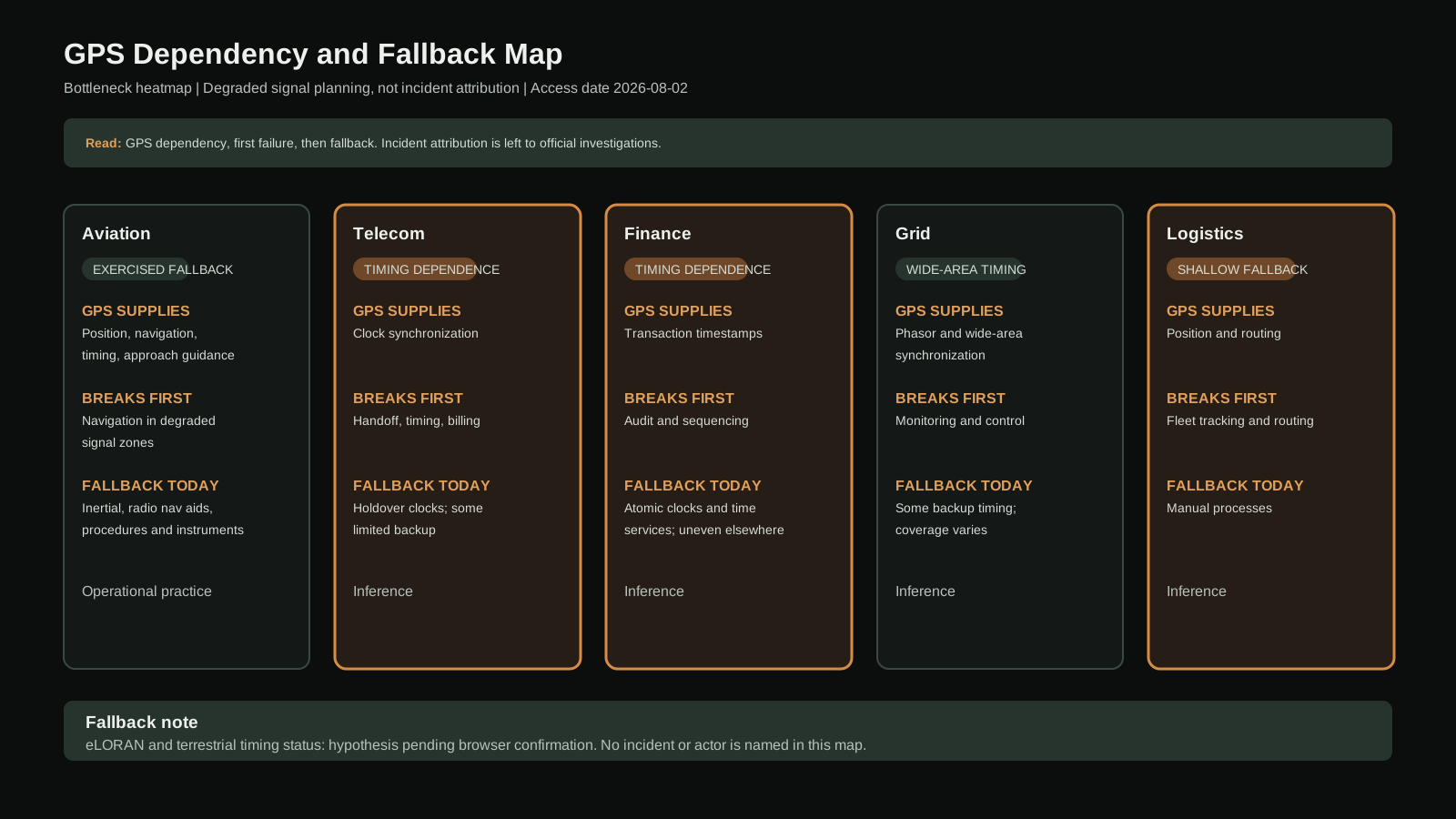
| Sector | What GPS supplies | What breaks first | Fallback today | Evidence level | | --- | --- | --- | --- | --- | | Aviation | Position, navigation, timing, approach guidance | Navigation in degraded-signal zones; procedures and instruments exist | Inertial, radio nav aids, procedures; strong operational fallback | Verified (GPS.gov); operational practice | | Telecom | Clock synchronization for the network | Handoff, timing, and billing degradation distributed across the network | Holdover clocks; some use GNSS as primary with limited backup | Inference | | Finance | Transaction and settlement timestamps | Order timestamping, audit, and sequencing integrity | Atomic clocks and authoritative time services at major venues; uneven elsewhere | Inference | | Grid | Phasor measurement and wide-area synchronization | Wide-area monitoring and control degrade; protection remains local | Some operators hold backup timing; coverage varies | Inference | | Logistics | Position and routing at scale | Fleet tracking and routing degrade; paper procedures are the fallback | Manual processes; shallowest stack | Inference |
The row to study is the one where the fallback is thinnest, because that is where the risk concentrates. Sector fallback stacks are uneven by research synthesis; aviation has the most exercised fallback culture, and logistics the shallowest. Source confidence: Analytical for the sector rows except where noted. Signal strength: Medium.
Who controls it?
The U.S. government owns and operates the GPS constellation, and the same government is the authority on incident causation. Attribution of any specific jamming or spoofing disruption is explicitly withheld in this article pending official investigations; speculation in advance of those findings serves no operator. Source confidence: Analytical (attribution boundary set by the drafting brief).
What can be said without attribution is structural. GPS.gov maintains resilience resources because widespread GPS dependence creates vulnerability when signals are disrupted or manipulated, and it instructs users to plan for potential signal loss. (GPS.gov resilience resources, accessed 2026-08-02.) CISA also provides federal PNT acquisition guidance for resilient use. (CISA PNT guidance, accessed 2026-08-02.) Source confidence: Primary. Signal strength: High.
Why should founders care?
Because resilience is a fallback stack, and the stack is uneven.
The fallback architecture is not one system. Inertial navigation and augmentation are mature in aviation and military use and thin in consumer logistics. Timing over fiber and network time services are deployed at major venues, with uneven adoption. High-quality holdover clocks exist in telecom and power, not universally. eLORAN and terrestrial timing systems are not evaluated here as deployed national fallbacks; this remains a hypothesis pending a dated program source. Procedures and manual fallback exist in aviation and grid operations and are shallowest in logistics.
Three mechanisms follow. First, inventory is the first resilience step: you cannot back up a dependence you have not mapped, and the buried timing dependence is exactly the part operators do not inventory. Second, the market opportunity is measurement, not receivers: tools that show an operator every point where GPS enters the operation, and the fallback behavior of each, are the differentiated position. Third, read every resilient-PNT claim at its fallback column: a fallback that exists on a roadmap is not a fallback that exists in the fleet, and allocators who conflate the two misprice schedule risk.
The military's own modernization is a calibration on pace. The M-code receiver rollout, covered separately in this cluster, is still completing testing for maritime and aviation platforms in fiscal 2027 per trade press. (Breaking Defense, July 31, 2026, accessed 2026-08-02.) Source confidence: Primary (trade press, verified HTTP 200). Signal strength: High. If the well-resourced, clearly-threatened buyer is moving that slowly, the civilian sectors with buried dependence and thinner budgets are not about to close their fallback gap overnight.
FAQ
Q: Is GPS being jammed right now? A: This article does not assert attribution for any specific disruption. Official investigations are the authority for that question, and the dependency map stands on its own: the dependence exists, the fallback is uneven, and the signal is contested in ways the GPS program itself documents. Source confidence: Analytical.
Q: Which sector is most at risk? A: The sectors with buried timing dependence and thin fallback columns: telecom and finance depend almost entirely on time, and logistics has the shallowest fallback stack. Aviation degrades gracefully because its fallback culture is the most exercised. Source confidence: Analytical.
Q: What is the difference between navigation risk and timing risk? A: Navigation loss is visible: a lost position, a rerouted flight. Timing loss is distributed: handoffs, timestamps, and phasor alignment degrade across the network, and operators discover it in monitoring screens. Timing is the dangerous layer. Source confidence: Analytical.
Q: Is there a backup system being built? A: eLORAN and terrestrial timing systems are under evaluation and demonstration, not universal service. That is a hypothesis-level claim pending browser confirmation of program material, and it is labeled accordingly. Source confidence: Hypothesis.
Q: What should an operator do first? A: Inventory. Ask which equipment holds a clock, which network segment syncs against GNSS, and what happens to monitoring and audit trails when the reference degrades. You cannot back up a dependence you have not mapped. Source confidence: Analytical.
Q: Why does the military matter for civilian resilience? A: Because the M-code rollout is the calibration: even the constituency with the largest budget and the clearest threat model is still completing maritime and aviation testing in fiscal 2027. Civilian fallback gaps will not close overnight. Source confidence: Primary for the M-code timeline; Analytical for the read.
Sources
- GPS as a U.S.-provided PNT service and resilience planning for critical infrastructure: GPS.gov and Resilience Through Responsible Use of PNT (accessed 2026-08-02). Primary.
- CISA PNT acquisition and resilience guidance: Federal PNT Services Acquisitions Guidance PDF (accessed 2026-08-02). Primary.
- M-code maritime and aviation testing through fiscal 2027: Breaking Defense (July 31, 2026, accessed 2026-08-02). Secondary (trade press).
- FAA notices and investigation records: FAA (not machine-readable at the 2026-08-02 cutoff; no specific figure cited).
- Attribution of specific incidents: withheld pending official investigations. No URL invented.
- PNT dependence as a critical-infrastructure constraint: Bottleneck Map (accessed 2026-08-02). Site pillar.
- Post-quantum migration clock as the trust-cluster forcing function: Upstream Bottlenecks: Electrical Steel, Quantum, and Grid (accessed 2026-08-02). Site article.
- Market-access and compliance surface for resilience buyers: Export Controls for AI Models (accessed 2026-08-02). Site article.
Publication cutoff: 2026-08-02.
Methodology
This article follows the Bottleneck Map method. The bottleneck is assigned to Layer 9, Sovereign Capital: the PNT utility is sovereign-owned infrastructure, and the constraint is civilian dependence on a single state-provided signal with under-provisioned sovereign investment in resilient alternatives.
Every claim carries a source-confidence classification per the editorial standards: Primary where a named, publicly verifiable source is cited inline; Mixed where public data is combined with editorial interpretation; Analytical where the claim reflects Stack & State ecosystem observation. The sector dependency and fallback rows are research synthesis and are labeled Inference or Hypothesis accordingly; no fallback system's current status is asserted without a dated source, and no incident is attributed to any actor. The active GPS.gov resilience page is cited directly; no incident is attributed to any actor. Nothing here is legal, investment, procurement, or compliance advice.
Research cutoff and access date for all sources: 2026-08-02. Corrections: /connect/.
Stack & State is an editorial and ecosystem-intelligence publication. Nothing here is legal, investment, procurement, or compliance advice. Program details change; verify requirements with primary sources and qualified advisors.