Government Procurement & Non-Dilutive Capital
How to Get a DoD Contract as a Startup: Registration to Payment
A step-by-step walkthrough from SAM registration through CAGE code, solicitation matching, proposal writing, and contract management for first-time defense contractors
Atomic answer
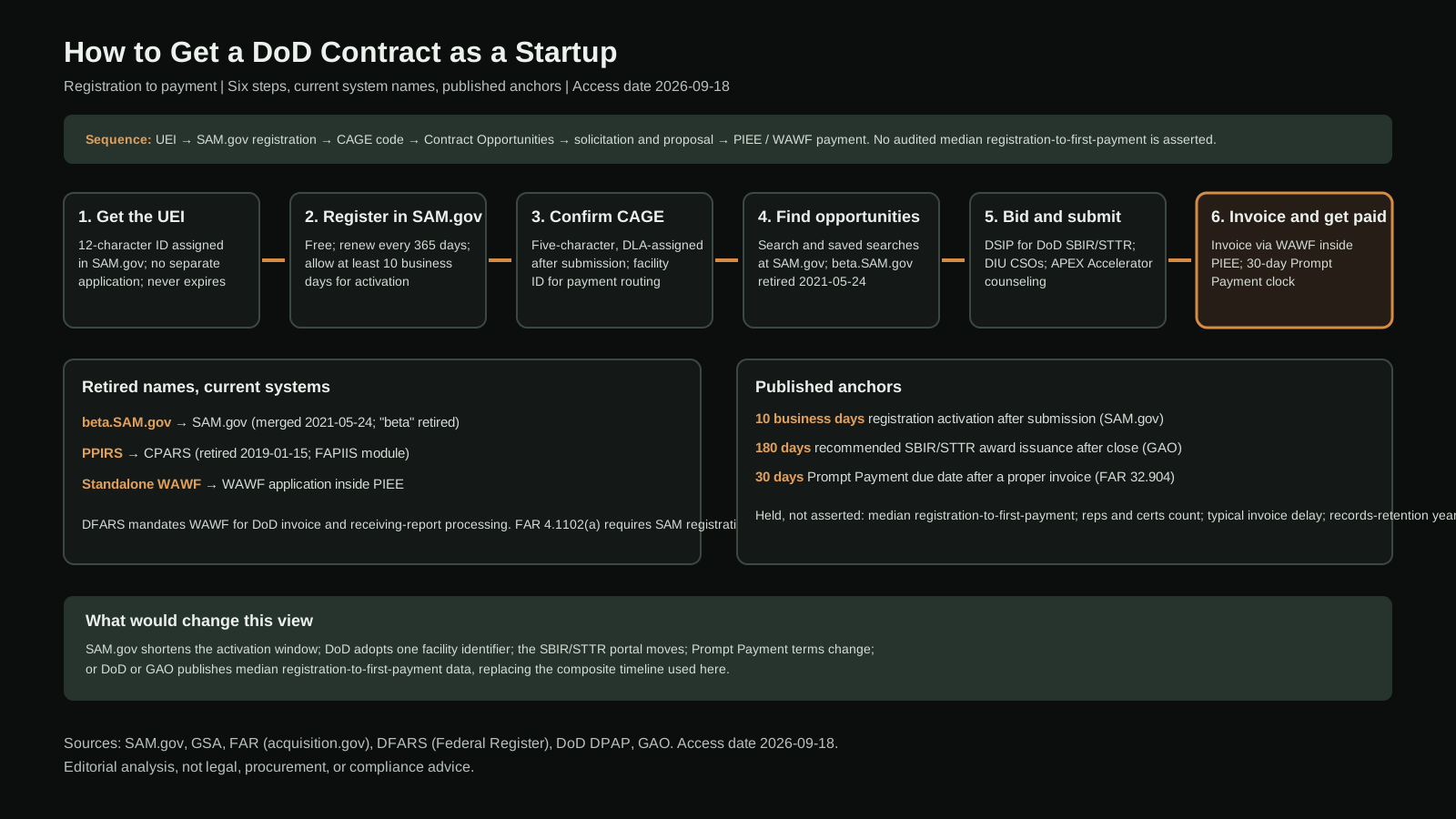
Getting paid by the DoD is a registration problem before it is a sales problem. An active SAM.gov entity registration, a Unique Entity ID, and a CAGE code precede everything else, and payment runs through the Wide Area Workflow (WAWF) application inside the Procurement Integrated Enterprise Environment (PIEE). The published anchors are 10 business days (SAM.gov's advice for allowing a registration to become active after submission), 180 days (the SBIR/STTR policy directive's recommended window for award issuance after solicitation close), and 30 days (the Prompt Payment Act due date after receipt of a proper invoice). No audited median exists for registration-to-first-payment, so none is asserted. The system names changed while most guides slept. beta.SAM.gov merged into SAM.gov on 2021-05-24 and the "beta" label was retired. ([GSA news release](https://www.gsa.gov/about-gsa/newsroom/news-releases/gsa-unveils-new-improved-and-more-secure-samgov-05242021), 2021-05-24; [GSAR final rule, 86 FR 48915](https://www.govinfo.gov/content/pkg/FR-2021-09-01/pdf/2021-18847.pdf), 2021-09-01.) PPIRS was retired on 2019-01-15 and merged into CPARS. ([DFARS final rule, 84 FR 48507](https://www.federalregister.gov/documents/2019/09/13/2019-19565/defense-federal-acquisition-regulation-supplement-update-to-performance-information-system), 2019-09-13.) WAWF is no longer a standalone system; it is an application inside PIEE. ([DoD DPAP](https://www.acq.osd.mil/asda/dpc/ce/cap/piee.html), accessed 2026-09-18.) A founder working from a pre-2021 checklist is following systems that no longer exist, and a stale system name costs weeks. This article walks the sequence in six steps, names the system that governs each one, and labels every number with its source. It is informational, not legal, procurement, or compliance advice.
Who is this for?
This article is for three readers: the founder with a product DoD might buy, the investor who needs the operational timeline their portfolio company will face, and the first contracts hire handed a process described in retired system names. The shared question is whether the company can carry the administrative lead time before revenue arrives. Source confidence: Analytical.
What does the six-step registration sequence actually require?
Step 1: Get the Unique Entity ID (UEI). The UEI is a 12-character alphanumeric value assigned and owned by the government. It is generated during SAM.gov entity registration rather than applied for separately, and it does not expire. The legacy DUNS number was removed from federal award systems on 2022-04-04. (GSA UEI transition FAQ, accessed 2026-09-18.) Source confidence: Primary.
Step 2: Complete the SAM.gov entity registration. The registration captures the legal business name, physical address, tax identification number, banking information for electronic funds transfer, NAICS codes, points of contact, and the representations and certifications. It is free and must be renewed every 365 days. SAM.gov advises allowing at least 10 business days after submission for the registration to become active, and a TIN mismatch or CAGE validation failure restarts part of that clock. (SAM.gov entity registration; SAM.gov entity checklist, accessed 2026-09-18.) Source confidence: Primary.
Hold on the certification count: the set changes with FAR and DFARS clause updates, and the annual certifications are incorporated by reference from FAR 52.212-3. The authoritative list is the live provision and the SAM.gov Reps & Certs module, not a fixed number in a guide. (FAR 52.212-3; FAR 4.1201, accessed 2026-09-18.) Source confidence: Primary for the mechanism; the count is an explicit hold.
Step 3: Confirm the CAGE code. The Commercial and Government Entity code is a five-character identifier assigned by the Defense Logistics Agency. If the company does not already have one, it selects "No" during SAM.gov registration and the code is assigned after the registration is submitted. The CAGE code identifies the facility for contracting and payment routing. Name and TIN mismatches against DLA records are a common validation failure; when CAGE rejects a registration, DLA's Customer Interaction Center corrects the record before SAM.gov can activate it. (SAM.gov entity checklist, accessed 2026-09-18.) Source confidence: Primary for the assignment mechanics; the activation timeline is SAM.gov's.
Step 4: Set up SAM.gov Contract Opportunities. beta.SAM.gov and its FedBizOpps content were consolidated into SAM.gov in 2021; the current system is SAM.gov Contract Opportunities. Anyone can search without an account. An account allows saved searches, following opportunities, and joining interested-vendor lists. (SAM.gov Contract Opportunities; GSA news release, accessed 2026-09-18.) Source confidence: Primary.
Step 5: Match solicitations across the four lanes. General procurement runs through SAM.gov Contract Opportunities, filtered by NAICS code, keyword, and set-aside status. DoD SBIR/STTR runs through the Defense SBIR/STTR Innovation Portal (DSIP), the official portal for topic search, Topic Q&A, and proposal submission; proposals submitted any other way are disregarded. SBIR.gov carries government-wide program information and award data. DIU runs Commercial Solutions Openings for prototype work with non-traditional vendors. APEX Accelerators, managed under DoD's Office of Small Business Programs, provide no-cost counseling on registration and bidding. (DoD SBIR/STTR opportunities; SBIR.gov; DIU open solicitations; APEX Accelerators, accessed 2026-09-18.) Correction on a stale claim: DTIC maintains technical report and document collections, not the DoD SBIR/STTR solicitation portal. The portal is DSIP. Source confidence: Primary for portal roles; Analytical for the lane framing.
Step 6: Stand up the post-award systems. Invoicing runs through WAWF as an application inside PIEE, and DFARS mandates WAWF as the DoD enterprise system for processing invoices and receiving reports, with narrow exceptions. (DoD DPAP; PIEE, accessed 2026-09-18.) Past performance is recorded in CPARS, with terminations for cause or default visible through the FAPIIS module of CPARS. (DFARS final rule, 84 FR 48507, 2019-09-13.) FAR 4.1102(a) also requires offerors to be registered in SAM when an offer is submitted, so registration cannot run in parallel with a live solicitation. (FAR 4.1102, accessed 2026-09-18.) Source confidence: Primary.
How do you find a solicitation worth bidding?
The volume of federal notices is the first filter. Configure saved searches in SAM.gov Contract Opportunities by NAICS code and keyword, and follow them for change notifications. On the SBIR/STTR side, monitor DSIP topic releases on each component's cycle. Review the SBIR.gov award database for who won in the company's category and under which topic; that is the cheapest competitive intelligence available. (SAM.gov Contract Opportunities; DoD SBIR/STTR opportunities; SBIR.gov, accessed 2026-09-18.) Source confidence: Primary for the portal mechanics; Analytical for the workflow.
The second filter is the program office. A solicitation is a symptom; the buyer is a program executive office or acquisition command with a funded requirement. Industry days, demonstrations, and APEX Accelerator counseling are the practical channels for learning which office owns the requirement before a solicitation posts. Source confidence: Analytical.
The solicitation states the evaluation factors and their relative importance. A proposal that answers different questions than the ones asked loses before the technical read. Source confidence: Analytical.
What does a winning proposal look like for a startup?
Three volumes carry the evaluation. The technical volume demonstrates understanding of the operational problem, a technical approach, and measurable performance. The management volume covers team qualifications, schedule, and risk mitigation. The cost volume must be realistic under the FAR cost principles the solicitation references, and the solicitation's cost instructions control the format.
Past performance is the hardest factor for a first-time contractor. CPARS is the government's record, and a new entrant has none. The substitutes are commercial contracts, SBIR/STTR awards, grants from other agencies, research collaborations, and team members' prior defense experience. Source confidence: Analytical for the proposal guidance; Primary for CPARS as the performance record.
Hold on win-loss rankings: no audited DoD dataset supports a win rate or a ranked list of causes, so this article asserts neither.
How do you manage the contract after award?
Execute the award documents promptly; failure to execute can lead to award cancellation. Then invoice correctly. The Prompt Payment Act due date is the later of 30 days after the designated billing office receives a proper invoice or 30 days after Government acceptance, and an invoice that does not meet the content requirements of FAR 32.905 is returned with reasons rather than paid. Interest penalties are automatic when the conditions of FAR 32.907 are met, but the penalty is not the business model. (FAR 32.904; FAR 32.907, accessed 2026-09-18.) Source confidence: Primary.
The most common self-inflicted delay is invoice data that does not match the contract: wrong CAGE code or DoDAAC, wrong line items, or uninspected quantities. Source confidence: Analytical. Hold: no audited government dataset supports a typical delay figure, so this article states none.
CPARS is the loop that closes the contract and opens the next one. The contracting officer records an evaluation of performance, and future source selections read that record. Deliver the first contract so the evaluation works for the company, and use whatever comment period the contract and the CPARS process provide. Source confidence: Primary for the record; Analytical for the operational advice.
Contract modifications, including scope, funding, and period-of-performance changes, run through the contracting officer as bilateral agreements; keep a contract file of correspondence, reports, invoices, and modifications. Hold on retention: the audit and records-retention period depends on the clause in the awarded contract, so no number of years is stated here. Source confidence: Analytical; the retention period is an explicit hold.
What would change this view
The falsifiers are specific. This view weakens if SAM.gov shortens or eliminates the published activation window, because registration would stop being a scheduling constraint. It weakens if DoD moves to a single facility identifier across contract writing and payment systems, retiring the CAGE step as described. It weakens if the SBIR/STTR submission portal moves again, changing the DSIP lane, or if Congress, OMB, or the FAR Council changes the Prompt Payment terms in FAR Subpart 32.9.
It also weakens if DoD or GAO publishes actual median registration-to-first-payment data. The composite timeline used here is an editorial assembly of three sourced anchors: up to 10 business days for registration activation, 180 days recommended for SBIR/STTR award issuance after solicitation close, and 30 days for payment after a proper invoice. (SAM.gov entity registration; GAO-22-104677, 2021-10-14; FAR 32.904.) Source confidence: Mixed. The best calibration on the award leg is GAO's finding that DoD issued 65 percent of its SBIR/STTR awards on time from fiscal 2016 through fiscal 2021, against 85 percent at civilian agencies. (GAO-23-105591, 2022-10-12.) Source confidence: Primary.
Finally, the system map itself can move. The federal Integrated Award Environment consolidated multiple legacy award systems in the 2021 merger, and further consolidation would change the post-award stack described here. (GSA news release, 2021-05-24.)
FAQ
Q: How long does SAM.gov registration actually take for a startup? A: SAM.gov advises allowing at least 10 business days after submission for the registration to become active. TIN and CAGE validation failures extend that, and registration renews every 365 days, so start 45 to 60 days before an expiration. Registration is free; no third party can sell a UEI or CAGE code. (SAM.gov entity registration; SAM.gov entity checklist, accessed 2026-09-18.) Source confidence: Primary.
Q: Does a startup need a DUNS number to get a DoD contract? A: No. The federal government replaced the DUNS number with the Unique Entity ID, assigned during SAM.gov registration at no cost, and DUNS numbers were removed from federal award systems on 2022-04-04. Do not pay any third party for an identifier. (GSA UEI transition FAQ, accessed 2026-09-18.) Source confidence: Primary.
Q: Can a startup bid before SAM registration is complete? A: Practically, no. FAR 4.1102(a) requires offerors and quoters to be registered in SAM when the offer or quotation is submitted, with narrow exceptions. Activation can exceed a short solicitation response window, so complete it before bidding seriously. (FAR 4.1102, accessed 2026-09-18.) Source confidence: Primary.
Q: Why do first invoices get paid late? A: The 30-day clock starts when the designated billing office receives a proper invoice and there is no disagreement over quantity, quality, or compliance. An invoice that does not meet FAR 32.905's content requirements is returned with reasons, so the clock does not run cleanly until a proper invoice is in place. Interest penalties are automatic when FAR 32.907's conditions are met, but a clean first invoice is the cheaper fix. (FAR 32.904; FAR 32.907, accessed 2026-09-18.) Source confidence: Primary for the rule; Analytical for the advice.
Q: How does a startup get past performance with no DoD history? A: CPARS is the DoD record and a new entrant starts empty. The substitutes are commercial contracts, SBIR/STTR awards, other-agency grants, and team members' prior defense work. Then deliver the first contract so the CPARS evaluation seeds the record. Source confidence: Analytical.
Sources
- SAM.gov, Entity Registration: sam.gov/entity-registration (accessed 2026-09-18). Primary.
- SAM.gov, Entity Registration Checklist (PDF, 2024-11): sam.gov PDF (accessed 2026-09-18). Primary.
- GSA, "GSA Unveils New, Improved and More Secure SAM.gov": gsa.gov (2021-05-24, accessed 2026-09-18). Primary.
- GSA, Unique Entity ID transition FAQ (PDF): gsa.gov PDF (accessed 2026-09-18). Primary.
- GSAR final rule updating the beta.SAM.gov URL, 86 FR 48915: govinfo.gov PDF (2021-09-01, accessed 2026-09-18). Primary.
- DFARS final rule, "Update to Performance Information System References," 84 FR 48507: federalregister.gov (2019-09-13, accessed 2026-09-18). Primary.
- DoD Defense Pricing and Contracting, PIEE / WAWF functional information: acq.osd.mil (accessed 2026-09-18). Primary.
- PIEE, WAWF functional information: piee.eb.mil (accessed 2026-09-18). Primary.
- FAR 4.1102 and FAR 4.1201, SAM registration and representations policy: acquisition.gov/far/4.1102; acquisition.gov/far/4.1201 (accessed 2026-09-18). Primary.
- FAR 32.904 and FAR 32.907, payment due dates and interest penalties: acquisition.gov/far/32.904; acquisition.gov/far/32.907 (accessed 2026-09-18). Primary.
- FAR 52.212-3, Offeror Representations and Certifications: acquisition.gov (accessed 2026-09-18). Primary.
- DoD SBIR/STTR, Funding Opportunities (DSIP): defensesbirsttr.mil (accessed 2026-09-18). Primary.
- SBIR.gov, program information and award data: sbir.gov (accessed 2026-09-18). Primary.
- DIU, Open Solicitations: diu.mil (accessed 2026-09-18). Primary.
- APEX Accelerators program: apexaccelerators.us (accessed 2026-09-18). Primary.
- GAO, "Small Business Research Programs: Agencies Should Further Improve Award Timeliness," GAO-22-104677: gao.gov PDF (2021-10-14, accessed 2026-09-18). Primary.
- GAO, "Small Business Research Programs: Reporting on Award Timeliness Could Be Enhanced," GAO-23-105591: gao.gov (2022-10-12, accessed 2026-09-18). Primary.
- CPARS: cpars.gov (accessed 2026-09-18). System access point.
- Companion visual, "DoD Contract Startup Pathway": how-to-get-dod-contract-startup.svg (accessed 2026-09-18). Site asset.

Methodology
This article follows the Bottleneck Map method as an operational guide inside the Government Procurement and Non-Dilutive Capital pillar. It is not a bottleneck claim and assigns no layer; the constraint it documents is administrative lead time.
Every claim carries a source-confidence classification per the editorial standards: Primary where a named government system, regulation, or GAO report is cited inline; Mixed where the timeline is an editorial assembly of sourced anchors; Analytical where the claim reflects Stack & State operational judgment. Four numbers are held rather than filled: the count of representations and certifications (it changes with FAR clause updates), a median registration-to-first-payment timeline, a typical invoice-delay figure, and audit-record retention years (contract-clause dependent). Research cutoff and access date for all sources: 2026-09-18. Corrections: /connect/.
Stack & State is an editorial and ecosystem-intelligence publication. Nothing here is legal, investment, procurement, or compliance advice. Program details change; verify requirements with primary sources and qualified advisors.