Water & Industrial Siting
Industrial Water Is the Missing Input in the Compute-and-Manufacturing Boom
Power gets the headlines. Water decides where data centers, fabs, mines, and thermal plants can actually site and scale, and local restrictions are multiplying faster than the buildout can adjust.
Atomic answer
The compute-and-manufacturing buildout is covered as a power story, and power is a real constraint. Water is the input that gets less coverage and decides more sites. Data centers cool servers, semiconductor fabs need ultrapure water, and thermal plants and mines need water for production and discharge. The practical distinction: water is not one input, it is four. Quantity decides whether a site can run. Quality decides whether a fab can process wafers. Timing decides whether supply is reliable through drought and peak seasons. Discharge decides whether the site survives permitting. Federal policy has moved water into industrial policy, with EPA's Water Reuse Action Plan 2.0 and DOE's National Alliance for Water Innovation treating reuse as a competitiveness program, while over 530 local laws now restrict or ban new data centers. The bottleneck operates in Layer 1, Materials & Processing: water is the physical input that gates siting.
Who is this for?
This article is for the developer, the industrial founder, and the allocator deciding where the next data center, fab, mine, or thermal plant can actually sit.
The decision in front of you: can you run the siting decision tree and know which water questions to answer before a site is chosen, not after? Water is local, which is why the national conversation keeps missing the per-project reality. A data center can buy more power or relocate for cheaper land. It cannot build a watershed.
Where does it actually bottleneck?
The bottleneck is in Layer 1, Materials & Processing, because water is the physical input that gates production, in the same way a critical mineral or a specialty alloy gates a component.
Every sector in the buildout has a water story, and the stories are different enough that treating water as one constraint is the first mistake. A data center cools servers, and cooling tower evaporation draws on supply while dry-cooling and air-side designs change the equation entirely. A fab runs ultrapure water across wafers, which makes both quantity and quality binding; water quality is the input you cannot substitute. Thermal generation uses water for cooling at massive scale per unit of output, which is why plants sit on rivers and coasts. Mining uses water for processing and dust control, which is why ore bodies in arid basins face a water question before a capital question. Source confidence: Analytical (ecosystem observation); sector-specific intensity figures are pending permit-level data and are not stated here. Signal strength: Medium.
The industrial stack runs from intake to discharge, and the binding stage is different for each sector.
| Stage | What it is | Why it decides siting | Evidence level | | --- | --- | --- | --- | | Intake and supply | The source: surface water, groundwater, municipal supply | Source reliability and cost vary by basin and contract | Verified (structural) | | Treatment | Making the water fit for use; ultrapure for fabs | Quality requirements are sector-specific and non-negotiable | Inference | | Use and cooling | The consumption stage; cooling vs. process | Cooling is the dominant draw for data centers and thermal plants | Inference | | Reuse and recycle | Onsite treatment for reuse across processes | Reuse changes the whole siting equation | Verified (federal programs) | | Discharge | Return to the environment or sewer | Discharge permitting is a local and increasingly contested gate | Verified (local politics) |
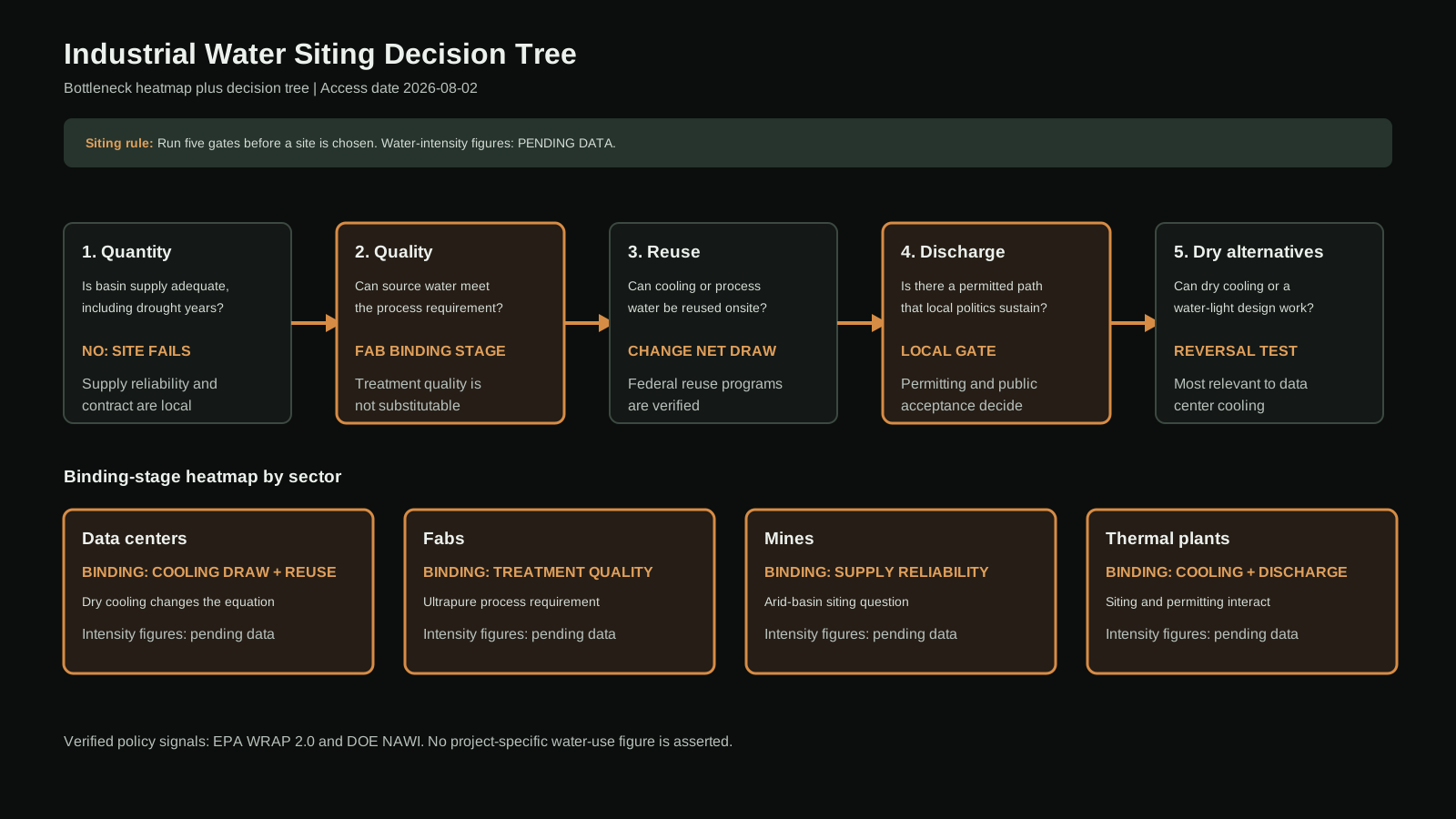
For a fab the binding stage is treatment quality. For a data center it is cooling draw and the reuse choice. For a mine it is supply reliability in an arid basin. Identify your sector's binding stage before you pick a site.
Who controls it?
Control is split between local politics and federal programs, and both moved in 2026.
Local politics is where the water story is landing. Heatmap's review of public records counts more than 530 local laws now seeking to restrict or ban new data centers in the United States, with the overwhelming majority enacted in 2026 and nearly 190 passed since June 1. The same review counts more than 50 data center projects canceled this year after local pushback, more than double the 2025 figure, with roughly 200 pending projects fought locally and a contested project now facing about a 50 percent cancellation rate. New York has adopted a statewide moratorium on new data center permit approvals. (Heatmap, July 30, 2026, accessed 2026-08-02.) Source confidence: Mixed (named secondary review of public records, verified HTTP 200). Signal strength: High. The immediate triggers vary by project. This review does not establish a national causal share for water, discharge, or drought; treat those as site-level diligence questions rather than as the cause of the recorded cancellations.
In April 2026, the EPA launched Water Reuse Action Plan 2.0, organized around three initiatives: reuse for resurgent domestic industry, water for the technology revolution (microchip and memory fabrication plus data center cooling), and American energy dominance. The plan is explicitly not a regulatory mandate; it works through partnerships, with 200 partners on 76 actions. (EPA news release, April 16, 2026, accessed 2026-08-02.) Source confidence: Primary (epa.gov, verified HTTP 200). Signal strength: High. In July 2026, DOE's National Alliance for Water Innovation issued a $12 million request for proposals for onsite industrial water reuse systems, targeting cooling water, process and rinse water, and wastewater effluent. (DOE NAWI, July 27, 2026, accessed 2026-08-02.) Source confidence: Primary (energy.gov, verified HTTP 200). Signal strength: High. The Bureau of Reclamation is a third federal lane; its root is verified, but specific funding pages block automated fetching and need browser confirmation before any figure is cited.
Why should founders care?
Because water now gates siting in ways power, labor, and land mostly do not, and the decision tree is runnable today.
Quantity: is basin supply adequate at the site's draw, including drought years? If no, the site fails before permitting. Quality: can the source be treated to the sector's requirement at acceptable cost? For fabs, this is binding. Reuse: can cooling and process water be recycled onsite to cut net draw? If yes, footprint shrinks and resilience rises. Discharge: is there a permitted discharge path, and can local politics sustain it? Projects die here after power is solved. Dry alternatives: does a dry-cooling or water-free design change the answer? This is what would change the data-center assessment. Source confidence: Analytical.
Three mechanisms follow. First, water diligence is cheaper before the site is chosen; a basin's discharge politics belongs in the underwriting, not the PR plan. Second, the risk profile differs by binding stage: a project whose binding stage is treatment quality is a different risk from one bound by discharge politics, and allocators should ask which stage binds. Third, the federal turn changes the capital picture: public capital is starting reuse capacity, and the missing piece is the revenue that makes reuse facilities permanent, the subject of companion pieces in this cluster. Water-intensity comparisons are notoriously project-specific, and the intensity asset for this cluster ships only with figures tied to dated permits and disclosures; no such figure is asserted here.
FAQ
Q: Is water a bigger constraint than power for data centers? A: Power gets the headlines; water decides more sites, and the two interact. A data center can buy more power but cannot build a watershed, and discharge politics can kill a project after the power is solved. Source confidence: Analytical.
Q: Are data center restrictions really about water? A: The immediate trigger is often power and noise, but water use is a consistent thread in objections, and discharge and drought convert a public hearing into a cancellation, per Heatmap's review of public records. Source confidence: Mixed (secondary review).
Q: What does WRAP 2.0 actually do? A: It is a partnership-based program, not a regulatory mandate, with 200 partners working on 76 actions, and it explicitly names microchip and memory fabrication and data center cooling as priorities. Source confidence: Primary (EPA).
Q: What is the NAWI RFP? A: A $12 million request for proposals from DOE's National Alliance for Water Innovation for onsite industrial water reuse systems, targeting cooling water, process and rinse water, and wastewater effluent across semiconductors, chemicals, food and beverage, paper and pulp, iron and steel, and automotive. Source confidence: Primary (DOE).
Q: What is the single most important water question for a fab? A: Quality. A fab runs ultrapure water across wafers, and water quality is the input you cannot substitute. Treatment quality is the binding stage. Source confidence: Analytical.
Q: Can dry cooling eliminate the water constraint? A: For data centers, dry-cooling and air-side designs change the equation and are what would change this assessment. They do not eliminate the constraint for fabs, thermal plants, or mines, where process and cooling water remain binding. Source confidence: Analytical.
Sources
- EPA Water Reuse Action Plan 2.0 launch, three initiatives, partnership-based and not a mandate, 200 partners and 76 actions: EPA news release (April 16, 2026, accessed 2026-08-02). Primary.
- DOE NAWI $12M RFP for onsite industrial reuse, target sources and sectors: DOE / NAWI (July 27, 2026, accessed 2026-08-02). Primary.
- 530+ local laws restricting or banning data centers, 50+ canceled projects this year, New York moratorium: Heatmap (July 30, 2026, accessed 2026-08-02). Secondary (named review of public records).
- New York statewide hyperscale data-center moratorium: Empire State Development (July 14, 2026, accessed 2026-08-02). Primary.
- Bureau of Reclamation water-funding programs: Bureau of Reclamation (accessed 2026-08-02). Primary (root); specific funding pages browser-only, no figure cited.
- Water as the gating siting input: Bottleneck Map (accessed 2026-08-02). Site pillar.
- Processing-lens parallel for gating physical inputs: Materials Bottleneck article (accessed 2026-08-02). Site article.
- Non-dilutive capital context for industrial capacity: Non-Dilutive Capital guide (accessed 2026-08-02). Site article.
Publication cutoff: 2026-08-02.
Methodology
This article follows the Bottleneck Map method. The bottleneck is assigned to Layer 1, Materials & Processing, because water is a physical input that gates production and siting, in the same class as critical minerals and specialty alloys; Layer 2 (Energy & Power) and Layer 3 (Compute & AI Infrastructure) appear as connected layers where the constraint expresses.
Every claim carries a source-confidence classification per the editorial standards: Primary where a named, publicly verifiable institutional source is cited inline; Mixed where a secondary review of public records carries the figures; Analytical where the claim reflects Stack & State ecosystem observation. Water-intensity figures could not be tied to dated permits or disclosures for named projects at the 2026-08-02 cutoff, so the intensity comparison is published as pending data and no specific water-use figure is stated. Sources that blocked automated access are labeled browser-only rather than guessed. Analytical classifications are hypotheses for navigation, not verified findings.
Research cutoff and access date for all sources: 2026-08-02. Corrections: /connect/.
Stack & State is an editorial and ecosystem-intelligence publication. Nothing here is legal, investment, procurement, or compliance advice. Program details change; verify requirements with primary sources and qualified advisors.