Compute & AI Infrastructure
The Inference-Era Industrial Base: Five Layers, Five Clocks
AEI's Voltcraft framing and Bruegel's compute-gap work describe the demand for inference. The industrial base beneath it runs on five different clocks: power equipment, memory and HBM, advanced packaging, optical networking, and edge infrastructure.
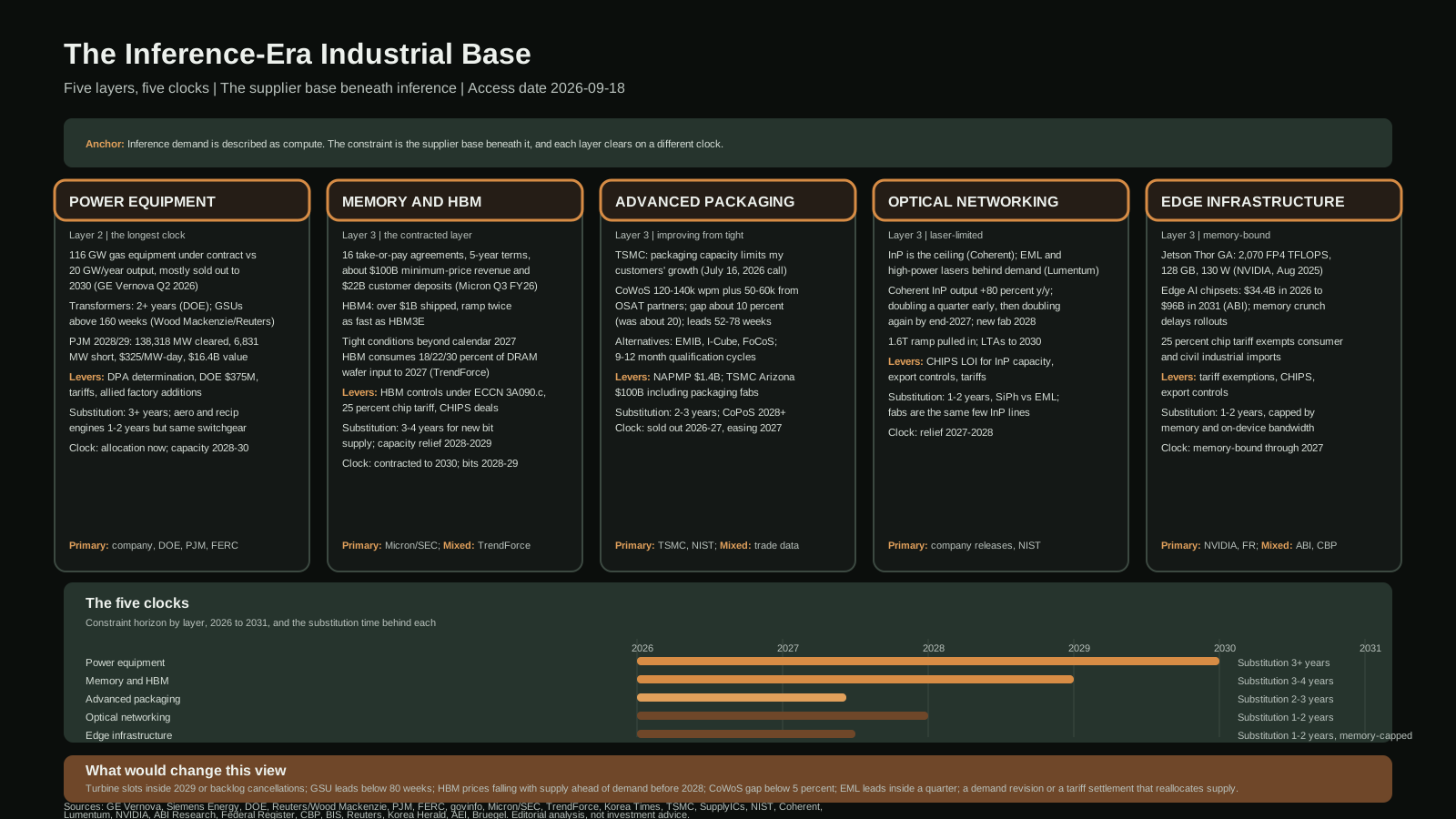
Atomic answer
The inference era's binding constraints sit in the industrial base beneath it: power equipment, memory and HBM, advanced packaging, optical networking, and edge infrastructure. Power equipment is an allocation market through 2030: 116 GW of GE Vernova gas equipment under contract against a 20 GW annual run rate, DOE transformer lead times of two or more years, and a PJM auction 6,831 MW short. Memory is contracted into 2030 on take-or-pay agreements worth about $100 billion at floor prices, with tight conditions beyond calendar 2027. Advanced packaging is sold out through 2026-2027 and improving; TSMC says packaging capacity limits customer growth. Optical networking is limited by indium phosphide laser output. Edge is memory-bound. Policy levers change price and location faster than capacity; a compute schedule is only as firm as the slowest supplier behind it.
Who is this for?
Three readers: the operator underwriting a compute schedule against supplier dates, the allocator separating cyclical tightness from structural shortage, and the policy reader asking which levers add capacity. The decision is the same for all three: separate a price signal from a capacity signal, and ask each layer what substitutes for it and how fast. (Analytical)
What the demand framing gets right, and what it leaves out
AEI's July 2026 working paper, Voltcraft, argues that AI competition has shifted from training to inference and introduces Annual Energizable Compute, in megawatts, to size the installable power-drawing potential of a year of accelerator production. It projects the US-led chip ecosystem at roughly 14,600 megawatts in 2026 against about 780 megawatts for Huawei, and warns that grid limits can strand the hardware advantage. (AEI, 2026-07-29; context, not authority.) Bruegel's September 2026 brief puts EU operational AI compute near 2 gigawatts, about 5 percent of the global total, with the US near 35 gigawatts, and argues that permits and grid access bind before capital does. (Bruegel, 2026-09-10; context, not authority.)
Both are demand-side. The operational question is one layer down: who makes the equipment, the memory, the package, the laser, and the edge silicon, and how long each substitute takes to qualify. (Analytical)
Layer one: power equipment, the longest clock
Power equipment is the longest clock. GE Vernova closed the second quarter of 2026 with gas equipment backlog and slot reservation agreements at 116 gigawatts, up from 100, against an annualized output run rate of 20 gigawatts, and expects at least 125 gigawatts under contract by year-end, mostly sold out through 2030. Slot reservations carry deposits and run three to five years out. (GE Vernova, 2026-07-22; Primary.) Siemens Energy's gas services division closed its June 2026 quarter with a firm turbine backlog near 69 gigawatts, lead times beyond three years, a Grid Technologies backlog near 51 billion euros, and plans to expand transformer and switchgear capacity by about 50 percent by 2030. (Pecos Operating summary of Siemens Energy Q3 FY2026, 2026-08-10; Mixed, trade press summarizing company disclosures.)
The grid side runs on the same clock. DOE's Office of Electricity states that critical grid equipment faces lead times of two or more years, that some transformers have seen price increases of four to nine times over five years, and plans a program worth up to $375 million to rebuild domestic grid-equipment manufacturing. (DOE, 2026-08-10; Primary.) Wood Mackenzie data reported by Reuters put generator step-up transformer lead times above 160 weeks in the first quarter of 2026, versus a 143-week average in 2024. (Reuters, 2026-07-09; Primary reporting of consultancy data.) PJM's 2028/2029 Base Residual Auction cleared 138,318 megawatts at the $325 per MW-day cap and finished 6,831 megawatts short of the reliability requirement, with a total cleared value of $16.4 billion. (PJM, 2026-07-14; Primary.) FERC's June 18, 2026 show-cause orders to all six RTOs and ISOs, EL26-67 through EL26-72, put large-load tariff terms in play through at least the fourth quarter. (FERC, 2026-06-18; Primary.) The policy anchor is the April 20, 2026 Defense Production Act determination naming grid infrastructure and electrical core steel as essential to national defense. (Federal Register, 2026-04-23; Primary.)
The additions are allied and late. Hitachi Energy broke ground in June 2026 on a $457 million expansion of its South Boston, Virginia transformer campus, and Siemens Energy broke ground on a $300 million switchgear factory in Pearl, Mississippi as part of a $1 billion US program. (Hitachi Energy, 2026-06-29; Siemens Energy, 2026-07-17; Primary.) Those are 2027-2029 additions. The substitution timeline is the longest in the map: aeroderivative turbines and reciprocating engines deliver inside one to two years and are the bridge for on-site power, but they still queue for the same transformers and switchgear, and no substitute exists for large power transformer capacity inside three years. Constraint horizon: 2030. (Analytical)
Layer two: memory and HBM, the contracted layer
Memory is where the shortage has converted into contracts. Micron's fiscal third quarter of 2026, ended May 28, disclosed 16 strategic customer agreements across data center, consumer, and auto, typically five-year terms through calendar 2030, structured as take-or-pay with binding volume commitments. Fourteen of the 16 carry cumulative minimum-price revenue of roughly $100 billion, and the company projects $22 billion in customer cash deposits and related commitments. HBM4 is in high-volume shipment for the lead customer's platform, and Micron has shipped over $1 billion of HBM4 revenue, with the ramp twice as fast as HBM3E. Management expects tight conditions to persist beyond calendar 2027. (Micron Q3 FY2026 press release, SEC Exhibit 99.1, 2026-06-24; earnings call transcript, 2026-06-24; Primary.)
The supply math is structural. TrendForce estimates that HBM consumes roughly 18, 22, and 30 percent of total DRAM wafer input for the top three suppliers by the end of 2025, 2026, and 2027, and forecasts HBM bit shipments growing 50 to 60 percent year over year in 2027 while DRAM supply remains tight through that year. (TrendForce via IntuitionLabs synthesis, accessed 2026-09-18; Mixed, consultancy figures compiled from published notes.) TrendForce's June 2026 bulletin describes diverging HBM4 qualification timelines: Samsung shipped first, and SK hynix slipped to third-quarter mass production. (TrendForce, 2026-06-23; Mixed, research summary.)
Capacity relief is slow. SK hynix broke ground in August 2026 on a US advanced packaging facility in West Lafayette, Indiana, targeting HBM4E mass production in 2029. (Korea Times, 2026-09-06; Mixed.) HBM supply is allocated through long-term agreements, so spot demand does not clear the market, and the substitution timeline is three to four years for meaningful new bit supply. Constraint horizon: 2028-2030. (Analytical)
Layer three: advanced packaging, the improving layer
Advanced packaging is the layer with the clearest public admission of bindingness. On TSMC's July 16, 2026 earnings call, chairman and CEO C.C. Wei said, "our packaging capacity is so tight that now it limits my customers' growth." TSMC raised its 2026 capital budget to $60 billion to $64 billion, with 10 to 20 percent for advanced packaging and testing, and announced an additional $100 billion Arizona investment including advanced packaging fabs. (TSMC 2Q26 transcript, 2026-07-16; 2Q26 earnings release, 2026-07-16; Primary.)
The measured picture is tight but improving. Trade analysis of TrendForce data put TSMC CoWoS capacity near 120,000 to 140,000 wafers per month in mid-2026 plus 50,000 to 60,000 from OSAT partners, with the supply-demand gap narrowing from about 20 percent in mid-2026 toward roughly 10 percent by end-2026 and lead times at 52 to 78 weeks. (SupplyICs, 2026-05-11; Mixed, trade analysis of paywalled research.) Alternatives are qualifying: Intel's EMIB, Samsung's I-Cube, and ASE's FoCoS, with nine to twelve month qualification cycles. The policy lever is domestic piloted capacity: NIST's National Advanced Packaging Manufacturing Program finalized $1.4 billion, $300 million for substrate work at Absolics, Applied Materials, and Arizona State University and $1.1 billion for Natcast's packaging piloting facility in Tempe. (NIST, accessed 2026-09-18; Primary.) The next platform, CoPoS, is a 2028 and later technology. Substitution timeline: two to three years. Constraint horizon: 2027, easing. (Analytical)
Layer four: optical networking, the laser-limited layer
Optical networking is constrained at the laser, not at the module. Coherent told investors that indium phosphide remains the internal supply constraint for 800G and 1.6T transceivers and that it produced about 80 percent more InP lasers in its June 2026 quarter year over year. It expects to double internal InP output by the end of the September quarter, a quarter ahead of plan, and to more than double it again by the end of calendar 2027. Datacenter and communications revenue reached $1.62 billion in the quarter, up 58.6 percent year over year, and long-term agreements run through the end of the decade with take-or-pay commitments. (Coherent Q4 FY2026 earnings release, 2026-08-12; Futurum analysis of the call, 2026-08; Primary for the release, Mixed for call detail.) The federal signal is the June 2026 CHIPS letter of intent with Coherent for indium phosphide capacity. (NIST, June 2026; Primary.)
Lumentum's disclosure points the same way. Fourth-quarter revenue reached $1.01 billion, up 109 percent year over year, with record 800G cloud transceiver shipments and initial 1.6T production; management said EML shipments remain behind customer demand and that ultra-high-power laser demand has accelerated faster than its ability to supply, with new fab capacity landing in 2028. (Lumentum Q4 FY2026 press release, 2026-08-11; earnings call transcript, 2026-08-18; Primary for the release, Mixed for call detail.)
The optics substitution path is the shortest. Silicon photonics and continuous-wave lasers are taking share from EMLs at 1.6T, and 200G-per-lane EML volume is expected to pass half of shipments by mid-2027, but the wafer fabs behind every variant are the same few InP lines. Substitution timeline: one to two years. Constraint horizon: 2027-2028. (Analytical)
Layer five: edge infrastructure, the memory-bound layer
The edge is the fifth layer because inference-era demand growth is distributed, and the constraint it inherits is memory. NVIDIA's Jetson Thor, generally available since August 2025, delivers up to 2,070 FP4 teraflops within a 130-watt envelope with 128 gigabytes of memory, a 7.5-times improvement over Orin, and is the reference platform for physical AI. (NVIDIA, 2025-08-25; Primary.) ABI Research forecasts the edge AI chipset market growing from $34.4 billion in 2026 to $96 billion in 2031 and reports that the memory crunch is delaying AI rollouts. (ABI Research, 2026-06-15; Mixed, vendor research.)
Edge also sits where memory and tariffs meet. The January 2026 Section 232 action imposes a 25 percent duty on certain advanced computing chips but exempts imports for US data centers, consumer applications, and civil industrial uses, which keeps edge-facing consumer silicon outside the tariff while memory stays in its own allocation queue. (Federal Register, 2026-01-20; CBP guidance, 2026-01-15; Primary.) The edge layer's substitution timeline is the shortest, one to two years, but it is capped by the memory clock above and by on-device memory bandwidth, which remains an order of magnitude below datacenter HBM. Constraint horizon: memory-bound through 2027. (Analytical)
What can policy actually change?
Four levers appear across the five layers, and they are not interchangeable.
Allied co-production is the only lever that adds capacity. Japan's $550 billion investment framework includes talks on a semiconductor plant with GlobalFoundries reported as operator, valued at $12.85 billion to $19.27 billion. (Reuters, 2026-09-17; Primary reporting.) Korea's framework includes a reported $950 billion in five-year memory supply and manufacturing partnerships. (Korea Herald, 2026-07-25; Mixed, government briefing via trade press.) Both add capacity on a 2027-2030 horizon.
DOE and DPA programs target the power layer: the $375 million grid-equipment program and the April 2026 determination can finance and prioritize domestic capacity, but public capital starts lines and construction schedules decide when they ship. (Analytical)
CHIPS and NAPMP money targets packaging and photonics. The $1.4 billion in packaging awards and the Coherent InP letter of intent are real but pilot-scale relative to the demand in front of them. (Primary for the awards; Analytical for the scale read.)
Tariffs and export controls move price, location, and availability; they do not shorten any capacity clock. The January 2026 BIS rule moved H200-class exports to China to case-by-case review with supply, testing, and 50 percent volume conditions, while HBM remains controlled under ECCN 3A090.c with a temporary general license extended to December 31, 2026. (Federal Register, 2026-01-15; BIS advanced computing rule materials, accessed 2026-09-18; Primary.) A relaxation that lets Chinese demand absorb supply would loosen the US market by reallocation, not by new capacity. (Analytical)
What would change this view
The map is built to be falsified layer by layer.
- Power equipment. Heavy-duty turbine slots available inside 2029, or GE Vernova's backlog conversion stalling with cancellations, would shorten the longest clock. Generator step-up transformer lead times below roughly 80 weeks would move the materials leg.
- Memory and HBM. HBM prices falling with bit supply growth outrunning demand before calendar 2028, or new fabs pulling first output materially forward, would end the contracted-shortage read. If agreement floors become the effective market price rather than downside protection, the layer is loosening.
- Advanced packaging. A CoWoS supply-demand gap below 5 percent held for two quarters, alternative platforms qualifying at volume, or TSMC's Arizona packaging fab qualifying early would move this layer from tight to balanced.
- Optical networking. EML and high-power laser lead times inside one quarter, allocations ceasing to be rationed at 1.6T, or the new InP fabs ramping early would close the laser gap.
- Edge. The memory crunch easing and on-device rollouts accelerating would move the edge layer first, because it has the shortest substitution path.
- Demand and policy. A material downward revision to the 2030 US data-center outlook (roughly 24 gigawatts in 2026 toward 110 gigawatts in 2030), or a tariff and export-control settlement that reallocates supply rather than adding it, would turn the scarcity map into a location map.
FAQ
Q: Is this just the transformer shortage story with more layers? A: No. Transformer and turbine scarcity is one clock, and the longest. Inference-era compute is gated by five supplier bases whose clocks differ by years, so a project can have power and still wait on HBM, packaging, or lasers. The unit of analysis is the slowest layer. (Analytical)
Q: Which layer binds today? A: Power equipment has the longest horizon (2030); memory the most contractual lock-in; packaging the tightest but improving fastest; optics the shortest relief path. For a 2026-2027 schedule, packaging and optics gate; for 2028-2030, power and memory. (Analytical)
Q: Does allied co-production really change the constraints? A: It is the only lever that adds capacity, on a two-to-five-year horizon through plants like Hitachi Energy's Virginia expansion, Siemens Energy's Mississippi factory, TSMC's Arizona packaging fabs, and the Japan and Korea frameworks. It does not change a 2026 order book. (Analytical)
Q: Why is edge infrastructure in a story about datacenter bottlenecks? A: Inference-era demand is distributed. Edge silicon is inference-first and grows from $34.4 billion in 2026 toward $96 billion by 2031 on ABI's forecast, but it competes for the same memory wafers as HBM. The edge is where the memory clock reaches the device market. (Mixed)
Q: What is the single number to watch? A: The spread between contracted gas equipment and annual output, 116 gigawatts against a 20-gigawatt run rate at GE Vernova, measures how far the base is booked. The relief measure is the CoWoS supply-demand gap, near 10 percent and improving. (Mixed)
Sources
- GE Vernova, second quarter 2026 results: 116 GW gas equipment under contract, 20 GW annualized output, at least 125 GW expected by year-end, $176 billion backlog: gevernova.com (2026-07-22, accessed 2026-09-18). Primary.
- Siemens Energy Q3 FY2026 gas services backlog near 69 GW, lead times beyond three years, Grid Technologies backlog near 51 billion euros, transformer and switchgear capacity plus 50 percent by 2030: pecosoperating.com (2026-08-10, accessed 2026-09-18). Mixed, trade press summarizing company disclosures.
- DOE Office of Electricity, "Strengthening America's Grid Supply Chain": up to $375 million program, critical grid equipment lead times of two or more years, transformer price increases of four to nine times over five years: energy.gov (2026-08-10, accessed 2026-09-18). Primary.
- Reuters, US power companies scramble for equipment: Wood Mackenzie data on generator step-up transformer lead times above 160 weeks in Q1 2026 versus a 143-week 2024 average: reuters.com (2026-07-09, accessed 2026-09-18). Primary reporting of consultancy data.
- PJM 2028/2029 Base Residual Auction: 138,318 MW cleared, $16.4 billion total cleared value, 6,831 MW short, $325 per MW-day cap: pjm.com PDF (2026-07-14, accessed 2026-09-18). Primary.
- FERC show-cause orders to six RTOs and ISOs, dockets EL26-67 through EL26-72, June 18, 2026: ferc.gov (2026-06-18, accessed 2026-09-18). Primary.
- Presidential Determination No. 2026-10 under DPA section 303, grid infrastructure, transformers, and electrical core steel: govinfo.gov (2026-04-23, accessed 2026-09-18). Primary.
- Hitachi Energy, $457 million South Boston, Virginia large power transformer expansion: hitachienergy.com (2026-06-29, accessed 2026-09-18). Primary.
- Siemens Energy, $300 million Pearl, Mississippi switchgear factory and $1 billion US manufacturing program: siemens-energy.com (2026-07-17, accessed 2026-09-18). Primary.
- Micron Technology, third quarter fiscal 2026 results press release: 16 strategic customer agreements, take-or-pay, approximately $100 billion minimum-price revenue across 14 agreements, $22 billion cash deposits and commitments, HBM4 in high-volume shipment, HBM4E volume production expected in calendar 2027: sec.gov Exhibit 99.1 (2026-06-24, accessed 2026-09-18). Primary.
- Micron third quarter fiscal 2026 earnings call: more than $1 billion HBM4 revenue shipped, HBM4 ramp tracking twice as fast as HBM3E 12-high, tight conditions expected beyond calendar 2027, 14 of 16 agreements at approximately $100 billion minimum-price revenue: roic.ai transcript (2026-06-24, accessed 2026-09-18). Primary, transcript.
- TrendForce HBM Market Bulletin: diverging HBM4 certification timelines, Samsung first to complete validation and ship in 2Q26, SK hynix mass production pushed to 3Q26: trendforce.com (2026-06-23, accessed 2026-09-18). Mixed, research summary.
- TrendForce-based HBM and DRAM synthesis: HBM consuming roughly 18, 22, and 30 percent of top-three DRAM wafer input by end-2025, 2026, and 2027; HBM bit shipments projected to grow 50 to 60 percent year over year in 2027; DRAM tight through 2027: intuitionlabs.ai (compiled September 2026, accessed 2026-09-18). Mixed, secondary synthesis of paywalled research and company disclosures.
- Korea Times, US and Japan as Korean chipmakers' production bases: SK hynix West Lafayette, Indiana advanced packaging groundbreaking in August 2026, HBM4E mass production targeted for the third quarter of 2029, Samsung Taylor, Texas funding: koreatimes.co.kr (2026-09-06, accessed 2026-09-18). Mixed, trade press.
- TSMC second quarter 2026 earnings conference transcript: packaging capacity "so tight that now it limits my customers' growth," additional $100 billion Arizona investment including advanced packaging fabs, 2026 capex of $60-64 billion with 10-20 percent for advanced packaging, testing, and mask making: investor.tsmc.com PDF (2026-07-16, accessed 2026-09-18). Primary.
- TSMC second quarter 2026 earnings release: revenue NT$1,270.38 billion, gross margin 67.7 percent, 2Q26 guidance: investor.tsmc.com PDF (2026-07-16, accessed 2026-09-18). Primary.
- SupplyICs, CoWoS advanced packaging bottlenecks 2026: TSMC CoWoS near 120,000-140,000 wafers per month mid-2026, OSAT partners 50,000-60,000, gap narrowing from about 20 percent to roughly 10 percent, lead times 52-78 weeks, alternatives EMIB, FoCoS, and I-Cube with 9-12 month qualification: supplyics.com (2026-05-11, accessed 2026-09-18). Mixed, trade analysis of paywalled research.
- NIST National Advanced Packaging Manufacturing Program: $1.4 billion finalized awards, $300 million for substrates to Absolics, Applied Materials, and Arizona State University, $1.1 billion to Natcast for the packaging piloting facility: nist.gov (accessed 2026-09-18). Primary.
- Coherent fourth quarter and full fiscal year 2026 earnings release: datacenter and communications revenue $1.62 billion, up 58.6 percent year over year, record revenue, exceptional demand with 1.6T ramp: coherent.com PDF (2026-08-12, accessed 2026-09-18). Primary.
- Futurum Group analysis of Coherent Q4 FY2026: InP as the internal supply constraint, about 80 percent more InP lasers year over year, doubling a quarter early, plans to more than double again by end-2027, long-term agreements with take-or-pay commitments through the decade: futurumgroup.com (August 2026, accessed 2026-09-18). Mixed, analyst summary of the earnings call.
- Lumentum fourth quarter and full fiscal year 2026 results: revenue $1.01 billion, 1.6T initial production, OCS and cloud module growth drivers, guidance of $1.225-1.275 billion: investor.lumentum.com (2026-08-11, accessed 2026-09-18). Primary.
- Lumentum Q4 FY2026 earnings call: EML shipments behind demand, ultra-high-power laser demand accelerating beyond supply, new InP fab not contributing significantly until 2028, 200G EMLs to exceed half of volume by mid-2027: fool.com transcript (2026-08-18, accessed 2026-09-18). Mixed, transcript.
- NIST CHIPS program letter of intent with Coherent for indium phosphide capacity: nist.gov (June 2026, accessed 2026-09-18). Primary.
- NVIDIA, Blackwell-powered Jetson Thor now available: 2,070 FP4 teraflops, 128 GB memory, 130-watt envelope, $3,499 developer kit: nvidianews.nvidia.com (2025-08-25, accessed 2026-09-18). Primary.
- ABI Research edge AI market update: edge AI chipset market from $34.4 billion in 2026 to $96 billion in 2031, memory crunch delaying AI rollouts: abiresearch.com (2026-06-15, accessed 2026-09-18). Mixed, vendor research.
- Presidential Proclamation 11002, adjusting imports of semiconductors, semiconductor manufacturing equipment, and derivative products: 25 percent duty on covered advanced computing chips effective January 15, 2026, with exemptions for US data centers, consumer, and civil industrial uses: federalregister.gov (2026-01-20, accessed 2026-09-18). Primary.
- CBP CSMS guidance on Section 232 semiconductor duties, including the greater-than-100 MW US data center exemption and startup definition: content.govdelivery.com (2026-01-15, accessed 2026-09-18). Primary.
- BIS final rule, revision to license review policy for advanced computing commodities: case-by-case review for H200-class exports to China and Macau with supply, testing, and 50 percent volume conditions: federalregister.gov (2026-01-15, accessed 2026-09-18). Primary.
- BIS advanced computing and supercomputer rule materials, including HBM controls under ECCN 3A090.c, License Exception HBM, and General Order No. 4 temporary general license extended to December 31, 2026: bis.gov (rule dated December 2024; TGL extension noted in materials, accessed 2026-09-18). Primary.
- Reuters, Japan and US discussing a chip factory as part of the $550 billion investment framework, GlobalFoundries reported as operator, project value $12.85 billion to $19.27 billion: reuters.com (2026-09-17, accessed 2026-09-18). Primary reporting.
- Korea Herald, Korea and US technology firms pursue $950 billion in semiconductor supply and manufacturing partnerships announced at the San Francisco AI Summit, five-year long-term purchase agreements: koreaherald.com (2026-07-25, accessed 2026-09-18). Mixed, government briefing via trade press.
- AEI, "Voltcraft: Industrial Competition in the Age of AI": Annual Energizable Compute, Inference Era framing, roughly 14,600 MW US-led versus about 780 MW for Huawei in 2026: aei.org (2026-07-29, accessed 2026-09-18). Context, not authority.
- Bruegel policy brief, "How can Europe address its pressing AI compute infrastructure shortfall?": EU at about 2 GW and 5 percent of global AI compute in 2026, roughly 35 GW US and 5 GW China, capital not the binding constraint: bruegel.org (2026-09-10, accessed 2026-09-18). Context, not authority.
- Companion visual, "The Inference-Era Industrial Base": inference-era-industrial-base.svg (accessed 2026-09-18). Site asset.
- Bottleneck Map pillar: Bottleneck Map (accessed 2026-09-18). Site pillar.
- Related Stack & State analysis: Upstream Bottlenecks (updated 2026-08-02); The Energy-Materials-Compute Nexus (updated 2026-09-18); Photonics Is Becoming the Hidden Compute Bottleneck (updated 2026-08-02).

Methodology
This article follows the Bottleneck Map method. The primary constraint is assigned to Layer 3, Compute & AI Infrastructure, because the question is what inference-era compute can be served, with Layer 2 (Energy & Power) connected through power equipment and Layer 1 (Materials & Processing) connected through the inputs beneath it: grain-oriented electrical steel, indium phosphide substrates, and glass and silicon-core packaging substrates. The five-layer structure is the map; the substitution timeline in each section is the analytical claim.
Claims are labeled Primary where a named institutional source, docket, company disclosure, or SEC filing is cited inline; Mixed where trade press, consultancy data, or call summaries are used; Analytical where the claim is Stack & State judgment across sources. The following claims are held rather than asserted: NVIDIA's share of CoWoS allocation (single-origin secondary estimates); the reported NVIDIA-Coherent strategic agreement value (secondary reporting only); Lumentum's supply-demand shortfall percentage (primary disclosure: shipments are behind demand); edge AI market size estimates (research houses diverge); SK hynix Indiana capacity and cleanroom schedule (project and 2029 HBM4E target confirmed, dollar details held); the magnitude of Micron's sequential DRAM price increases (secondary figure held); and the 128-week large power transformer figure (standing house hold; the sourced range is DOE's two or more years and Wood Mackenzie's above 160 weeks for generator step-up units). No bracketed placeholders remain in this draft.
Research cutoff and access date for all sources: 2026-09-18. Corrections: /connect/.
Stack & State is an editorial and ecosystem-intelligence publication. Nothing here is legal, investment, procurement, or compliance advice. Program details change; verify requirements with primary sources and qualified advisors.