Trust & Resilience
M-Code's Rollout: The Procurement Backlog Behind Resilient GPS
The satellites are in orbit. The receivers are the bottleneck: a program that began in 1999 still has maritime and aviation testing finishing in fiscal 2027, with roughly a million receivers across some 700 weapon systems still to equip.
Atomic answer
M-code is not waiting on the satellites. The constellation has broadcast M-code for decades; the bottleneck is the receivers and the integration work to put them on platforms. The Military GPS User Equipment (MGUE) program is the cleanest example of a capital brief: a well-defined threat, a funded program, and a timeline that keeps slipping because the hard part is hardware qualification and platform integration. The GAO has estimated up to a million M-code receivers across some 700 weapon systems. As of mid-2026, ground-vehicle testing is done and the Army has fielded roughly 4,000 receivers, but maritime, aviation, and destroyer testing all run into fiscal 2027, and next-generation cards are a 2028 story. The practical distinction: in orbit is not in service. The bottleneck operates in Layer 7, Buyers: the program-of-record acquisition pipeline is the gate.
Who is this for?
This article is for the defense-electronics founder, the prime integrator, and the allocator deciding where M-code demand sits and when it lands.
The decision in front of you: do you position capability against the named integration paths (R-EGI, EGI-M, MAGR-2K-M, MAVRC) and the program's real schedule, or against the mission narrative? The program's own schedule is the asset that matters. The Defense Department is the program-of-record buyer; its acquisition machinery is the constraint.
Where does it actually bottleneck?
The bottleneck is in Layer 7, Buyers, because the binding constraint is the program-of-record acquisition pipeline: receiver qualification, platform integration, test capacity, and fleet scale.
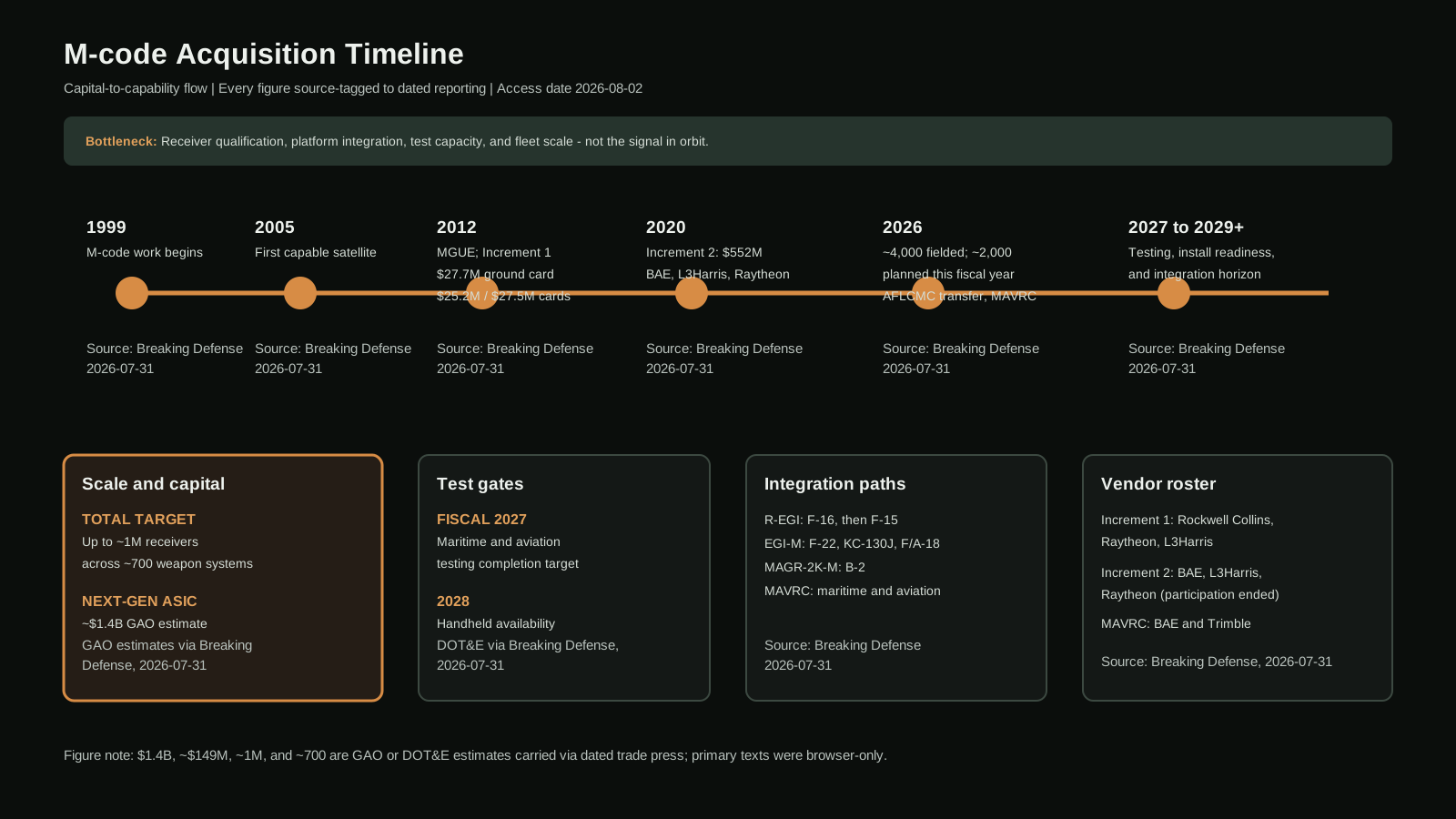
M-code is the jam- and spoof-resistant GPS signal. Work began in 1999 over jamming and spoofing concerns. The first M-code-capable GPS satellite launched in 2005, built by Lockheed Martin. The Pentagon hoped for initial operational capability across the services in 2009. The MGUE program, which builds the receivers and chip cards, began in 2012 after an earlier effort failed and moved to the Space Force in 2019. In July 2026 the Space Force and Air Force finalized the transfer of MGUE management to the Air Force Life Cycle Management Center. (Breaking Defense, July 31, 2026, accessed 2026-08-02.) Source confidence: Primary (trade press, verified HTTP 200). Signal strength: High.
That estimate is carried here as reported by Breaking Defense; GAO and DOT&E block automated fetch, and their reports are cited via the verified trade-press account. Source confidence: Mixed (GAO estimate via verified trade press). Signal strength: High.
| Program element | Value or scale | Timeline | | --- | --- | --- | | 2012 Increment 1 contracts | $27.7M ground card; $25.2M and $27.5M maritime/aviation cards | 2012 | | 2020 Increment 2 contracts | $552M (BAE, L3Harris, Raytheon) | first deliveries due 2026 | | Increment 2 next-gen ASIC | ~$1.4B GAO estimate | in development | | Increment 2 handheld radio | ~$149M GAO estimate (2020) | available 2028 per DOT&E | | Total receiver need | up to ~1M receivers across ~700 weapon systems | GAO estimate |
All table figures trace to the verified Breaking Defense reporting, with GAO and DOT&E estimates labeled as such; both agencies block automated fetch and their reports are cited via the verified trade-press account. Source confidence: Mixed (figures via verified trade press).
Who controls it?
The Space Force and Air Force control the program; the Air Force Life Cycle Management Center oversees service-wide integration after the July 17, 2026 transfer. The industrial side is a small roster. Increment 1 put Rockwell Collins, Raytheon, and L3Harris under contract in 2012. Increment 2 in 2020 issued contracts valued at $552 million to BAE, L3Harris, and Raytheon with a 2026 first-delivery deadline; Raytheon's participation has since ended without a stated reason in the coverage. On July 23, 2026, the Space Force announced agreements with BAE Systems and Trimble Military and Advanced Systems to develop a next-generation Maritime and Aviation Receiver Card (MAVRC), the first phase of a two-part prototyping, integration, and testing approach. Source confidence: Primary (trade press, verified HTTP 200). Signal strength: High.
Control of the schedule sits with test capacity and platform availability, not with the satellites. Destroyer testing depends on finding a ship in a deployed fleet, which is why Arleigh Burke operational testing has slipped to fiscal 2027.
Why should founders care?
Three mechanisms, not recommendations.
First, the program maps where defense-electronics demand is headed and where it is stuck. A million receivers across 700 systems is a procurement program of record: the market is real and large. Every test slip, software shortfall, and re-qualification moves demand later, and a company whose revenue depends on M-code test completion carries the program's slippage risk. Diligence the schedule, not the mission.
Second, the constraint sits downstream of the signal. Increment 1 testing for Army and Marine Corps ground vehicles is complete, and the Army has fielded nearly 4,000 M-code receivers to high-priority units, with another 2,000 planned by the end of the fiscal year. The maritime and aviation cards are the constraint: software shortfalls surfaced after they finished development, per the GAO's July 2, 2026 review (GAO blocks automated fetch; the review is cited via the verified trade-press account). One accuracy issue was resolved, and a navigation-precision glitch was fixed for the Gray Eagle, whose testing awaits a test and evaluation report expected in the fourth quarter of 2026.
Third, the integration paths are the demand forecast. R-EGI first equips the F-16 then the F-15; EGI-M covers the F-22, KC-130J, and F/A-18; MAGR-2K-M covers the B-2. Initial operational capability is anticipated on two platforms in fiscal 2027; R-EGI and EGI-M are install-ready in fiscal 2028, with IOC on one Air Force plane each in fiscal 2029. Revenue is in receiver cards, qualification, and software sustainment, and the program is building a sustainment strategy because software is never done. Source confidence: Primary for program facts; Analytical for the positioning read.
FAQ
Q: Why is the M-code rollout so slow if the satellites have broadcast for decades? A: Because the bottleneck is receivers and integration, not the signal. Receiver qualification, platform integration, test capacity, and software maturity are the binding stages, and each weapon system must be individually equipped and tested. Source confidence: Primary for the timeline; Analytical for the read.
Q: Who builds the receivers? A: BAE and L3Harris remain in the MGUE program. Raytheon's participation ended without a stated reason. BAE and Trimble are under MAVRC agreements announced July 23, 2026 for the next-generation maritime and aviation receiver card. Source confidence: Secondary (trade press).
Q: Is the GAO estimate of a million receivers reliable? A: The estimate is carried here as reported by Breaking Defense and labeled accordingly. GAO and DOT&E block automated fetch; their reports are cited via the verified trade-press account. Source confidence: Mixed.
Q: When will the handheld receiver arrive? A: The Increment 2 handheld radio is not expected until 2028, per DOT&E via Breaking Defense; the DOT&E primary is browser-only. The next-generation ASIC is in development, with a GAO estimate around $1.4 billion on a 2020 basis. Source confidence: Mixed.
Q: What does the July 2026 program transfer change? A: MGUE management moved to the Air Force Life Cycle Management Center, finalized July 17, 2026, consolidating service-wide integration under one office. It is a management change; the schedule constraints are unchanged. Source confidence: Primary.
Q: Where should a defense-electronics founder point capability? A: At the named integration paths and test gates: receiver cards, qualification, and software sustainment for R-EGI, EGI-M, MAGR-2K-M, and MAVRC. The program is a question of when, not whether, and the when is driven by test capacity and platform availability. Source confidence: Analytical.
Sources
- M-code program history, receiver scale, and fielding risk: GAO-21-145 and GAO-18-74. Primary. Detailed current test schedules and vendor status: Breaking Defense (July 31, 2026). Secondary.
- MGUE transfer and MAVRC agreements: AFLCMC transition record and Space Systems Command MAVRC release (accessed 2026-08-02). Primary.
- GAO estimates (up to ~1M receivers, ~700 weapon systems, ~$1.4B ASIC, ~$149M handheld) and GAO review of July 2, 2026: GAO (not machine-readable at the 2026-08-02 cutoff; figures carried via the verified trade-press account and labeled accordingly).
- DOT&E handheld timeline of 2028: DOT&E via defense.gov (not machine-readable at the 2026-08-02 cutoff; figures carried via the verified trade-press account and labeled accordingly).
- GPS program context: GPS.gov (accessed 2026-08-02). Primary.
- Program-of-record buying and non-dilutive capital context: Non-Dilutive Capital guide (accessed 2026-08-02). Site article.
- Defense procurement and program-of-record context: Bottleneck Map (accessed 2026-08-02). Site pillar.
Publication cutoff: 2026-08-02.
Methodology
This article follows the Bottleneck Map method. The bottleneck is assigned to Layer 7, Buyers, because the constraint is the program-of-record acquisition pipeline: the DoD as buyer, its qualification gates, and its fleet-scale integration. Layer 8, Strategic Capital, is connected because the program is a state-funded strategic program whose committed capital cannot accelerate the industrial throughput; the schedule is the constraint, not the funding.
Every claim carries a source-confidence classification per the editorial standards: Primary where a named, publicly verifiable source is cited inline; Mixed where GAO or DOT&E figures are carried through verified trade press with the primary text browser-only. GAO and DOT&E primary texts block automated fetch and are labeled browser-only rather than asserted; no URL is invented. Analytical classifications are hypotheses for navigation, not verified findings, and nothing here is legal, investment, procurement, or compliance advice.
Research cutoff and access date for all sources: 2026-08-02. Corrections: /connect/.
Stack & State is an editorial and ecosystem-intelligence publication. Nothing here is legal, investment, procurement, or compliance advice. Program details change; verify requirements with primary sources and qualified advisors.