Compute & AI Infrastructure
The Memory Wall: High Bandwidth Memory (HBM) Is Now the Binding Constraint on the AI Buildout
Micron's HBM and conventional dynamic random access memory (DRAM) contract book runs through 2030, a single Morgan Stanley estimate puts about 85 percent of 2027 HBM output with three buyers, and the shortage now shows up in accelerator configurations and Chinese chip prices: an operator-grade read of the contract book, the capacity pipeline, and who is exposed. (Binding-constraint thesis: Analytical; allocation estimate: Mixed, single-origin.)
Atomic answer
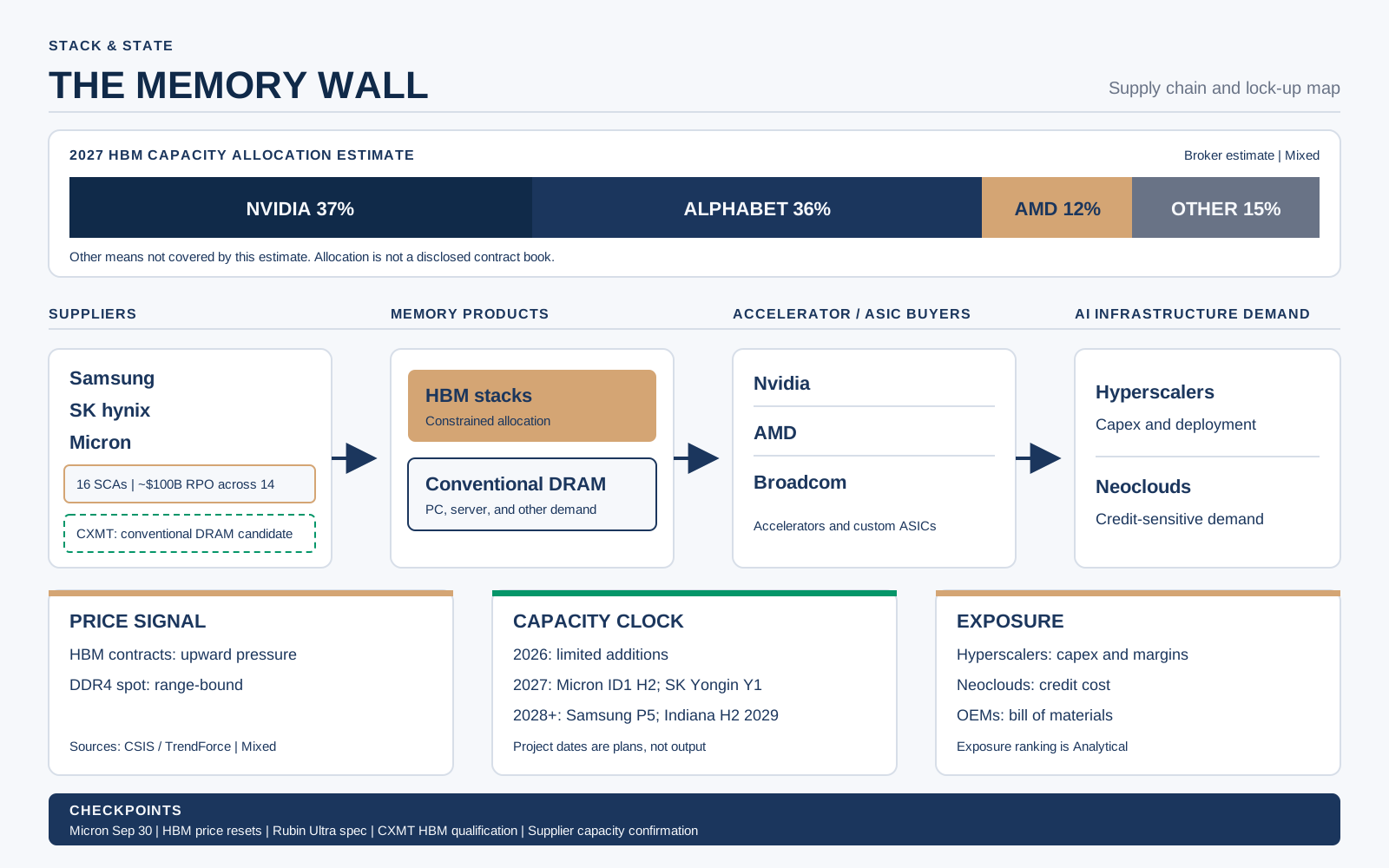
HBM and conventional DRAM have moved from a spot-market cycle to a contracted capacity market; that market-wide framing is Analytical, while the Micron figures below are Primary. Micron's fiscal Q3 2026 disclosure is the hardest evidence: 16 strategic customer agreements (SCAs) through calendar 2030, with 14 carrying roughly $100 billion of minimum-price remaining performance obligations (RPO) and a projection of $22 billion of customer deposits and commitments, about $18 billion of it cash (Primary). The Center for Strategic and International Studies (CSIS) calls the shortage structural and dates meaningful relief to 2028 at the earliest, though its 60 percent demand-coverage figure restates industry forecasts (Mixed). A Morgan Stanley estimate puts Nvidia, Alphabet, and AMD at about 85 percent of 2027 HBM capacity (Mixed, single-origin broker estimate). Contract prices are rising while the cited double data rate 4 (DDR4) 8G (1Gx8) 3200 spot grade stayed range-bound on 2026-09-21 to 2026-09-23 (Mixed; one consultancy's daily quote). The constraint shows up first in product configuration: TrendForce reports Nvidia decided to halve memory per module on its next platform (Mixed, reported), and Reuters reports Chinese accelerator makers are passing costs through (Primary). The Analytical read is that memory pricing, not packaging, is the pacing item. Micron's fiscal Q4 print on 2026-09-30 is the nearest hard test.
How tight is memory, really?
CSIS's 2026-09-17 report, "Beyond the Memory Cycle," argues the shortage is structural: scarcity should persist through 2027 and, by some industry estimates, into 2028, when significant new capacity is projected to come online. It maps a three-stage response: limited additions in 2026, meaningful expansion in 2027, and a larger post-2028 wave that "could either relieve scarcity or recreate the conditions for another glut." The report states that suppliers will meet only around 60 percent of global demand in calendar 2026 and that data centers are projected to consume approximately 70 percent of all memory devices produced worldwide in 2026. Both figures restate industry forecasts: direction Primary, precise values Mixed.
The price signal needs discipline. CSIS cites DDR4 prices up 700 to 800 percent since early 2025 (Mixed). TrendForce, via Businesskorea, forecasts conventional DRAM fixed contract prices up as much as 18 percent quarter over quarter in Q3 2026 (Mixed). TrendForce's spot bulletins for 2026-09-21 to 2026-09-23 put DDR4 8G (1Gx8) 3200 range-bound near US$45.89 to US$46.04 (Mixed, one consultancy's daily quote). Micron's own language is the counterweight: management described a "meaningful moderation in the rate of price increases" in its fiscal Q4 guidance commentary as revenue and margins set records (Primary).
The capacity signal matters more for a schedule. A new memory fab costs approximately $15 to $20 billion and takes two to three years or more (Mixed, industry rule of thumb via CSIS). HBM requires roughly four times the cleanroom capacity per gigabyte versus standard DRAM (Mixed, CSIS citing third-party analysis). The inventory picture is extraordinary if accurate: KB Securities stated on 2026-09-07 that Samsung and SK hynix hold less than 10 days of memory chips (Mixed, single-origin broker note; the definition of inventory is not public, so treat it as directional). Price tells you where the market clears today. Cleanroom intensity, fab lead time, and inventory days tell you when supply can answer.
Who has locked up the supply?
The Analytical read is that allocation, not price, is how this market clears. Morgan Stanley estimates that Nvidia has secured 37 percent of 2027 HBM capacity, Alphabet 36 percent, and AMD 12 percent, about 85 percent of next year's production (Mixed, single-origin broker estimate at second hand). The same report notes HBM requires upwards of three times the wafer capacity of ordinary DRAM and that ASML, the sole extreme ultraviolet (EUV) lithography supplier, is expanding capacity about 30 percent per year (Mixed). If roughly right, the 2027 merchant market is thin before any new entrant qualifies (Analytical).
The partnerships behind those shares are real but mostly not binding volume contracts. Nvidia and SK Group announced more than $500 billion of letters of intent (LOIs) spanning AI factories and memory on 2026-07-24, following a separate multiyear technology partnership announced 2026-06-07 (Primary, company releases; LOIs are not binding volume commitments). Samsung and Broadcom signed a memorandum of understanding (MOU) on 2026-07-24 (announced 2026-07-25), valued above $200 billion across memory and foundry through 2030, covering HBM4 and HBM4E (Primary, MOU). AMD signed a long-term memory deal with Samsung in March 2026 (Mixed, via secondary reporting). The binding layer sits underneath: SK hynix has finalized long-term agreements (LTAs) with around 10 customers (Primary), and Micron's 16 SCAs are the industry's most detailed contract disclosure.
Capacity plans stay concentrated in the same three suppliers. Businesskorea reports Samsung intends to raise HBM wafer input from 180,000 sheets per month in 2026 to 250,000 in 2027, a 40 percent increase, with HBM4-series products reaching 80 percent of HBM shipments, and puts SK hynix's M15X plan at about 10,000 to 80,000 sheets per month (Mixed, single-source trade press, no named attribution; not supplier guidance). The same report forecasts 2027 HBM demand growth at 56 percent against supply growth of 50 percent (Mixed, no named forecaster). ChangXin Memory Technologies (CXMT) reached 10 percent of global DRAM revenue share in Q2 2026, fourth place, but its Shanghai initial public offering (IPO) prospectus reportedly contains no HBM project (Mixed; a Counterpoint estimate via trade press). CXMT is a conventional-DRAM relief valve candidate, not an HBM answer in this window (Analytical).
What does the contract book tell you?
Micron's fiscal Q3 2026, which ended on 2026-05-28, is the clearest window into how AI memory is bought. The company disclosed 16 SCAs, generally five-year terms through calendar 2030, structured as take-or-pay with binding volume commitments and quarterly pricing inside floor and ceiling bands. Fourteen agreements carry approximately $100 billion of cumulative minimum-price remaining performance obligations (RPO). The company projects $22 billion of deposits and related commitments, about $18 billion of it cash. Management said the agreements "cannot be canceled," that deposits are not prepaid revenue, and that they are returned weighted to the back half (Primary).
First, the floor is the contract. Roughly $100 billion of minimum-price RPO across 14 agreements is disclosed downside protection, not upside. Watch whether agreement floors become the effective market price; if they do, the layer is loosening even while headline prices stay high (Analytical).
Second, customer deposits and commitments are a financing structure, not revenue. Micron projects $22 billion of deposits and related commitments, of which about $18 billion is cash; that cash is returned late in the term, so buyers are underwriting supplier capacity and taking return-of-capital and timing risk, not only price risk (Primary for the figures; Analytical for the interpretation).
Third, management judgment is not a contract. Micron said HBM demand for 2027 and 2028 is "far in excess" of its ability to supply, expects tight conditions "beyond calendar 2027," and now sees the HBM total addressable market (TAM) crossing $100 billion in 2027 rather than 2028. Those are management projections, not disclosed contract volumes (Analytical).
The price path is contested: Businesskorea reports a prevailing view that HBM4 prices in 2027 will be about 65 percent higher than 2026 (Mixed, HOLD: single-source, no named forecaster, a market expectation rather than a contract price, and in tension with Micron's moderation language and contractual price ceilings).
Where does the constraint bite first?
The first bite is the accelerator bill of materials. On Nvidia's fiscal Q2 2027 call on 2026-08-26, chief financial officer (CFO) Colette Kress described "extreme pricing conditions in memory," said increases had surpassed expectations and would keep rising, and warned memory costs would push down margins (Primary, company disclosure via press). The configuration changes are reported, not confirmed: TrendForce reported on 2026-08-04 that Nvidia decided to halve the Small Outline Compression Attached Memory Module (SOCAMM) capacity of next-generation Vera Rubin Superchip modules after concluding low-power double data rate 5X (LPDDR5X) supply constraints are likely to continue through 2027, and The Information and Tom's Hardware reported Nvidia testing Rubin Ultra configurations with as little as 192 GB of HBM and stepping back from HBM4E to HBM4 against a planned 1 TB (Mixed; not confirmed by Nvidia; the 192 GB figure is a test configuration, not a product specification).
Does that destroy demand or redistribute it? Fewer HBM bits per accelerator can coexist with more total HBM consumed if unit volumes rise. Only unit-volume disclosures settle it (Analytical).
The second bite is pass-through abroad. Reuters reported on 2026-09-10 that Huawei, Cambricon, MetaX, and Iluvatar CoreX are raising processor prices as the HBM shortage bites, with Huawei's Ascend 950DT indicated above 250,000 Chinese renminbi (RMB), a 20 to 50 percent increase from quotes two months earlier depending on contract terms; Huawei says the 950DT ships in Q4 2026 (Primary, wire exclusive).
The third bite is consumer and industrial demand destruction. CSIS documents average smartphone selling prices forecast up 14 percent in 2026 to an all-time high of $523, with sub-$100 phones no longer viable and some producers expected to exit; PC systems configured with 128 GB of memory up $575 to $765; and new automotive DRAM contracts forecast 70 to 100 percent higher in 2026. Tesla has warned the DRAM shortage will affect 2026 production, with Elon Musk saying the company must "hit the chip wall or make a fab" and planning a "TeraFab" integrating logic, memory, and packaging. TrendForce reports global smartphone production fell 8 percent year over year in Q2 2026 and forecasts full-year notebook shipments down 9.4 percent, with memory cost pressure a stated factor (Mixed; CSIS compiles secondary press; TrendForce figures are consultancy data).
On packaging, all three HBM suppliers have qualified for Vera Rubin, and TrendForce expects CoWoS-L (Chip on Wafer on Substrate) to remain mainstream through 2028 (Mixed). The constraint has moved up the stack from the package to the memory it carries (Analytical).
What breaks if it persists?
The exposure map runs from hyperscaler capex through neocloud credit. CSIS puts 2024 AI-capable data center investment by Meta, Microsoft, Amazon, and Alphabet at $217 billion, rising to $380 billion in 2025 and projected at $650 billion in 2026 (Mixed). CSIS also reports that OpenAI reportedly agreed in October 2025 to purchase up to 900,000 DRAM wafers per month for Stargate, about 40 percent of global DRAM output; the agreements are not public, and stockpiling is a reported consequence rather than a verified one (Mixed, HOLD).
The house credit-stack article documents Morgan Stanley's roughly $2.9 trillion data center capex estimate through 2028 with a $1.5 trillion external financing gap, Bank for International Settlements private credit to AI firms above $200 billion, CoreWeave credit default swaps near 855 basis points against roughly $35 billion of debt, and Oracle at BBB- from S&P. Memory cost inflation raises the working capital and bill-of-materials burden on every layer of that stack as financing costs rise. No source quantifies memory cost as a share of data center capex, so the transmission to credit stress is a hypothesis, not a measured relationship (Analytical).
Policy is a live second channel. CSIS reports that Commerce Secretary Howard Lutnick has threatened 100 percent tariffs on major overseas memory producers, notably Samsung and SK hynix, unless they significantly expand US-based production (Mixed; a stated threat with no implementing action). HBM above a memory bandwidth density of 2 gigabytes per second per square millimeter is controlled under Export Control Classification Number (ECCN) 3A090.c, extended through the foreign direct product rule and applied to South Korean firms in China; the January 2026 Bureau of Industry and Security (BIS) rule moved H200-class advanced computing exports to China and Macau to case-by-case review with supply, testing, and 50 percent volume conditions, while third-country reexports remain under a presumption of denial (Primary).
The relief valve, when it comes, will hurt somewhere. If consumer and auto demand keeps shrinking, that memory returns to the allocation pool, but only by shrinking the unit markets that fund the conventional DRAM base (Analytical).
Who pays for the capacity race?
The suppliers pay first, out of record profits. SK hynix reported Q2 2026 revenue of 79.3187 trillion South Korean won (KRW), up 257 percent year over year, operating profit of KRW 60.5426 trillion (76 percent margin), and net cash of KRW 69.4 trillion (Primary; preliminary figures subject to audit). Samsung reported Q2 2026 revenue of KRW 171.5 trillion, up 28 percent quarter over quarter, and operating profit of KRW 89.5 trillion, with the Device Solutions division contributing KRW 89.2 trillion, about 99.7 percent of the total, and memory revenue of KRW 120.8 trillion, up 471 percent year over year (Primary headline; Mixed segment split). That those profits fund the build is an inference, not a traced funding path (Analytical).
The build is large and late. SK hynix broke ground on its Indiana advanced packaging fab on 2026-08-27: more than $4 billion, cleanroom by October 2028, HBM mass production in H2 2029, wafers made in Korea and packaged in Indiana (Primary). CSIS maps the rest: Micron's ID1 fab near Boise (about 600,000 square feet of cleanroom, first output H2 2027); SK hynix's $400 billion Yongin cluster (Y1 completion 2027, 150,000 wafers per month by end-2028); Samsung's P5 (resumed after a six-month pause, 2028 start-up at 100,000 to 120,000 wafers per month); and Micron's Singapore and Taiwan (ex-Powerchip) shipments from 2028 (Mixed; CSIS compiling company disclosures and trade press; all capacity figures are plans, not output).
Public capital covers part of the bill. Micron receives roughly $6.2 billion in direct CHIPS and Science Act funding plus up to $275 million proposed for Manassas, and raised its US investment commitment above $250 billion through 2035; New York committed $5.5 billion, Japan $3.6 billion for Hiroshima, and India and Gujarat fund about 70 percent of Micron's $2.75 billion Sanand facility, opened February 2026. SK hynix receives nearly $1 billion in US grants and loans for Indiana (Mixed; CSIS compiling public awards). Micron chief executive officer (CEO) Sanjay Mehrotra says the US share of global memory production could grow from about 2 percent to around 10 percent (Analytical, a CEO projection).
Customer deposits and commitments are the fourth payer: Micron projects roughly $22 billion of deposits and related commitments, about $18 billion of it cash. The deposits are non-dilutive capacity capital that customers provide and get back, weighted to the back half of five-year terms; the return applies to deposits, not to the full projected commitment (Primary for the projection). Hyperscalers carry the demand side, with $217 billion of 2024 investment growing to a projected $650 billion in 2026 (Mixed, CSIS). The open question is where the margin lands. Nvidia has warned on margins, Chinese accelerator makers are passing prices through, and PC makers have raised prices on 128 GB configurations by $575 to $765 (Mixed, CSIS compiling secondary press). Whether server and hyperscaler buyers absorb the rest depends on contract terms that are not public (Analytical).
What would change this view
- Micron's fiscal Q4 print on 2026-09-30. Watch fiscal 2027 capex guidance, whether "tight beyond calendar 2027" is extended or narrowed, SCA deposit trajectory, and gross margin against the approximately 86 percent guide (Primary for the date and June guidance; Mixed for consensus of roughly $50.6 to $50.8 billion revenue and $31.27 to $31.43 of earnings per share).
- HBM contract prices falling before calendar 2028. The 2027 expectation of a 65 percent increase is a single-source market view; a signed contract at or below 2026 levels would falsify the shortage read (Mixed, HOLD).
- Nvidia restoring Rubin Ultra memory specifications. The 192 GB test configuration and the HBM4 step back are reported, not confirmed; a return to 1 TB-class plans, or confirmation the reduction is permanent, resolves the demand-destruction question (Mixed).
- CXMT qualifying HBM at volume. Counterpoint says CXMT targets HBM production from the end of 2026, while the IPO prospectus reportedly contains no HBM project; a qualified, yielding line would be the first genuine supply surprise (Mixed).
- Supplier confirmation of single-source capacity plans. Samsung's 180,000 to 250,000 wafer input and SK hynix's M15X 10,000 to 80,000 are trade-press figures; company confirmation or a disclosed ramp would move the capacity clock (Mixed).
- The next pricing checkpoints. Samsung's preliminary Q3 2026 results in early October and SK hynix's Q3 report in late October follow Micron; a demand air pocket would show there first (Analytical).
FAQ
Q: Is this just the memory cycle again? A: CSIS argues no: the demand shock is structural, with a capacity response that runs 2026 (limited), 2027 (meaningful), and post-2028 (potentially glut-forming). Micron's contract book is consistent with the structural read: 16 take-or-pay agreements through 2030 with binding volume commitments, quarterly pricing bands, and roughly $100 billion of minimum-price RPO at one supplier. (Primary for the Micron structure; Mixed for the CSIS framing; Analytical for the structural inference.)
Q: What is the single number to watch? A: Micron's SCA deposit trajectory on 2026-09-30. Micron projects $22 billion of deposits and related commitments, about $18 billion of it cash; the cash is returned, not recognized as revenue, weighted to the back half of five-year terms. Whether continued funding at the projected scale confirms the contracted-shortage read is an Analytical inference, not something the disclosure states. (Primary for the figures; Analytical for the inference.)
Q: Why do LOIs and MOUs matter if they are not binding? A: They may set allocation priority and qualification pipelines before contracts are signed, but no public filing establishes that priority as a contractual right; the priority mechanism is a possibility, not a disclosed term (Analytical). The Nvidia-SK Group package above $500 billion and the Samsung-Broadcom MOU above $200 billion are not volume commitments, so they inform the map without carrying contract weight. (Primary for the instruments; Analytical for the priority mechanism.)
Q: Does cutting memory per accelerator reduce memory demand? A: Not necessarily. Fewer bits per unit can coexist with more total bits if unit volumes rise, and Nvidia's changes are reported test configurations, not specifications. Total bit consumption is the number that matters, and it is not disclosed. (Analytical.)
Q: Can CXMT relieve the shortage? A: For conventional DRAM, partially and later: CXMT reached 10 percent of global DRAM revenue share in Q2 2026 and is projected to exit 2026 at roughly 350,000 wafer starts per month (Mixed, estimates via trade press). For HBM, the IPO prospectus reportedly contains no HBM project, and the timeline is an analyst statement, not a company commitment. (Mixed.)
Q: Who is most exposed if tightness persists? A: The layers that cannot pass price through quickly: neoclouds, where credit markets are already pricing stress (CoreWeave credit default swaps near 855 basis points against roughly $35 billion of debt, per the house credit-stack article); PC makers and buyers facing documented price increases of $575 to $765 on 128 GB configurations (Mixed, CSIS compiling secondary press); and consumer and auto demand that is already shrinking. Hyperscalers have the balance sheets but face margin compression through accelerator costs. The ranking is Analytical, not a measured exposure map. (Analytical.)
Sources
- CSIS, "Beyond the Memory Cycle: AI, HBM, and the New Semiconductor Shortage," structural shortage, 60 percent demand coverage, 70 percent data center share, 4x cleanroom intensity, $15-20 billion fab cost: csis.org (2026-09-17, accessed 2026-09-23). Primary direction, Mixed values.
- Micron Technology, Q3 FY2026 results press release and Securities and Exchange Commission (SEC) Exhibit 99.1, 16 SCAs, take-or-pay, approximately $100 billion minimum-price RPO across 14, $22 billion projected deposits and commitments: sec.gov (2026-06-24, accessed 2026-09-23). Primary.
- Micron Technology, Q3 FY2026 earnings call prepared remarks, demand "far in excess" of supply, tight beyond calendar 2027, HBM TAM above $100 billion in 2027, moderation in the rate of price increases: investors.micron.com (2026-06-24, accessed 2026-09-23). Primary.
- SK hynix, "SK hynix Announces 2Q26 Financial Results," KRW 79.3187 trillion revenue, 76 percent operating margin, about 10 LTAs, net cash KRW 69.4 trillion, HBM4 mass shipments: news.skhynix.com (2026-07-29, accessed 2026-09-23). Primary.
- Samsung Electronics, Q2 2026 results, KRW 171.5 trillion revenue, KRW 89.5 trillion operating profit, Device Solutions at KRW 89.2 trillion: news.samsung.com (2026-07-30, accessed 2026-09-23). Primary.
- TrendForce, Samsung segment summary, Device Solutions at 99.7 percent of profit, HBM4 revenue expected to triple in Q3: trendforce.com (2026-07-30, accessed 2026-09-23). Mixed.
- The Motley Fool citing Morgan Stanley, 37 percent Nvidia, 36 percent Alphabet, 12 percent AMD of 2027 HBM capacity, 3x wafer capacity, ASML at about 30 percent expansion: fool.com (2026-09-18, accessed 2026-09-23). Mixed.
- NVIDIA, SK Group and NVIDIA partnership of letters of intent above $500 billion across AI factories and memory: nvidianews.nvidia.com (2026-07-24, accessed 2026-09-23). Primary, non-binding.
- Samsung Electronics, Samsung and Broadcom expand strategic collaboration, MOU above $200 billion across memory and foundry through 2030 (MOU signed 2026-07-24; company release dated 2026-07-25; accessed 2026-09-23): news.samsung.com. Primary, MOU.
- Businesskorea, "Samsung, SK hynix Race to Expand HBM Output as Supply Remains Tight," 180,000 to 250,000 wafer input, M15X 10,000 to 80,000, 56 percent versus 50 percent growth, 65 percent HBM4 price view: businesskorea.co.kr (2026-09-23, accessed 2026-09-23). Mixed, single-source.
- Business Insider, Nvidia earnings recap, CFO "extreme pricing conditions in memory," margins warned: businessinsider.com (August 2026, accessed 2026-09-23). Primary via press.
- TrendForce, DRAM tight in 2027, NVIDIA to lower HBM configurations for Rubin Ultra, SOCAMM halved on LPDDR5X: trendforce.com (2026-08-04, accessed 2026-09-23). Mixed.
- The Information, Nvidia weighs lower Rubin Ultra memory: theinformation.com (2026-08-06, accessed 2026-09-23); Tom's Hardware, Rubin Ultra test configurations as low as 192 GB and a step back to HBM4: tomshardware.com (2026-08-12, accessed 2026-09-23). Mixed.
- TrendForce, CoWoS-L to remain mainstream AI packaging through 2028: trendforce.com (2026-09-18, accessed 2026-09-23). Mixed.
- TrendForce, enterprise SSD prices rising into Q4 2026 on North American cloud service provider (CSP) demand: trendforce.com (2026-09-21, accessed 2026-09-23); TrendForce, DRAM module revenue up 59 percent in 2025: trendforce.com (2026-09-22, accessed 2026-09-23). Mixed.
- TrendForce daily DRAM spot bulletins, DDR4 8G (1Gx8) 3200 near US$45.89 to US$46.04, low activity: trendforce.com (2026-09-21 to 2026-09-23, accessed 2026-09-23). Mixed, single consultancy.
- Chosun, "Samsung Electronics, SK Hynix Face Memory Shortage as Inventories Drop," KB Securities note of under 10 days of inventory: chosun.com (2026-09-08, accessed 2026-09-23). Mixed, single-origin.
- Reuters, "China's AI chipmakers raise prices as high-bandwidth memory shortage bites," Huawei Ascend 950DT above RMB 250,000, 20 to 50 percent increases: reuters.com (2026-09-10, accessed 2026-09-23). Primary.
- CNBC, CXMT Shanghai debut and HBM targets: cnbc.com (2026-07-31, accessed 2026-09-23); Tom's Hardware, CXMT targets 30 percent DRAM share by 2030 and posts a 466 percent IPO jump with no HBM project in the prospectus: tomshardware.com (2026-07-27, accessed 2026-09-23). Mixed.
- SK hynix, Indiana groundbreaking, more than $4 billion, cleanroom October 2028, mass production H2 2029: news.skhynix.com (2026-08-28, accessed 2026-09-23). Primary.
- Federal Register, revision to license review policy for advanced computing commodities, case-by-case review for H200-class exports to China and Macau: federalregister.gov (2026-01-15, accessed 2026-09-23). Primary.
- BIS, enforcement guidance on license requirements for advanced computing: bis.gov (2026-05-31, accessed 2026-09-23). Primary.
- Torres Trade and Export Law, ECCN 3A090.c HBM controls and License Exception HBM: torrestradelaw.com (2025-01-07, accessed 2026-09-23). Primary for the rule summary.
- TrendForce, smartphone production down 8 percent year over year in Q2 2026: trendforce.com (2026-09-08, accessed 2026-09-23); TrendForce, notebook shipments forecast down 9.4 percent in 2026: trendforce.com (2026-09-04, accessed 2026-09-23). Mixed.
- The Motley Fool, Micron fiscal Q4 date of 2026-09-30 and preview: fool.com (2026-09-22, accessed 2026-09-23); Vantage Markets, Micron fiscal Q4 earnings date: vantagemarkets.com (2026-09-23, accessed 2026-09-23). Primary for the date.
- AD Hoc News citing MarketBeat, Micron fiscal Q4 consensus of approximately $50.6 to $50.8 billion revenue and $31.27 to $31.43 earnings per share: ad-hoc-news.de (2026-09-23, accessed 2026-09-23). Mixed, aggregator.
- Stack & State, "The AI Infrastructure Credit Stack," Morgan Stanley $2.9 trillion estimate and $1.5 trillion gap, Bank for International Settlements private credit above $200 billion, CoreWeave credit default swaps near 855 basis points and roughly $35 billion of debt, Oracle at BBB-: stackandstate.com (updated 2026-09-18, accessed 2026-09-23). Primary for the cited disclosures; Analytical for the transmission to memory costs.
Methodology
This article follows the Bottleneck Map method. The primary constraint is assigned to Layer 3, Compute & AI Infrastructure, because the question is whether the AI buildout can actually be served; Layer 1 (Materials & Processing) is connected through the memory wafer base, Layer 6 (Non-Dilutive Capital) through customer deposits, CHIPS awards, and public incentives, and Layer 8 (Strategic Capital & CVCs) through the Nvidia-SK, Samsung-Broadcom, and AMD-Samsung partnership structures. Claims are labeled Primary, Mixed, or Analytical per the editorial standards; single-source or unverified items are flagged HOLD in the text. Research cutoff and access date for all sources: 2026-09-23.
Stack & State is an editorial and ecosystem-intelligence publication. Nothing here is legal, investment, procurement, or compliance advice. Program details change; verify requirements with primary sources and qualified advisors.
Verified sources
- CSIS, Beyond the Memory Cycle: AI, HBM, and the New Semiconductor Shortage (2026-09-17)
- Micron Technology, Q3 FY2026 results press release and SEC Exhibit 99.1 (2026-06-24)
- Micron Technology, Q3 FY2026 earnings call prepared remarks (2026-06-24)
- SK hynix, 2Q26 financial results (2026-07-29)
- Samsung Electronics, Q2 2026 results (2026-07-30)
- Motley Fool citing Morgan Stanley, 2027 HBM capacity allocation estimate (2026-09-18)
- NVIDIA, SK Group and NVIDIA letters of intent above $500 billion (2026-07-24)
- Samsung Electronics and Broadcom MOU above $200 billion (2026-07-25)
- Businesskorea, Samsung and SK hynix HBM output expansion (2026-09-23)
- TrendForce, NVIDIA to lower HBM configurations for Rubin Ultra (2026-08-04)
- Chosun, Samsung and SK hynix inventories below 10 days (KB Securities note, 2026-09-08)
- Reuters, China's AI chipmakers raise prices as HBM shortage bites (2026-09-10)
- SK hynix, Indiana groundbreaking (2026-08-28)
- Federal Register, revision to license review policy for advanced computing commodities (2026-01-15)
- Stack & State, The AI Infrastructure Credit Stack (updated 2026-09-18)
- AD Hoc News citing MarketBeat, Micron fiscal Q4 consensus (2026-09-23)
Last verified