Energy & Grid
The Offtake Map: Where Purchase Commitments Are (and Aren't) Becoming Contracts
Public capital starts capacity. Purchase commitments make it permanent. This is the map of where offtake is becoming a real, named contract by sector, and where it is still an announcement.
Atomic answer
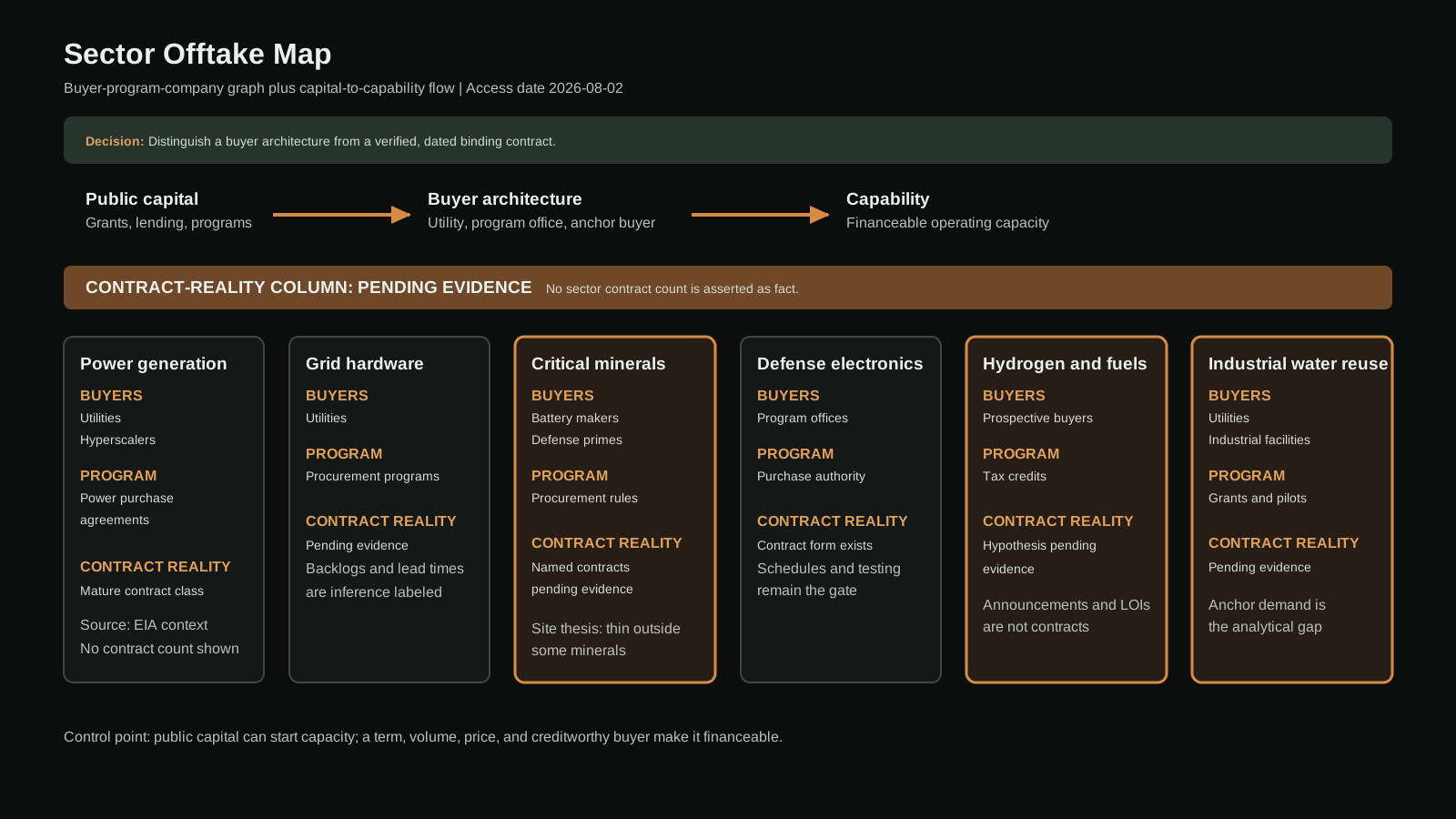
The Bottleneck Map names offtake as the bridge between policy and production: public capital starts capacity, and only purchase commitments make it permanent. This piece makes that claim concrete by sector. The sector contract-reality column is published as pending evidence: three named offtake contracts or program-of-record commitments could not be verified from dated sources at the 2026-08-02 cutoff. What is verified is the buyer architecture. Power generation runs a mature power purchase agreement contract class. Grid hardware buys through utility procurement programs with multi-year order backlogs. Critical minerals offtake is thin outside a few minerals. Defense electronics buys through program-of-record authority with named budgets. The practical distinction: an announcement is a press release, an LOI, or a reservation. A contract is a term, a volume, a price, a buyer with credit, and a default. Source confidence: Mixed for the sector rows (verified architecture, pending contract counts). Signal strength: Medium.
Who is this for?
This article is for the materials, grid-hardware, or energy-hardware founder deciding whether a facility, a processing line, or a product line can reach financial close; for the allocator or corporate venture investor underwriting capacity announcements; and for the government program official deciding whether an award funds capacity or confirms demand.
The decision in front of each reader is the same: can you tell which sectors already have a buyer in the room before a facility breaks ground, and which are still living on public-capital announcements? If you can read a project at its real contract stage, you can tell the difference between a revenue stream and a press release.
Where does it actually bottleneck?
The bottleneck is in Layer 7, Buyers. Capacity is not the scarce stage. Capacity gets announced everywhere: steel mills, battery plants, hydrogen projects, reuse facilities, and receiver fleets all produce ribbon-cuttings. What is scarce is the revenue that keeps a facility running after the ribbon is cut. A government grant or loan can start construction; it cannot generate revenue. For a project-financed asset, the lender wants a term, a volume, a price, and a creditworthy counterparty. Offtake is that revenue made contract.
| Sector | Buyer architecture | Contract reality now | Evidence level | | --- | --- | --- | --- | | Power generation | Utilities and hyperscalers sign power purchase agreements | Mature contract class; long-term PPAs are standard and financeable | Verified (EIA power market context) | | Grid hardware | Utility procurement programs specify and order transformers and switchgear | Multi-year order backlogs; lead times are the gate, not contract form | Inference, pending | | Critical minerals | Battery makers, defense primes, and energy developers sign long-term offtake | Thin outside a few minerals; the classic gap stage | Site thesis; named contracts pending | | Defense electronics | Program-of-record buying and purchase authority with named budgets | Contract form exists; schedules and testing are the gate | Verified (trade press) | | Hydrogen and clean fuels | Tax credits plus prospective buyers | Mostly announcements and LOIs; little bankable term | Hypothesis, pending | | Industrial water reuse | Utilities and industrial facilities as anchor buyers | Grants dominate; revenue contracts are the gap | Inference, pending |
The contract-reality column is explicitly pending evidence for every sector where a named, dated contract could not be verified at the 2026-08-02 cutoff. No sector contract count is asserted as fact. Source confidence: Primary for the power, defense, and federal-program rows; Analytical or Hypothesis for the pending rows.
The GSA's OneGov effort claims $1.1 billion in first-year savings through consolidated federal purchasing. That figure is the agency's own claim and is not independently verified; it is presented here as a claim, never as fact. (GSA release, accessed 2026-08-02.) Source confidence: Primary as agency claim, not independently verified. Signal strength: Medium.
Who controls it?
Control sits with the buyer side, and the buyer side is concentrating. In power, utilities and hyperscalers set the contract terms that make generation bankable. In grid hardware, utility procurement programs control the order books. In defense, program offices hold purchase authority with named budgets. The minerals executive order and its waiver mechanics, covered by Breaking Defense in July 2026, are a second example of procurement rules reshaping who can sell and to whom. (Breaking Defense, July 2026, accessed 2026-08-02.) Source confidence: Secondary (Breaking Defense analysis); the underlying waiver rules are corroborated by Executive Order 14415. Signal strength: High.
When demand concentrates into fewer, larger contracts, the offtake a single buyer can provide grows, and the facilities that sign that buyer have an easier path to financial close. Buyer architecture is changing faster than most coverage of individual projects suggests. Source confidence: Analytical (Stack & State ecosystem observation).
Why should founders care?
Three mechanisms, not recommendations.
First, bankability is a contract property, not an engineering property. A lender counts revenue the project can document: a signed term with a creditworthy buyer is bankable, while an LOI is a direction of intent and a reservation is a queue position. The gap between the two is where capital is either mispriced or priced correctly, and a founder who presents an LOI as revenue is carrying the discount.
Second, offtake is allocation priority. When supply tightens, processors serve their offtake partners first; a spot buyer is last in line. For a materials or grid-hardware founder, the purchase commitment is also the instrument that converts a pilot-scale domestic processor into a financeable line, which is the same mechanism the site maps in critical minerals: processing capacity does not come online because a feasibility study is funded, it comes online because a buyer has signed.
Third, government demand is changing shape. Federal lending can finance industrial capacity once a project is bankable, but it cannot create the revenue that makes it bankable. (DOE Loan Programs Office, accessed 2026-08-02.) Source confidence: Primary. Signal strength: High. The Office of Energy Dominance Financing can start a line; multi-year purchase commitments decide whether it operates past its first cycle. Programs that fund capacity without confirming demand create stranded assets.
FAQ
Q: What is the difference between an offtake agreement and a tolling agreement? A: An offtake agreement is a purchase commitment for finished output at a specified volume and price. A tolling agreement has the buyer provide feedstock and pay a conversion fee, retaining ownership of the material throughout. Tolling requires less capital commitment but is harder to find in critical minerals. Source confidence: Analytical.
Q: Is the GSA OneGov savings figure real? A: It is the agency's own claim of $1.1 billion in first-year savings, and it is not independently verified. Treat it as a directional signal about consolidated purchasing, not as an audited number. Source confidence: Primary as agency claim; not independently verified.
Q: Which sectors have real offtake today? A: Power generation is the mature case: long-term power purchase agreements are standard and financeable. Defense electronics buys through program-of-record authority. Every other sector in this map has a contract-reality column labeled pending evidence, because named, dated contracts could not be verified at the 2026-08-02 cutoff. Source confidence: Mixed.
Q: Why does hydrogen get so much capital and so few contracts? A: That is the pending hypothesis of this map: tax credits and project announcements are real, while binding offtake terms remain thin relative to announced capacity. The column is labeled Hypothesis, not fact, until dated offtake terms are verified. Source confidence: Hypothesis.
Q: What should a founder bring to a lender? A: A term, a volume, a price, and a counterparty with credit. A term sheet from a strategic buyer is worth more to a lender than a milestone grant, because it is revenue the lender can underwrite. Source confidence: Analytical.
Q: What would change this map? A: Named offtake contracts appearing in the thin sectors. If binding contracts proliferate in hydrogen, clean fuels, or water reuse, the scarcity framing narrows to the sectors that remain thin. The map is built to be falsifiable. Source confidence: Analytical.
Sources
- Power offtake as a mature contract class and grid/power market context: EIA Today in Energy (accessed 2026-08-02). Primary.
- Federal lending mandate for commercial-scale capacity once bankable: DOE Loan Programs Office (accessed 2026-08-02). Primary.
- GSA OneGov first-year savings claim of $1.1 billion: GSA news release (accessed 2026-08-02). Primary as agency claim; not independently verified.
- Minerals procurement rules and waiver mechanics reshaping buyer access: Breaking Defense (July 2026, accessed 2026-08-02). Secondary (trade press).
- Offtake as the gap between public capital and permanent capacity: Bottleneck Map (accessed 2026-08-02). Site pillar.
- Processing capacity needs offtake, not only funding: Materials Bottleneck article (accessed 2026-08-02). Site article.
- Offtake as the bridge between public capital and permanent capacity, energy cluster context: Upstream Bottlenecks: Electrical Steel, Quantum, and Grid (accessed 2026-08-02). Site article.
- Processing, magnet, and offtake stages in critical minerals: China Rare-Earth Controls: Processing Is the Real Bottleneck (accessed 2026-08-02). Site article.
Publication cutoff: 2026-08-02.
Methodology
This article follows the Bottleneck Map method. The bottleneck is assigned to Layer 7, Buyers, because the scarce stage is the purchase commitment itself, not the capacity: the constraint is that the revenue contract a lender will count does not exist in enough sectors.
Every claim carries a source-confidence classification per the editorial standards: Primary where a named, publicly verifiable institutional or trade-press source is cited inline; Mixed where verified architecture is combined with pending contract evidence; Analytical where the claim reflects Stack & State ecosystem observation. Analytical and Hypothesis classifications are hypotheses for navigation, not verified findings. Fewer than three named offtake contracts or program-of-record commitments could be verified from dated sources at the 2026-08-02 cutoff, so the contract-reality column is published as pending evidence and no sector contract counts are asserted as fact. The GSA $1.1 billion savings figure is presented as an agency claim, never as fact.
Research cutoff and access date for all sources: 2026-08-02. Corrections: /connect/.
Stack & State is an editorial and ecosystem-intelligence publication. Nothing here is legal, investment, procurement, or compliance advice. Program details change; verify requirements with primary sources and qualified advisors.