Energy, Power & Critical-Minerals Supply Chain
Upstream Bottlenecks: Electrical Steel, Quantum, and Grid
Why the binding constraint sits upstream of the visible assembly line, and what that means for founders building grid hardware, transformers, and cryptographic discovery tooling
Atomic answer
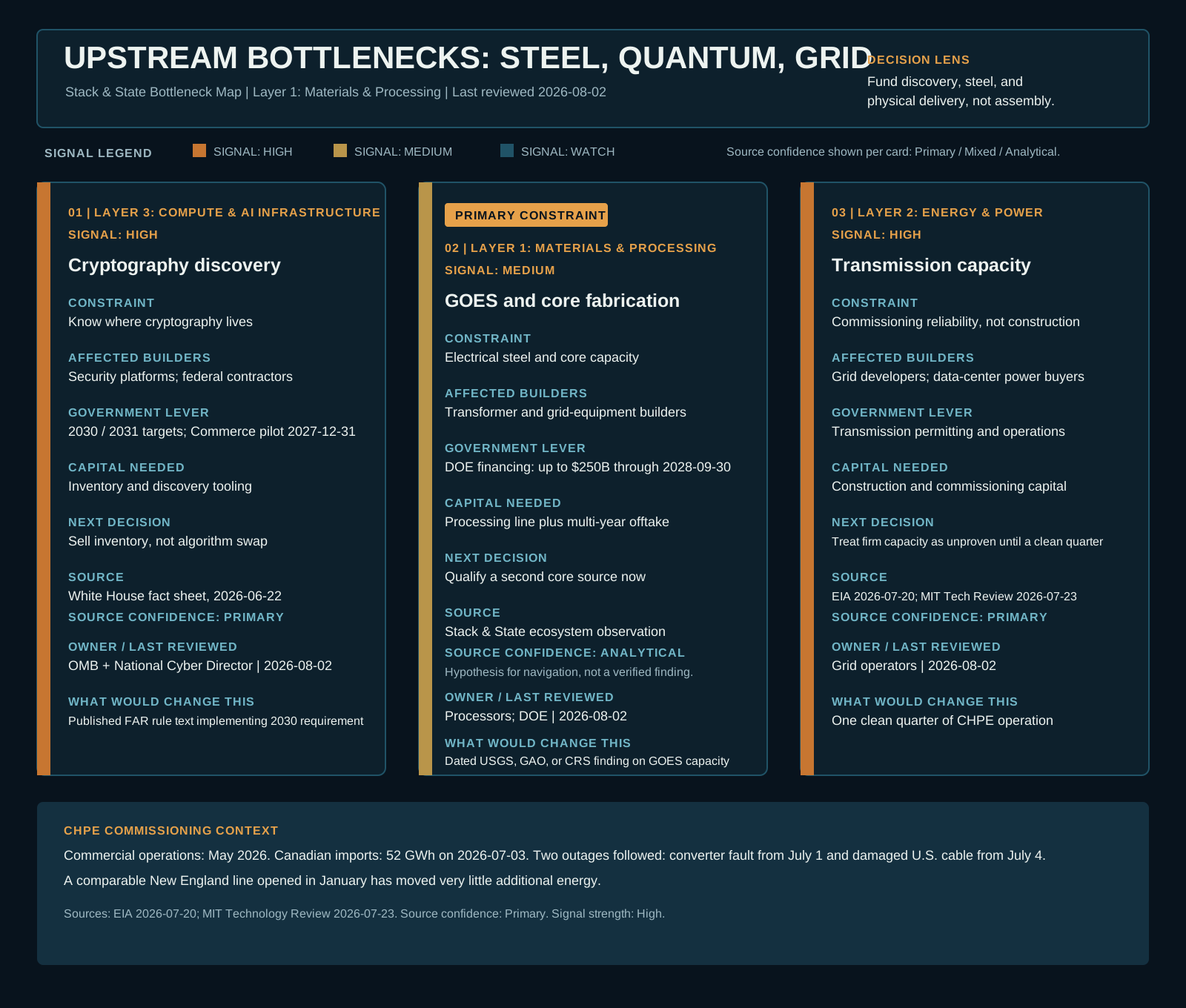
The binding constraint in the grid and quantum buildout is upstream of the stage that gets blamed. Post-quantum migration bottlenecks at cryptographic discovery, transformer delivery at grain-oriented electrical steel and core fabrication, and grid capacity at physical construction and commissioning. The primary constraint operates in Materials & Processing, with grid delivery and quantum migration as connected layers.
Who is this for?
This article is for two operators and the allocator who underwrites both.
The first is the hardware founder whose bill of materials or delivery schedule runs through a transformer, a converter station, or a specialty alloy: grid equipment, power electronics, electrification hardware, data-center power, industrial heat. The decision you face is whether to treat a quoted lead time as a supplier problem or as a capacity problem. If it is a capacity problem, the mitigation is qualification of a second processing source and a purchase commitment that is long enough to be financeable, not a better purchase order.
The second is the security platform or federal contractor operating under the post-quantum clock. The decision you face in the next four quarters is whether to sell algorithm replacement or cryptographic inventory. The federal deadlines convert inventory from a hygiene project into a procurement line item, and a contractor that cannot enumerate its own cryptographic surface is holding deferred technical debt that a dated requirement turns into cost.
The third is the capital allocator, strategic or non-dilutive, deciding where a dollar changes the constraint. In all three chains, the dollar that moves the constraint is placed upstream of the stage that is generating the headline.
Where does the buildout actually bottleneck?
Three chains, one shape.
Cryptographic migration bottlenecks at discovery, not selection. On 2026-06-22 the White House released a fact sheet accompanying an Executive Order directing the Office of Management and Budget and the National Cyber Director to lead an accelerated, nationwide migration to post-quantum cryptography. The order directs agencies to designate a post-quantum cryptography migration lead, sets transition targets for high-value assets in 2030 and 2031 depending on the use case, and directs Commerce to complete a post-quantum cryptography migration pilot by December 31, 2027. (White House fact sheet, 2026-06-22.) Source confidence: Primary (whitehouse.gov fact sheet, accessed 2026-08-02). Signal strength: High.
The algorithms are already standardized. What is not standardized is knowing where cryptography lives inside a large estate: embedded firmware, third-party libraries, hardware security modules, expired certificates nobody owns. That inventory step is the constraint, and it is the step the deadlines price. Source confidence: Analytical (Stack & State ecosystem observation).
Transformer delivery bottlenecks at electrical steel. Transformer lead times trace upstream to grain-oriented electrical steel mill capacity and core fabrication rather than to transformer assembly floors. A transformer plant with idle assembly capacity and no core steel is a plant that cannot ship. This is a synthesis across our internal evidence base rather than a single dated external finding, and it is classified accordingly. Source confidence: Analytical (Stack & State ecosystem observation and pattern recognition). Signal strength: Medium. Readers should treat it as a hypothesis for navigation, not a verified quantitative finding.
Grid capacity bottlenecks at physical delivery and commissioning. The Champlain Hudson Power Express, a 1,250 MW high-voltage line from Quebec into New York City, reached commercial operations in May 2026 after roughly three years of construction. On July 3, 2026, NYISO imported 52 gigawatt-hours from Canada, the most traded between the two areas since January 2025; the line was fully utilized that day and Canadian imports met 9 percent of NYISO demand. (EIA Today in Energy, 2026-07-20.) Source confidence: Primary (eia.gov, accessed 2026-08-02).
That single day is not the month. MIT Technology Review reported on 2026-07-23 that the line has seen two outages since opening: one beginning July 1 attributed to a converter issue on the Canadian side, and a second beginning July 4 caused by a damaged section of cable on the United States side that remained unresolved as of July 22, 2026. The record import fell in the window between them. The same reporting notes that a comparable New England line that opened in January has moved very little additional energy, and that three years of drought in Quebec have eaten into the water reserves used to generate the electricity the line carries. (MIT Technology Review, 2026-07-23.) Source confidence: Primary (named institutional reporting, accessed 2026-08-02). Signal strength: High.
The correct read is not that transmission buildout fails. It is that reaching commercial operations and delivering reliable energy are two different milestones, and commissioning reliability is unproven until a line has run a clean quarter. For a founder, that gap is the difference between a line on an interconnection map and firm capacity you can sell against.
Who controls the upstream stages?
Control at each upstream stage sits with a small set of actors, and in 2026 the federal government moved into all three.
On the compute and quantum side, the Department of Commerce announced on 2026-05-21 nine letters of intent providing $2.013 billion in federal incentives under the CHIPS and Science Act for quantum computing. Two are quantum foundries: GlobalFoundries at $375 million and IBM at $1 billion. Seven are quantum computing companies (Atom Computing, Diraq, D-Wave, Infleqtion, PsiQuantum, Quantinuum, and Rigetti) with individual amounts ranging up to $100 million, though the spread is wide and Diraq's is up to $38 million. The department takes a minority, non-controlling equity stake in each company. (NIST news release, 2026-05-21.) Source confidence: Primary (nist.gov, accessed 2026-08-02). Signal strength: High.
The equity stake is the sharpest detail in that announcement. It changes the government from grant-maker to co-investor at the manufacturing and packaging layer, which is where quantum systems currently fail to scale.
On 2026-07-07 the National Science Foundation launched Project Triad, described as a first-of-its-kind initiative to integrate quantum sensing, quantum networking, and quantum computing into a single operational system, with applications spanning navigation and secure communications, subsurface detection of oil, gas, and mineral deposits, and precise medical imaging. NSF plans to accelerate several National Quantum Virtual Laboratory projects from design to implementation by December 2026, pending funding availability. (NSF news, 2026-07-07.) Source confidence: Primary (nsf.gov, accessed 2026-08-02). Signal strength: Medium.
Read together, the two programs define the integration layer as the offtake. The named federal demand is not for a qubit count. It is for interconnects, photonics, control hardware, and systems integration.
On the materials and grid side, the financing vehicle is the Department of Energy's Office of Energy Dominance Financing, formerly the Loan Programs Office. Its published mandate covers grid and materials capacity and names critical materials financing explicitly, with a loan guarantee ceiling of up to $250 billion in total principal through 2028-09-30. (DOE, accessed 2026-08-02.) Source confidence: Primary (energy.gov, accessed 2026-08-02).
Two caveats belong next to that number. First, the office has been restructuring, revising, and eliminating existing loans and conditional commitments, so mandate is not the same as execution. Source confidence: Mixed (public reporting on the reorganized office plus editorial judgment). Second, the missing side is offtake. Public capital can start a domestic electrical steel or processing line; multi-year purchase commitments are what make it bankable and what decide whether it survives past the grant cycle. Source confidence: Analytical.
Why should builders care about the 2030 clock now?
Because the same Executive Order directs the Federal Acquisition Regulatory Council to require covered contractors to meet certain federal cybersecurity standards and vulnerability disclosure policies by the end of 2030. (White House fact sheet, 2026-06-22.) Source confidence: Primary (whitehouse.gov, accessed 2026-08-02). Signal strength: High.
That converts post-quantum readiness from a security posture into a contract condition on a fixed date. For a company selling into the federal market, three things follow.
First, the buying window opens before the deadline, not at it. Agencies with a designated migration lead and a 2030 or 2031 target must inventory before they can plan, and the Commerce pilot completing by December 31, 2027 is the reference implementation other agencies will point at. Discovery tooling is procurable now.
Second, the deadline is enforced through acquisition, not through a security office. A contractor that cannot produce a cryptographic bill of materials will lose the recompete rather than fail an audit, and losing a recompete is a revenue event.
Third, the physical chains have no equivalent forcing function on the same timeline. A transformer order placed today lands on a schedule set by steel and core capacity, not by policy urgency. Software deadlines can be met by working harder. Materials deadlines cannot.
What would change this assessment
The Bottleneck Map is built to be falsifiable. Each of the three constraints above has a specific, observable event that would move it.
- Electrical steel. A dated external finding on grain-oriented electrical steel capacity or on transformer lead times, from USGS, GAO, the Congressional Research Service, or a public company filing, would move the classification from Analytical to Primary. A financed and constructed domestic electrical steel line backed by a multi-year offtake would lower the signal strength.
- Grid delivery. A clean quarter of Champlain Hudson Power Express operation with sustained imports, or resolution of the July 4 cable fault with a published root cause, would move commissioning reliability from an open question to a demonstrated capability. Continued outages, or continued weak flows on the comparable New England line, would raise it.
- Post-quantum migration. A published Commerce pilot result before December 31, 2027, or a proposed FAR rule text implementing the 2030 contractor requirement, would convert the deadline from policy intent into a procurable specification. Slippage of either date would lower the signal strength.
Last editorially reviewed: 2026-08-02.
FAQ
Q: If the transformer constraint is really electrical steel, why do suppliers quote assembly capacity? A: Because assembly capacity is what a supplier can see and schedule. The upstream input, core steel of the right grade and thickness, is allocated further back in the chain and is not visible in the quote. The practical test is to ask a supplier what changes their date: if the honest answer is core availability rather than plant hours, the constraint is upstream. Source confidence: Analytical (Stack & State ecosystem observation). This is a hypothesis for navigation, not a verified finding.
Q: Does a completed transmission line reduce demand for transformers and electrical steel? A: The opposite. A line reaching commercial operations concentrates downstream load: converter stations, substations, transformers, and the specialty steel inside them, plus the scheduling software that prices the new path. Completed lines are the demand engine for the upstream grid stack, not the end of the buildout. Source confidence: Analytical.
Q: What does the government actually buy in the quantum programs? A: Manufacturing and engineering capacity, not laboratory research. The Commerce letters of intent fund foundries and companies at the fabrication layer and take a minority, non-controlling equity stake (NIST, 2026-05-21), and NSF's Project Triad defines the deliverable as an integrated sensing, networking, and computing system (NSF, 2026-07-07). Founders at the interconnect, photonics, and control-hardware layer are inside a named federal pipeline. Source confidence: Primary for both program facts; Analytical for the pipeline read.
Q: Can DOE financing solve the domestic electrical steel gap? A: It can finance it, once a project is bankable. The Office of Energy Dominance Financing names critical materials financing explicitly and carries a loan guarantee ceiling of up to $250 billion in total principal through 2028-09-30 (DOE, accessed 2026-08-02). The gap it does not close is offtake. Public capital can start a line; multi-year purchase commitments decide whether it operates. Execution risk is also real: the reorganized office has been restructuring, revising, and eliminating existing loans and conditional commitments. Source confidence: Primary for the program and ceiling; Mixed for the execution-risk read.
Q: Is the post-quantum deadline a real procurement trigger or an aspiration? A: It is written into acquisition. The Executive Order directs the Federal Acquisition Regulatory Council to require covered contractors to meet certain federal cybersecurity standards and vulnerability disclosure policies by the end of 2030, alongside agency high-value asset targets in 2030 and 2031 and a Commerce pilot completing by December 31, 2027 (White House fact sheet, 2026-06-22). The implementing FAR rule text is the thing to watch; until it publishes, the date is directed but not yet specified. Source confidence: Primary for the direction; Analytical for the implementation read.
Sources
- Post-quantum cryptography Executive Order, agency transition targets for 2030 and 2031, Commerce pilot due December 31, 2027, and Federal Acquisition Regulatory Council contractor requirement by end of 2030: White House fact sheet (2026-06-22). Primary.
- NSF Project Triad launch and National Quantum Virtual Laboratory acceleration to December 2026 pending funding: NSF news (2026-07-07). Primary.
- $2.013 billion in CHIPS quantum incentives, nine letters of intent, GlobalFoundries $375 million, IBM $1 billion, seven quantum companies up to $100 million each with Diraq up to $38 million, minority non-controlling equity stake: NIST news release (2026-05-21). Primary.
- Champlain Hudson Power Express commercial operations in May 2026, 1,250 MW capacity, 52 GWh NYISO import on July 3, 2026, and 9 percent of NYISO demand met by Canadian imports that day: EIA Today in Energy (2026-07-20). Primary.
- Two Champlain Hudson Power Express outages (converter issue from July 1, damaged United States cable section from July 4 unresolved as of July 22), weak flows on a comparable New England line, and Quebec drought effects on generation: MIT Technology Review (2026-07-23). Primary.
- DOE Office of Energy Dominance Financing mandate, explicit critical materials financing, and $250 billion loan guarantee ceiling through 2028-09-30: Department of Energy (accessed 2026-08-02). Primary.
Methodology
This article follows the Bottleneck Map method. The primary constraint is assigned to Layer 1, Materials & Processing, because the root failure in the chain is grain-oriented electrical steel and core fabrication capacity; Layer 2 (Energy & Power) and Layer 3 (Compute & AI Infrastructure) appear as connected layers where the constraint is expressed rather than where it originates.
Every claim above carries a source-confidence classification: Primary where a named, publicly verifiable institutional source is cited inline; Mixed where public data is combined with editorial interpretation; Analytical where the claim reflects Stack & State ecosystem observation. Analytical classifications are hypotheses for navigation, not verified factual findings, and should not be used as legal, investment, procurement, or compliance advice. The electrical steel to transformer link is the most load-bearing Analytical claim in this piece and is flagged as such in the change conditions above.
Research cutoff and access date for all sources: 2026-08-02. Corrections: /connect/.
Stack & State is an editorial and ecosystem-intelligence publication. Nothing here is legal, investment, procurement, or compliance advice. Program details change; verify requirements with primary sources and qualified advisors.
Verified sources
- White House fact sheet
- National Institute of Standards and Technology
- Energy Information Administration
Last verified