Government Procurement & Non-Dilutive Capital
The Valley of Death: How Defense Startups Bridge Prototype to Procurement
Why DoD-funded prototypes fail to become production programs, what bridge capital mechanisms exist, and which transition strategies actually work for funded companies
Atomic answer
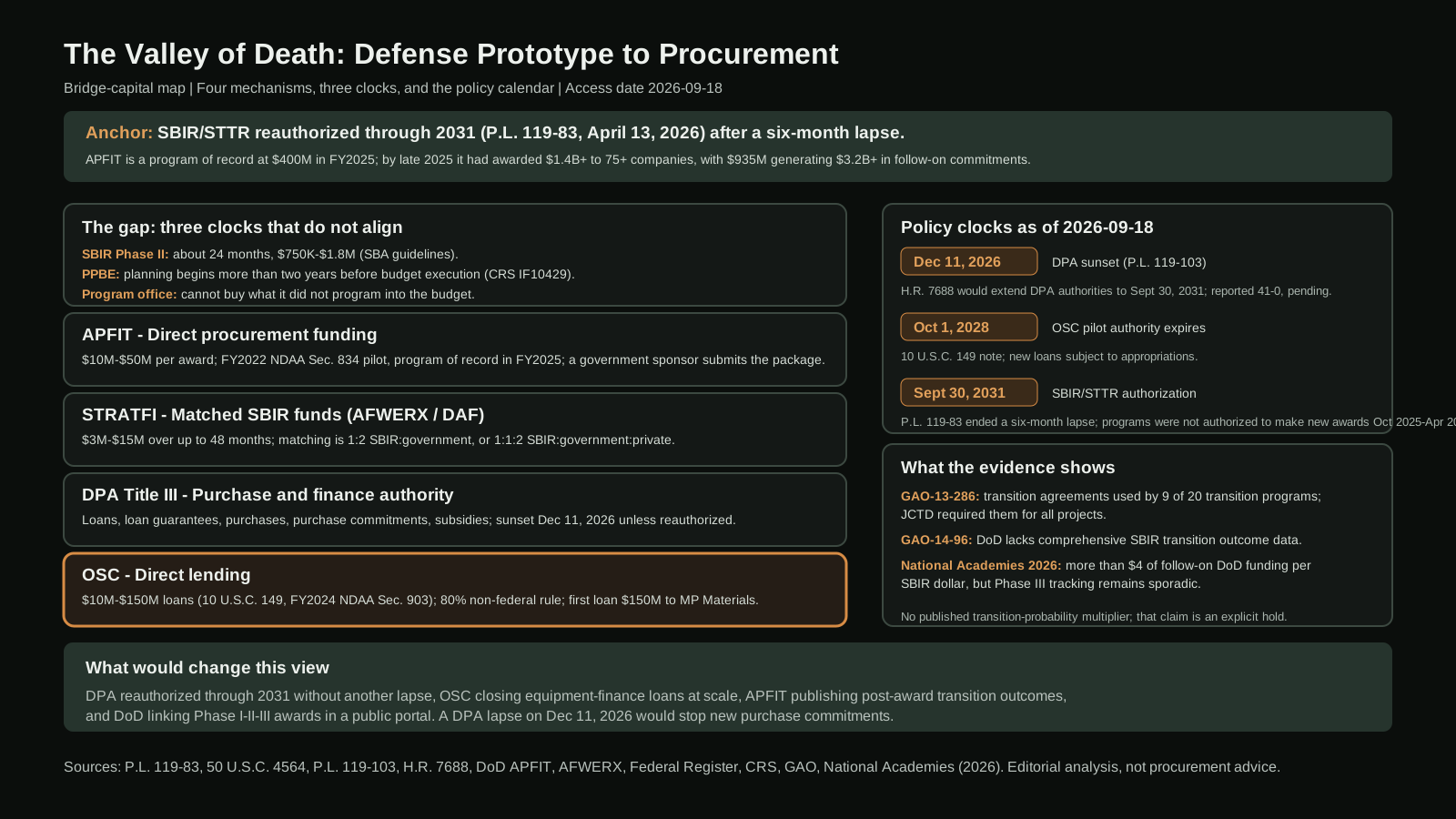
The valley of death is the gap between a completed prototype and a funded production program. Three clocks create it: an SBIR Phase II runs about 24 months on roughly $750,000 to $1.8 million, the PPBE budget cycle begins planning more than two years before execution, and a program office cannot buy what it did not program. Four federal mechanisms bridge the gap. APFIT awards $10 million to $50 million per project and became a program of record in FY2025 after starting as a Section 834 pilot in the FY2022 NDAA. STRATFI provides $3 million to $15 million in Air Force SBIR funds over up to 48 months, matched 1:2 by other government funding or 1:1:2 by government and private capital. DPA Title III provides loans, loan guarantees, purchases, purchase commitments, and subsidies under a sunset now set at December 11, 2026. The Office of Strategic Capital, established by Section 903 of the FY2024 NDAA, makes direct loans of $10 million to $150 million under 10 U.S.C. 149. The mechanisms work best when a program office sponsor is identified before Phase II ends and the transition is documented. GAO has documented transition practices and data gaps, not a published probability model. Source confidence: Primary for program authorities and amounts; Analytical for the transition read. For six months, from October 2025 to April 2026, SBIR and STTR could not make new awards. Congress ended the lapse on April 13, 2026, when the Small Business Innovation and Economic Security Act (P.L. 119-83) reauthorized both programs through September 30, 2031. ([Congress.gov, CRS Insight IN12705](https://www.congress.gov/crs-product/IN12705), July 13, 2026, accessed 2026-09-18.) The same pattern runs through the Defense Production Act. Most DPA authorities lapsed on September 30, 2025. A stopgap restored them to January 30, 2026; the FY2026 NDAA extended them to September 30, 2026; and the Continuing Appropriations and Extensions Act, 2027 (P.L. 119-103) moved the sunset to December 11, 2026. The DPA Modernization Act of 2026 (H.R. 7688) would extend the authorities to September 30, 2031; it was reported 41-0 on April 15, 2026, and remains pending. ([50 U.S.C. 4564](https://uscode.house.gov/view.xhtml?req=granuleid:USC-prelim-title50-section4564&num=0&edition=prelim), laws in effect 2026-09-17; [H.R. 7688](https://www.congress.gov/bill/119th-congress/house-bill/7688/all-info), accessed 2026-09-18.) That is the environment a defense founder is raising into: the money exists, and the authority to spend it keeps walking up to a cliff and stepping back. The valley of death is no longer only a budget-cycle problem. It is also a policy-calendar problem.
Who is this for?
This article is for the defense-tech founder executing an SBIR Phase II, a DIU prototype OTA, or another non-dilutive program, with fewer than 18 months left and no signed path to production. It is also for the program manager who wants a prototype to survive the budget cycle, the investor underwriting transition risk rather than technology risk, and the acquisition officer who has watched a good demonstration go unbought. The decision is the same for all four: identify the funded requirement the prototype serves, attach a program office sponsor before Phase II ends, and match the mechanism to the stage.
Why do prototypes fail to become programs?
The first cause is arithmetic. A DoD SBIR Phase II is built on a roughly 24-month period of performance, with SBA's published guidelines setting the band at $750,000 to $1.8 million. The PPBE process that funds the receiving program begins planning more than two years before the budget year it executes. APFIT's own program office describes the result plainly: even when a service wants to procure a demonstrated technology, initial funding through the traditional PPBE process "can often take two years to come to fruition." (SBIR.gov, accessed 2026-09-18; CRS IF10429, updated July 2024, accessed 2026-09-18; APFIT program page, accessed 2026-09-18.) Source confidence: Primary.
The second cause is that transition is not measured, so it is not managed. GAO found in 2013 that DoD's SBIR program "lacks comprehensive data on technology transition outcomes." (GAO-14-96, December 20, 2013, accessed 2026-09-18.) The National Academies' 2026 review reached the same conclusion: despite directives, "DOD has no systematic way of tracking Phase III funding." (National Academies, Review of the SBIR and STTR Programs at the Department of Defense, 2026, DOI 10.17226/29329, accessed 2026-09-18.) Source confidence: Primary.
The earlier draft's claim of a published multiplier for transition agreements does not survive verification. GAO found that transition agreements are a recognized management tool, used by 9 of the 20 technology transition programs it reviewed in 2013, and that the Joint Capability Technology Demonstration program required them for all projects; GAO recommended expanding their use in 2006. The causal multiplier is an explicit hold. (GAO-13-286, March 2013, accessed 2026-09-18; GAO-06-883, September 14, 2006, accessed 2026-09-18.) Source confidence: Primary for the findings; hold on the multiplier.
The third cause is scope: SBIR topics are often written by technical staff who are not connected to an acquisition program, so the prototype solves a technical problem without addressing integration, sustainment, or training. The fourth is financial: if the prototype was not programmed into the budget, the program office has no current-year line to transition it, regardless of technical success. Source confidence: Analytical.
What bridge capital mechanisms exist?
Four mechanisms, one per stage.
APFIT (Accelerate the Procurement and Fielding of Innovative Technologies) is direct procurement funding. Created by Section 834 of the FY2022 NDAA as a pilot and managed by the Office of the Under Secretary of War for Research and Engineering, it awards $10 million to $50 million per project. Congress funded it at $100 million in FY2022, $150 million in FY2023, and $300 million in FY2024. (DoD biannual report to Congress, March 2023; DoD release, April 2024, accessed 2026-09-18.) The pilot became a program of record in the FY2025 budget at $400 million. By late 2025, APFIT had awarded more than $1.4 billion to over 75 companies, and $935 million of FY2022-FY2025 funding had generated more than $3.2 billion in follow-on contracts and commitments; the FY2026-1 cycle drew 76 viable proposals totaling $2.36 billion. (DoD APFIT news, June 17, 2025; APFIT program page, accessed 2026-09-18.) A company cannot apply directly; a government sponsor submits the package through the agency's designated representative. Source confidence: Primary.
STRATFI (Strategic Funding Increase) is matched funding, run by AFWERX for the Department of the Air Force. It provides $3 million to $15 million in SBIR/STTR funds over up to 48 months, and the matching is structured, not a leverage multiple. The Government-Only option matches one part SBIR to two parts non-SBIR government funding (1:2); the Government-Private option matches one part SBIR to one part government and two parts eligible third-party funding (1:1:2). Eligibility requires an active Phase II with at least 90 days completed, or a Phase II completed within the prior two years, plus a senior government sponsor. (AFWERX matching guidance PY26.1; AFWERX FAQ, accessed 2026-09-18.) Source confidence: Primary.
DPA Title III is the statutory purchase and finance authority: loans, loan guarantees, purchases, purchase commitments, and subsidies to expand domestic production of critical materials and goods. (CRS R49178, 2026, accessed 2026-09-18.) For a founder, the purchase commitment matters most, because a committed offtake gives private lenders a revenue line to underwrite. Availability is now the live question. Most authorities are subject to the sunset in 50 U.S.C. 4564(a), currently December 11, 2026, after a September 2025 lapse, a stopgap to January 30, 2026 (P.L. 119-37), the FY2026 NDAA extension to September 30, 2026 (P.L. 119-60), and the current date set by P.L. 119-103. H.R. 7688 would extend to 2031. Award size is an explicit hold: Stack & State could not verify a public, department-wide DPA Title III award range from primary sources, so the program is treated as case-specific.
The Office of Strategic Capital is the lending mechanism. Established by Section 903 of the FY2024 NDAA and codified at 10 U.S.C. 149, OSC can make direct loans and loan guarantees to eligible entities in covered technology categories. Its first Notice of Funding Availability, published September 27, 2024, offered equipment-finance direct loans of $10 million to $150 million from up to $984 million, subject to a statutory requirement that at least 80 percent of the capital for the funded technology come from non-federal sources. (Federal Register, 89 FR 79271, September 27, 2024; 10 U.S.C. 149, accessed 2026-09-18.) OSC closed its first direct loan in 2025: $150 million to MP Materials for heavy rare earth separation at Mountain Pass. (Department of War release, August 2025, accessed 2026-09-18.) CRS reports more than 200 applications representing $8.9 billion in requests and notes the pilot authority expires October 1, 2028. (CRS IF13215, accessed 2026-09-18.) Source confidence: Primary for statute and the loan; Mixed for application counts, which come from the DoD budget justification via CRS.
What transition strategies actually work?
First, align with the program office before Phase II. The transition literature GAO reviewed consistently found that a committed user separated transitions from demonstrations. (GAO-13-286, March 2013, accessed 2026-09-18.) Source confidence: Primary for the practice; Analytical for the recommendation.
Second, build to a documented requirement. A prototype mapped to a program office's funded requirement or a named modernization priority has a budget line to land on; a prototype that solves a generic problem has to create one. Source confidence: Analytical.
Third, document the transition. A transition agreement or memorandum of agreement signed during Phase II is the artifact that tells the budget office a customer exists. GAO's finding is about practice, not probability: 9 of 20 transition programs used these agreements, and JCTD required them. Source confidence: Primary for the GAO finding; Analytical for the investor read.
Fourth, use Phase III. Phase III is not a funding increment; it is the follow-on contract category for work that derives from a prior SBIR/STTR effort and is funded by non-SBIR sources. It is the production path. The National Academies found that SBIR/STTR firms ultimately attract more than four dollars in non-SBIR/STTR DoD funding for every SBIR/STTR dollar, while also finding that DoD does not systematically track Phase III, which makes the figure a floor rather than a target. (National Academies, 2026, accessed 2026-09-18.) Source confidence: Primary.
Fifth, raise private capital in parallel, not after. The National Academies found that experienced SBIR/STTR firms were more likely both to receive follow-on DoD funding and to attract private financing. (National Academies, 2026, accessed 2026-09-18.) Source confidence: Primary.
What patterns do successful companies follow?
They treat the prototype contract as customer discovery, not the end state. They identify the program office during the proposal phase, build the relationship during Phase I, and sign the transition document during Phase II. They plan production funding in Phase I and align deliverables so the prototype is ready before the target budget submission, not after. They use non-dilutive capital as validation for dilutive capital: the Phase II or DIU award signals a funded government customer, and the venture round pays for the scale-up while procurement runs.
They also manage cash against the payment clock. The Prompt Payment Act requires payment 30 days after receipt of a proper invoice if the contract does not set a different date, and the FAR implements that as the later of 30 days after a proper invoice or 30 days after acceptance. (31 U.S.C. 3903, accessed 2026-09-18; FAR 32.904, accessed 2026-09-18.) Typical first-payment delay statistics are not published in a form Stack & State could verify; that figure is an explicit hold. The practical posture is to budget working capital against the invoice cycle, not the award date. Source confidence: Primary for the statute and FAR; hold on delay statistics.
What would change this view
This assessment weakens if the policy clocks stop moving: DPA reauthorized through 2031 without another lapse, OSC moving beyond its first critical-minerals loan to close equipment-finance loans at scale, and APFIT publishing post-award transition outcomes rather than only award totals.
It weakens if the measurement gap closes. The National Academies recommended linking Phase I to Phase II to Phase III awards in a single public portal; implementation, or a GAO audit producing a verified transition rate, would replace this analytical read with data. (National Academies, 2026, accessed 2026-09-18.)
It breaks if neither happens and the DPA lapses again on December 11, 2026. A lapse would not stop existing contracts, but it would stop new purchase commitments at the moment founders need them most.
FAQ
Q: What is the difference between APFIT and STRATFI? A: APFIT is direct procurement funding of $10 million to $50 million, awarded through a government sponsor with no private matching requirement. STRATFI is $3 million to $15 million in SBIR funds over up to 48 months and requires matching: one part SBIR to two parts other government funding, or one part SBIR to one part government and two parts private. APFIT suits a company without parallel private capital; STRATFI suits a company that can raise. Source confidence: Primary.
Q: How long does it take from Phase II to a production contract? A: There is no single published distribution; this is an explicit hold. The anchors are a Phase II period of about 24 months and a PPBE cycle that begins more than two years before execution, and APFIT's program office describes traditional production funding as often taking two years from the decision point. Build planning cases from those clocks, not a national average. Source confidence: Primary for the anchors; Analytical for the read.
Q: Can a startup apply directly for APFIT? A: No. Packages are submitted by an APFIT-designated government organization and must be endorsed by it. The founder's job is to become the technology in a sponsor's package. Source confidence: Primary.
Q: Is DPA Title III still available? A: Yes, through December 11, 2026, unless extended or reauthorized; H.R. 7688 would extend the authorities to September 30, 2031, but has not been enacted. Existing contracts survive a sunset, but new awards need authority and appropriations, so the status matters for any deal that depends on a Title III commitment closing soon. Source confidence: Primary.
Q: Can OSC lend to a pre-revenue startup? A: The equipment-finance NOFA targeted construction, expansion, or modernization of commercial facilities and equipment with creditworthiness review, and required at least 80 percent of the capital for the funded technology to come from non-federal sources. That fits a company with a commercial backlog and a facility plan more than a pre-revenue concept. Future NOFAs may offer different instruments. Source confidence: Primary for the terms; Analytical for the fit.
Sources
- Small Business Innovation and Economic Security Act, P.L. 119-83 (S. 3971): CRS Insight IN12705 (July 13, 2026, accessed 2026-09-18). Primary.
- Defense Production Act sunset, current text and amendment history: 50 U.S.C. 4564 (laws in effect 2026-09-17, accessed 2026-09-18). Primary.
- DPA stopgap extension to January 30, 2026: P.L. 119-37, Section 130 (November 12, 2025, accessed 2026-09-18). Primary.
- DPA extension to December 11, 2026: P.L. 119-103, Continuing Appropriations and Extensions Act, 2027, Section 2004 (signed September 2, 2026, accessed 2026-09-18). Primary.
- DPA Modernization Act of 2026, H.R. 7688 status and five-year extension: Congress.gov and CRS R49178 (accessed 2026-09-18). Primary.
- SBIR/STTR Phase II duration and award guidelines: SBIR.gov (accessed 2026-09-18). Primary.
- PPBE planning lead time: CRS IF10429, Defense Primer: Planning, Programming, Budgeting, and Execution (updated July 2024, accessed 2026-09-18). Primary.
- APFIT authorization, award range, annual funding, program-of-record status, and transition metrics: DoD biannual report to Congress (March 2023); DoD release on FY2024 awards (April 2024); DoD APFIT news (June 17, 2025); APFIT program page (accessed 2026-09-18). Primary.
- STRATFI award range, period of performance, and matching options: AFWERX PY26.1 matching funds guidance and AFWERX PY26 FAQ (accessed 2026-09-18). Primary.
- OSC authority, loan range, 80 percent non-federal requirement, and $984 million NOFA: Federal Register, 89 FR 79271 (September 27, 2024); 10 U.S.C. 149 (accessed 2026-09-18). Primary.
- OSC first loan, $150 million to MP Materials: Department of War release (August 2025, accessed 2026-09-18). Primary.
- OSC application volume, funding, and 2028 pilot expiry: CRS IF13215, Office of Strategic Capital: Overview and Considerations (accessed 2026-09-18). Mixed.
- SBIR transition data gaps: GAO-14-96 (December 20, 2013, accessed 2026-09-18). Primary.
- Technology transition programs and transition agreements: GAO-13-286 (March 2013, accessed 2026-09-18). Primary.
- Transition agreement best practice: GAO-06-883 (September 14, 2006, accessed 2026-09-18). Primary.
- SBIR/STTR outcomes, Phase III tracking gap, and more than four dollars of follow-on DoD funding per SBIR dollar: National Academies of Sciences, Engineering, and Medicine, Review of the SBIR and STTR Programs at the Department of Defense (2026, DOI 10.17226/29329, accessed 2026-09-18). Primary.
- Prompt Payment Act payment date: 31 U.S.C. 3903 and FAR 32.904 (accessed 2026-09-18). Primary.
- Companion visual: valley-of-death-defense-startups.svg (accessed 2026-09-18). Site asset.
- Bottleneck Map pillar: Bottleneck Map (accessed 2026-09-18). Site pillar.

Methodology
This article follows the Bottleneck Map method. The constraint is assigned to Layer 6, Non-Dilutive Capital and Procurement, because the binding risk sits in the funding transition between prototype and production rather than in technology development, with Layer 7 (Buyers) connected through the program office demand signal and Layer 1 (Materials & Processing) connected through the DPA Title III and critical-minerals cases. The companion visual at valley-of-death-defense-startups.svg maps the four mechanisms, the three clocks, and the policy-calendar risks cited in the text.
Every number carries a named source in the sources list, and source-confidence labels follow the editorial standards: Primary where a statute, Federal Register notice, GAO report, National Academies report, DoD program page, or agency release is cited; Mixed where a figure is carried through an intermediary, as with the OSC application counts from the DoD budget justification via CRS; Analytical where the claim reflects Stack & State judgment across multiple sources. Three claims are explicit holds rather than placeholders: the transition-agreement multiplier, the department-wide DPA Title III award range, and typical first-payment delay days. No number is asserted without a named source, and no URL is invented.
Research cutoff and access date for all sources: 2026-09-18. Corrections: /connect/.
Stack & State is an editorial and ecosystem-intelligence publication. Nothing here is legal, investment, procurement, or compliance advice. Program details change; verify requirements with primary sources and qualified advisors.
Verified sources
- CRS Insight IN12705, Small Business Research Programs Reauthorized After Six-Month Lapse (2026-07-13)
- 50 U.S.C. 4564, Defense Production Act termination, current text (laws in effect 2026-09-17)
- P.L. 119-103, Continuing Appropriations and Extensions Act, 2027, Sec. 2004 (2026-09-02)
- H.R. 7688, DPA Modernization Act of 2026, status (reported 2026-04-15)
- CRS R49178, The DPA Modernization Act of 2026: An Overview
- DoD APFIT program page (award range, program of record, FY2026-1 cycle)
- DoD APFIT news, record FY2025 funding of $400M (2025-06-17)
- AFWERX PY26.1 STRATFI matching funds guidance ($3M-$15M; 1:2 and 1:1:2)
- Federal Register 89 FR 79271, OSC equipment finance NOFA (2024-09-27)
- 10 U.S.C. 149, Office of Strategic Capital
- Department of War release, OSC first loan $150M to MP Materials (2025-08)
- GAO-14-96, SBIR transition data gaps (2013-12-20)
- GAO-13-286, technology transition programs and agreements (2013-03)
- National Academies, Review of the SBIR and STTR Programs at the Department of Defense (2026)
Last verified