Water & Industrial Siting
Who Pays for Water Infrastructure? The Grant-to-Offtake Gap
Reuse projects can receive grants and pilots support, but durable project revenue depends on the buyer and contract structure. This is a bounded map of the financing stack and the evidence still needed to assess it.
Atomic answer
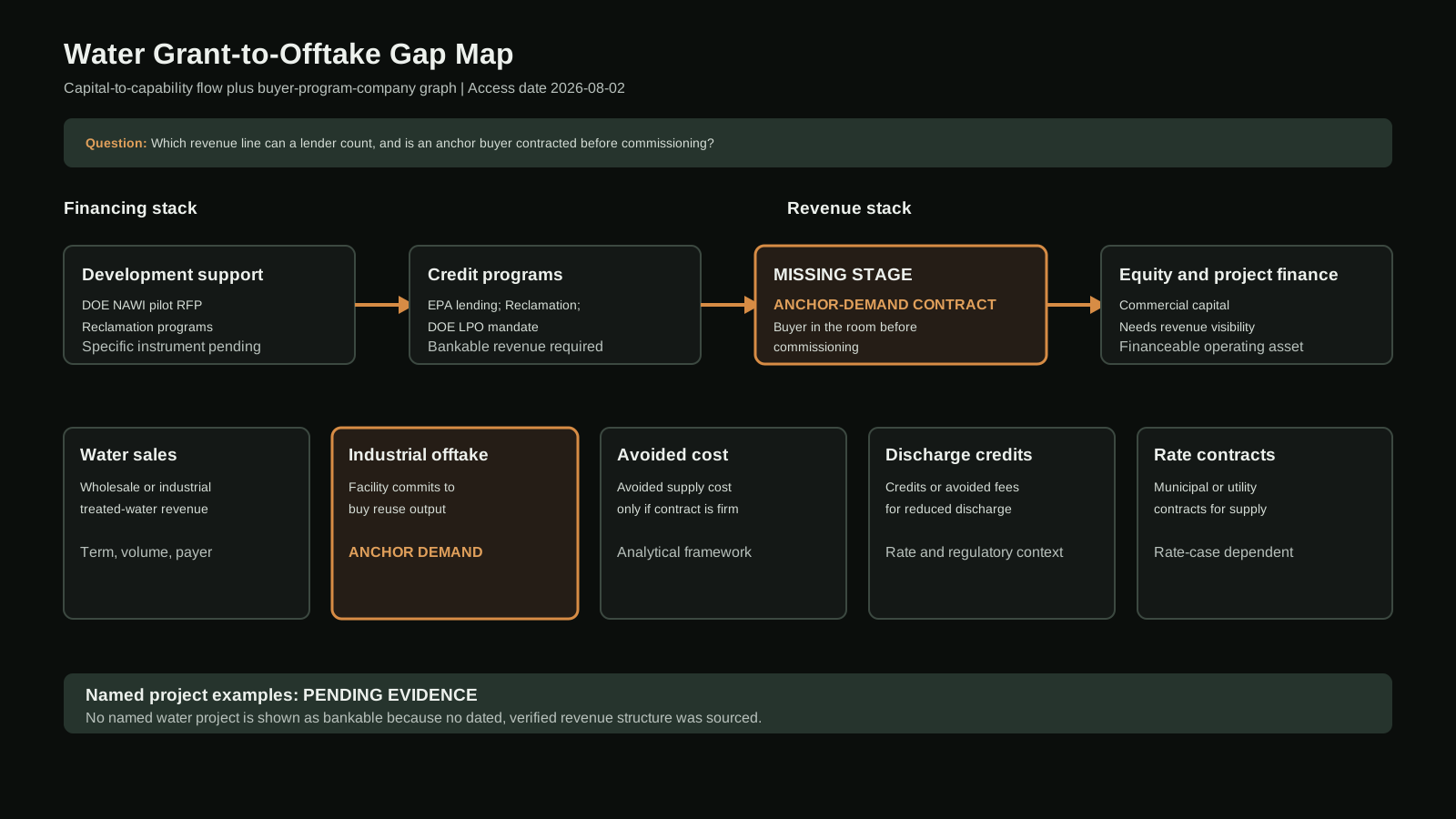
Water infrastructure can receive grants, loans, and other support, but the cited programs have different functions. EPA's WRAP 2.0 is a partnership and coordination initiative; DOE's NAWI RFP funds pilots and demonstrations; and Reclamation operates separate funding programs. This article does not establish a sector-wide claim about the frequency of grants or bankable revenue. Its bounded question is what contracted revenue a lender may underwrite for a reuse project. The practical distinction is between a project with support for development and a project with durable, contracted operating revenue. For water, the unresolved stage is anchor demand. The bottleneck operates in Layer 7, Buyers, as an analytical framework rather than a finding about every water project.
Who is this for?
This article is for the water-project developer, the founder, and the allocator deciding which revenue sources make a reuse or desalination project bankable, which anchors matter, and where the financing stack breaks.
The decision in front of you: can you tell the difference between a funded project and a financed one, and do you know which revenue line a lender will actually count? A plant without a signed buyer is a capital position on a construction narrative.
Where does it actually bottleneck?
The bottleneck is in Layer 7, Buyers, as an analytical framework for projects that require contracted revenue before finance can close. The cited programs have different functions: NAWI funds pilots and demonstrations, WRAP 2.0 coordinates actions and partnerships, and Reclamation operates separate funding programs. This article does not establish that every federal water program funds construction or that every water project has the same demand gap.
A reuse plant built on a grant still needs revenue every year after commissioning: energy, membranes, chemicals, labor, and maintenance. If the only revenue is another grant, the asset is a demonstration with an operating subsidy, not an infrastructure business. The whole federal stack is currently weighted to the construction side, which is why the same plants keep appearing as ribbon-cuttings and struggling as operations. Source confidence: Analytical (ecosystem observation); no named project's bankability is asserted, because no named water project with a verified revenue structure was available at the 2026-08-02 cutoff. Signal strength: Medium.
The site's materials lens is the right frame. Processing capacity does not come online because a feasibility study is funded; it comes online because a buyer has signed. Water infrastructure is the same asset class with a different molecule, and the bankability question is identical.
| Revenue line | What it is | Why a lender counts it | | --- | --- | --- | | Water sales | Wholesale or industrial sales of treated or reused water | A term, a volume, and a creditworthy payer | | Industrial offtake | A facility commits to buy reuse output for a term | The anchor demand that makes the project financeable | | Avoided cost | Utility or facility avoids a more expensive supply | Counted when the contract makes the avoided cost firm | | Wastewater and discharge credits | Credits or avoided fees for reduced discharge | Depends on the regulatory and rate environment | | Rate contracts | Municipal or utility contracts for treated supply | Reliable where a rate case exists |
The strongest revenue line is industrial offtake, because it is a term contract with a counterparty that has a balance sheet. The anchor buyer is the whole game: a data center, a fab, a municipality, or a utility that commits to buy the output for a decade is what turns a grant-funded plant into a financed asset. Source confidence: Analytical (framework); revenue structures of named projects are pending verification and are not asserted.
Who controls it?
The financing stack is controlled by three layers, and it breaks at the top.
The cited public programs serve different roles: NAWI funds pilots and demonstrations, WRAP 2.0 organizes collaboration, and Reclamation has separate water-program authorities that require program-specific verification. Credit programs cover the next layer: EPA's water infrastructure lending, the Bureau of Reclamation's program lending, and the DOE Loan Programs Office's commercial mandate, which can finance industrial capacity once a project is bankable. Equity and project finance sit on top, and they require the revenue lines above.
| Layer | Instrument | Requirement to clear | | --- | --- | --- | | Development support | DOE NAWI pilot RFP; Reclamation programs (specific instrument pending verification) | Program-specific eligibility and evidence | | Credit | EPA water infrastructure lending, Reclamation, DOE LPO | A bankable project with revenue visibility | | Equity and project finance | Commercial capital | Signed offtake with a creditworthy buyer | | Missing stage | Anchor demand contracts | The buyer in the room before commissioning |
The stack breaks at the top: project finance demands offtake, and the offtake does not exist because the anchor buyer has not been assembled. The federal credit programs are the bridge only where the revenue exists. DOE's LPO carries a commercial lending mandate; it can finance capacity once bankable, but it cannot create the revenue that makes a project bankable. (DOE Loan Programs Office, accessed 2026-08-02.) Source confidence: Primary (energy.gov, verified HTTP 200). Signal strength: High. That is the offtake gap, stated in one sentence.
EPA's water infrastructure lending programs exist but their specific pages were not machine-readable at the 2026-08-02 cutoff, and no specific lending figure is cited from them. The Bureau of Reclamation's root is verified; its funding pages are browser-only. WRAP 2.0 is explicitly partnership-based rather than a mandate, which is an asset for speed and a liability for enforcement: the revenue contract is left to the participants. (EPA news release, April 16, 2026, accessed 2026-08-02.) Source confidence: Primary for the program facts.
Why should founders care?
Three mechanisms, not recommendations.
First, anchor demand is the missing buyer, and it need not be heroic: an industrial user with material supply risk and a real balance sheet commits to a term contract for treated or reused water. Source confidence: Analytical.
Second, the policy fix is not more construction money; it is purchase authority and contract discipline. If federal programs required a buyer conversation before the award closed, the site's three materials questions would apply: offtake pathway, pilot-scale output, and a strategic buyer in the room. Funding capacity without demand creates stranded assets. Source confidence: Analytical (framework).
Third, the underwriting question is the revenue line, not the grant. A builder with a term sheet has something a lender can underwrite; a builder with only a construction grant has a capital position on a narrative. Allocators should ask who pays, for how long, at what price, and what happens at contract expiry. Source confidence: Analytical.
FAQ
Q: What is the grant-to-offtake gap? A: The distance between a funded project and a bankable one. Grants pay for construction; only a revenue contract a lender will count pays for operation. For water, the missing revenue contract is anchor demand. Source confidence: Analytical.
Q: Who can be an anchor buyer for a reuse project? A: A data center, a fab, a municipality, or a utility that commits to buy treated or reused water for a term. The strongest anchor is an industrial user with material supply risk and a balance sheet a lender recognizes. Source confidence: Analytical.
Q: Can the DOE Loan Programs Office finance water projects? A: It can finance industrial capacity once a project is bankable, under its commercial lending mandate. It cannot create the revenue that makes a project bankable, which is the offtake gap. Source confidence: Primary for the mandate; Analytical for the gap.
Q: Why do water projects get grants but not loans? A: Because lenders underwrite revenue, and most water projects lack a signed revenue contract. A construction grant does not make a project financeable; a term, a volume, and a price from a creditworthy buyer do. Source confidence: Analytical.
Q: Are there named water projects with verified revenue structures? A: No named water project with a dated, verified revenue structure was available at the 2026-08-02 cutoff, so the project examples are explicitly labeled pending evidence and no project's bankability is asserted. Source confidence: Pending verification.
Q: What would close the gap? A: Anchor demand contracts before commissioning, and federal programs that require a buyer conversation before the award closes. If a wave of signed industrial offtake contracts appears, this map shifts from a gap story to a formation story. Source confidence: Analytical.
Sources
- EPA Water Reuse Action Plan 2.0, a partnership-based coordination initiative rather than a grant program: EPA news release (April 16, 2026, accessed 2026-08-02). Primary.
- DOE NAWI $12M RFP for onsite reuse pilots: DOE / NAWI (July 27, 2026, accessed 2026-08-02). Primary.
- DOE Loan Programs Office commercial lending mandate: Department of Energy (accessed 2026-08-02). Primary.
- Bureau of Reclamation water-funding programs: Bureau of Reclamation (accessed 2026-08-02). Primary (root); specific funding pages browser-only, no figure cited.
- EPA water infrastructure lending programs: EPA (not machine-readable at the 2026-08-02 cutoff; no figure cited).
- Offtake as the gap between public capital and permanent capacity: Bottleneck Map (accessed 2026-08-02). Site pillar.
- Materials offtake thesis: Materials Bottleneck article (accessed 2026-08-02). Site article.
Publication cutoff: 2026-08-02.
Methodology
This article follows the Bottleneck Map method. The bottleneck is assigned to Layer 7, Buyers, because the missing stage is anchor demand: the revenue contract a lender will count does not exist for most water projects. Layer 6 (Non-Dilutive Capital) is connected as the layer where the current support structure sits and where it structurally cannot create revenue.
Every claim carries a source-confidence classification per the editorial standards: Primary where a named, publicly verifiable institutional source is cited inline; Analytical where the claim reflects Stack & State ecosystem observation. No named water project with a dated, verified revenue structure was available at the 2026-08-02 cutoff, so the framework is published with project examples explicitly labeled as pending evidence and no project's bankability is asserted. Sources that blocked machine-readable access (EPA lending pages, Reclamation funding pages) are labeled rather than guessed, and no URL is invented. Analytical classifications are hypotheses for navigation, not verified findings.
Research cutoff and access date for all sources: 2026-08-02. Corrections: /connect/.
Stack & State is an editorial and ecosystem-intelligence publication. Nothing here is legal, investment, procurement, or compliance advice. Program details change; verify requirements with primary sources and qualified advisors.